
 English
 Español
Cuba Presents Economic Ideas and Portfolio of Opportunities
especiales
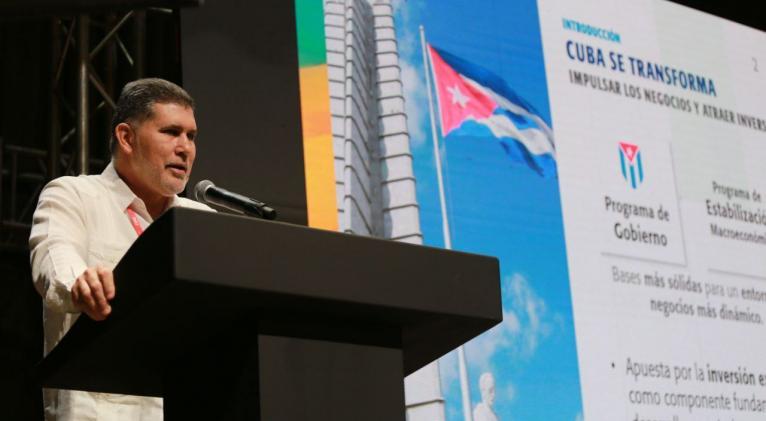
The Vice Prime Minister and Minister of Foreign Trade and Foreign Investment of Cuba, Oscar Pérez-Oliva, presented details today regarding the government's plans for the island's economy.
As part of the 41st Havana International Fair (FIHAV 2025), held from November 24 to 29, his address highlighted significant details of the Government's program to resolve current problems, in addition to presenting the Portfolio of Opportunities for foreign investment.
Oliva spoke at the eighth version of the business forum included in the Fair, providing details on the most salient topics. He began with the key idea of "changing what must be changed," a reference to the criteria of the leader of the Cuban Revolution, Fidel Castro (1926-2016).
He emphasized that the foundation lies in "self-emancipation, with our own efforts and challenging powerful dominant forces within and outside the social and national sphere." He stated that these are concepts that must be present in daily work.
He recalled that Cuba is implementing the Government program to correct errors and re-energize the economy within a complex economic environment that includes pressure from the United States ("blockade"), while also addressing internal problems and deficiencies that are sought to be eradicated.
He discussed the macroeconomic stabilization program proposed by the Government.
He indicated that the macroeconomic distortions present in the economy affect all interacting actors equally. The objective of this process is to create the foundations for a more dynamic business environment. The goal is for the different forms of management in the Cuban economy to interact seamlessly, while it is valid to highlight that Cuba reaffirms its commitment to foreign investment as a fundamental component for its economic and social development.
As measures, he mentioned, first, increasing national production of goods and services, and second, increasing external income by boosting exports of goods and services. Among the country's immediate objectives is precisely the expansion of national production, which is essential even to support the macroeconomic stabilization program, he insisted.
He outlined that the Cuban economic fabric is very diverse, contrary to what is often explained, and the current challenge is to get this business network to articulate naturally. Hence, as a key point, he referred to the need for all actors in the economy to participate and contribute to achieving the country's economic development objectives.
He insisted that the fundamental economic actor is the state, as it is present in different forms within that business framework.
He announced that there are currently 376 businesses with foreign capital in Cuba, from 40 countries, 56 of them established in the Mariel Special Development Zone (ZEDM). This enclave offers additional advantages and special regimes for foreign investors.
This year, 32 new businesses were approved there, from 13 countries, with committed capital of two billion dollars. Of these 32 businesses, 10 have already been confirmed through new procedures. An example of this new procedure was a direct approval by the heads of central state administration bodies of Chile.
This streamlines foreign investment in Cuba, as such implementations are part of the aforementioned Government program. A new decree will be issued to replace the current Decree 325, to facilitate these methods. These changes and new legal norms are expected to foster investment.
He also referred to the process of partial dollarization of the economy, another element of significant support for investment, with the possibility of operating with both currencies, the US dollar and the Cuban peso. For these purposes, a greater utilization of the level of productive capacities in Cuba and flexibility to allow foreign investment to function with greater dynamism is anticipated.
The mentioned changes point to a long list of elements that can benefit the Cuban economy, such as financial and commercial relations. Feasibility studies, commitments, trust, facilities for investment proposals, and productive development shape the new panorama for the Cuban economy.
He emphasized that any modality of foreign investment can engage in wholesale trade, unless retail is included in its scope, in its corporate purpose. These elements provide additional confidence to foreign investment, as reflected by the official, including through exchanges following his presentation and the marked interest shown by attendees at the Fair.




Add new comment