
 English
 Español
JG Almeida: Music Gives Me Energy
especiales

JG Almeida has just celebrated 16 years "sounding as good as he looks" with his own orchestra. He spoke with CubaSí about his beginnings, the present, and the immediate plans of a group that never stops being young.
How and when did you decide to create and lead your group?
“I remember I was at a private party with Gente de Zona. The concert ended, and some things that day just didn't go well. So I told Alexander, 'I'm done.' He asked me what was wrong, and I told him I'd decided to start my own orchestra. It just came to me in the moment. I wondered if it was the right decision, but I didn't feel ready to continue with that group. The next day, the first person I told was my dad. I sat down with him and explained that I wanted to start an orchestra, and he said, 'Are you sure about what you want to do? First, you have to finish your degree, and then you should start a new project.' I said, 'No, I think I'm ready to start.' He replied, 'Well, if you think you're ready to start, go for it. All I want is for you to do it right, finish your degree, and do your project well.'
Next day, I met with several musicians. Palacio was the first one I called, and I said, 'Hey, I want to start an orchestra. Would you care to join me?”. And he said, "Sure, let's go." We started looking for a pianist, and Edgar Olivera, an excellent pianist, joined. The bassist was El Chiqui, and the four of us started out: El Chiqui, Edgar, Palacio, and I. We called Marcos Alonso, Marquitos, a guitar player, and went to his studio to record three demos to release. The first was "La Farándula," which I wrote; the second was "Si te Preguntan," an unreleased song by my father; and the third was a song called "Yo le cojo la vuelta" by a musician friend of mine who later joined the orchestra as a backup singer.
"That was a unique experience. We went to the studio, started recording, and I kept saying, 'I think it's this way, I think it's that way,' everyone had several ideas, until we decided to call Ceruto." We told him about the idea, he helped us with the production, and that's how we made the first three demos, which started spreading like wildfire, and we were rehearsing for our first concert. That was at the beginning of August 2009. I made up my mind, I went for it, I did it, and on December 25th, we had our first concert at Macumba Habana.
How do you remember that first concert?
"Macumba was packed, everyone was waiting to see what was going to happen, what I was going to do, what I had in store. I already had 10 songs ready, including a collaboration with El Chacal called 'Gracias a la Vida' (Thanks to Life). It was an amazing concert, a real blast, and well, the first one was out, so what's next? Then, they booked us at the Salón Rojo of Capri Hotel every Sunday. Alain Daniel had Thursdays, and we took Sundays. We were there for almost four years, playing a regular gig."
Was it difficult to take on that challenge of making your way from scratch?
"Yes, it was quite a struggle, because it was a real ordeal trying to get airplay on the radio or a TV show. I remember that in my early days, Edith Massola was one of my biggest supporters. She would tell me, 'It doesn't matter, if they don't play your music on the radio, keep trying, keep making music, don't worry, one day they'll have to play you.' And she really gave me a huge boost, because there were days when I felt like giving up, until one day they finally played it and it started touring all over eastern Cuba, and from then on, we were constantly getting booked for that part of the country."

Did your father ever see you on stage, fulfilling that dream?
“No, he never saw me, because I made my decision in the first days of August and he passed away on September 11th. That means we only spent a month there talking about what I wanted to do. He was already ill, and I always gave him something to talk about to distract him from his situation. But well, I was able to tell him my ideas, what I wanted. He gave me a lot of advice, even some of his scores, which is how I chose the second song I recorded with the orchestra, and, well, when he passed away, I said: now I really have to do this.”
What advice did your father give you?
“The first, as I already mentioned, was that if I was going to do it, I had to do it well. Musically, he told me to strive, to improve myself, to find a singing teacher, and after a few years I found Carmen Rosa, who was a great teacher, and we started a wonderful friendship.”
How much have these 16 years of working with your orchestra meant to you?
“I think the most important thing has been my growth as a person, as an artist, as a performer, and the lessons I've learned from all the musicians who have been part of my orchestra. Some leave me with bitter experiences, but others bring me joy; I combine them all and learn from them."

What do you consider to be JG's signature sound?
"I always wanted to have a mix of Carlos Manuel y su Clan, Charanga Habanera, and Paulo FG, a blend of those three, but one that didn't sound like any of them, and I think we've achieved that—not sounding like anyone else, but keeping our own unique style."
What are you working on right now?
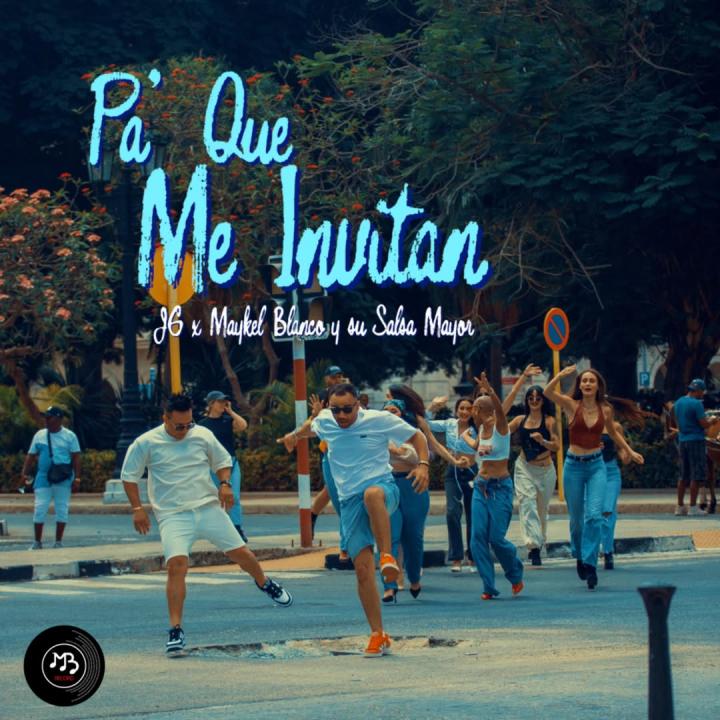
"Right now I'm not making any albums, but recording singles, which I think are doing better at the moment. I'm working with Pachy, with whom I've developed a great rapport on three or four tracks we've recorded since I decided to find someone to direct all my recordings, along with Eloy and Palacio, and we're working on 'Mi Congo,' written by Darián Chacón, the conga player for La Revé." "El Besito," a song of mine arranged by Pachy, and "Pa' Qué Me Invitan," with Maykel Blanco.
"There's another new song, mixed with urban music, which I also enjoy doing, because some people say: 'You're a salsa singer, you can't do reggaeton,' 'You're a timba singer, you can't do reggaeton,' no, I'm a musician, I fuse music however I want, whether it's with a guaracha, a son, reggaeton, urban, whatever. We also did a song with Thaly Lage, who used to be a backup singer for Belito Buffon, and now she has her own solo project. And that song is fantastic too; I'm waiting for Fernando Produce to finish it so we can release it. You have to reach all kinds of audiences.
"I'm doing really well in Europe and in Peru, which is what we're focused on right now, conquering the Peruvian market." "I'm happy with what we're doing so far."
And you'll be at the Salsa Festival in Cuba soon, right?
"This is my fourth time at the Salsa Festival. I missed six editions, but it's never too late if the opportunity is good. Last year, Maykel asked me to play at the Hotel Memory pool. The first set was canceled due to rain, so we had to play the next day… anyway, but this year I think I'll be playing on the main day, Saturday, along with Brayan Álvarez, Alain Pérez, and Maykel Blanco. They've set the bar pretty high, but I'm already preparing a varied repertoire, as always. I never play the same thing, and I think this year I'm going to make a splash at the Festival with the repertoire I'm bringing." It won't just be my own music; I also perform songs by other artists I like, whose music I'm drawn to sing, and I do it. I put it together with the orchestra and add a show, a spectacle, and that's more or less what I'm preparing for this tenth edition of the Salsa Festival."
We'll be waiting for you at Club 500 then, with all that energy you always have on stage…
"Of course, that's what music gives me. It's truly a positive energy that I transmit to people, a joy. I don't know how to explain it, but when I'm on stage, I kind of come out of myself, you know?" It's my moment to be myself, I don't know, something like that. I completely step out of the Juan Guillermo persona I usually am, although even offstage I'm also hyperactive and I like to joke around and everyone laughs, but when I'm working I'm a completely different person.”
Translated by Amilkal Labañino / CubaSí Translation Staff







Add new comment