
 English
 Español
Teachers, Pillars of Society
especiales

There are nearly 100 million educators worldwide today, and among them, Cuban teachers have begun this school year at their blackboards convinced that “Teachers are the ones who hold society together, they are the guardians of peace and the custodians of collective memory.”
This was emphasized in the Santiago Consensus, the final document of the World Teachers’ Summit, held in Chile at the end of August at the invitation of the United Nations Educational, Scientific and Cultural Organization (UNESCO) and the Chilean government.
The global shortage of teachers and the lack of resources for education were central issues driving this international meeting. Addressing representatives from about 50 countries, UNESCO Director-General Audrey Azoulay stressed during the opening session: “UNESCO and Chile wanted to convene this high-level event because the teaching profession, often described as the most beautiful in the world, is facing an unprecedented crisis.”
Among the most striking, and alarming, outcomes of the summit was UNESCO’s warning that by 2030, in order to achieve universal primary and secondary education, 44 million teachers will need to be hired, most of them in Asia and Africa. In Latin America and the Caribbean, however, the deficit already reaches 3.2 million.
This represents a cost of 120 billion dollars to cover the salaries of new teachers at a time when many countries are already struggling to meet their existing commitments to public education.
Consequently, the summit included among its commitments the need to adapt to the realities of educators’ work today and to support it with better resources, particularly given that teachers often face overcrowded classrooms and precarious conditions while carrying out responsibilities that go far beyond teaching itself.
UNESCO urged governments to invest more heavily in education, calling it essential to addressing the major challenges of the future, including the rise of artificial intelligence.
This first Teachers’ Summit also addressed the vocational challenges that currently undermine this essential profession, even as the shortage of teachers increasingly threatens access to quality education. So much so that the percentage of primary school teachers leaving the profession has doubled, rising from 4.6 percent in 2015 to more than 9 percent in 2022.
The Santiago Consensus: Commitment and Call
To reverse the global shortage of teachers and strengthen the profession, the Santiago Consensus adopted at the summit includes commitments to develop inclusive policies and fair employment conditions that support teachers throughout their careers, as well as to improve social dialogue and teacher participation in decision-making and policy design.
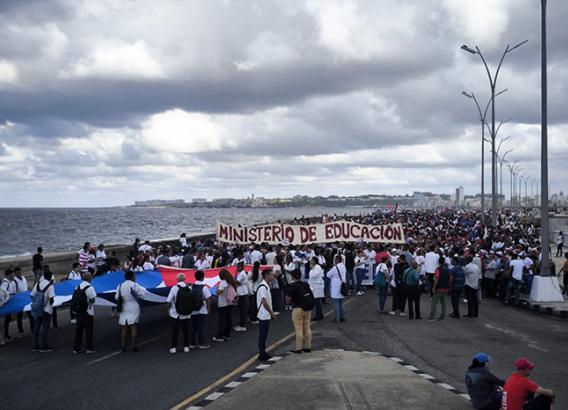
The meeting also emphasized the need to assist teachers in using digital technologies in education, which are inevitably transforming the profession, and to prioritize gender equality, inclusion, and diversity within the teaching workforce in order to raise the social status of the profession. Today, that profession continues to give its best in every classroom, including in Cuba, where schools have just opened their doors to a new academic year.
Translated by Amilkal Labañino / CubaSí Translation Staff











Add new comment