
An Illegal President in an Illegal War
It only takes a president to derive personal gain during their term for their actions to be considered illegal, and this has been the case with Donald Trump in the United States.
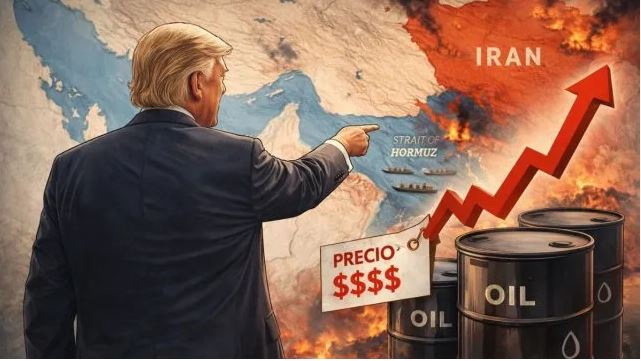
Without a doubt, Donald Trump has personally benefited from the illegal aggression he unleashed with Israel against the Islamic Republic of Iran, resulting in thousands of deaths, mostly civilians, and the destruction of vast infrastructure. This aggression has not led to any victory for Trump, due to Tehran's swift and appropriate response.
In this context, US Senator Chris Van Hollen accused President Donald Trump of personally profiting from the “illegal war with Iran,” based on a report indicating that Trump’s investments in the oil and gas sectors generated profits of up to $15.5 million this year, turning the White House into a “pay-to-play casino,” and accusing him of profiting “obscenely from a senseless war.”
In short, Trump has amassed more than a billion dollars since returning to office.
Meanwhile, support for the war against Iran has reached its lowest level. A Reuters/Ipsos poll revealed that only 31% of Americans support military action against Iran, contributing to the decline in support for the war. Trump's popularity is expected to remain at historic lows, according to the British newspaper The Independent.
REVEALING STORY
This whole story began at a high-profile meeting in April 2024, prior to the presidential election, when, at a private dinner at Mar-a-Lago, Donald Trump asked the oil executives present to donate one billion dollars to his campaign in exchange for deregulation, tax cuts, and expedited drilling permits.
He called it a “deal.” And many of them responded generously; according to data from OpenSecrets and Climate Power, the fossil fuel sector invested a total of 445 million dollars in influencing the outcome of the 2024 election through advertising and lobbying. The meeting was organized by Harold Hamm, founder of Continental Resources, one of the largest oil producers in the United States.
Hamm, with an estimated net worth of $18.5 billion, donated over $1 million to Trump's various Super PACs during the last campaign, which allowed him to influence the appointment of figures like Wright and Interior Secretary Douglas Burgum to the administration. He also contributed to the White House expansion and held numerous meetings with Trump officials to lobby for energy policies.
Another major beneficiary is businesswoman Kelcy Warren, founder of Energy Transfer, a pipeline empire valued at $54 billion. Warren is one of the biggest contributors to the Trump project, donating over $5 million to the presidential campaign and then $25 million to Maga Inc., the main Super PAC raising money for the White House. The return was immediate: Trump reversed Joe Biden's pause on liquefied natural gas exports and unblocked a flagship Energy Transfer project in Louisiana. According to the Brennan Center for Justice, Warren's personal fortune grew by approximately 10% with that approval alone.
THE “INSIDERS”
But this administration not only receives donations from the oil sector, it’s also comprised of it; 111 “fossil fuel industry insiders and opponents of renewable energy” are scattered across various positions in nine federal agencies, 43 of them coming from coal, oil, or gas companies. Most are in the Department of the Interior, headed by Burgum, former governor of North Dakota, the second most important oil-producing state in the United States, whose family is linked to leasing land to oil companies, including Hamm's Continental Resources.
Among his first actions as Secretary of the Interior, he revoked protections for several continental platforms for oil production and 1.53 million acres of the Arctic National Wildlife Refuge. Burgum is also the first Secretary of the Interior to chair the National Energy Dominance Council.
He is accompanied by figures like Wright himself, founder of Liberty Energy, a company that fractures almost 20% of the wells in the United States. Some of his measures have focused on eliminating 47 regulations, canceling $13 billion in funds for the promotion of clean energy, and issuing LNG export licenses to companies such as Commonwealth LNG, Venture Global CP2, Port Arthur LNG Phase II (Sempra Energy), and Golden Pass (owned by Qatar Energy and ExxonMobil), among others.
This sector is one of the biggest beneficiaries of the destruction of LNG facilities due to the war in Iran. Also in the Administration is Lee Zeldin, administrator of the U.S. Environmental Protection Agency, who, as a congressman, received more than $400,000 from the hydrocarbon sector. During his tenure, he eliminated 31 regulations and the legal basis that allowed the Agency to regulate greenhouse gas emissions.
All of this was compounded by $18 billion in tax incentives and tax cuts provided by the One Big Beautiful Bill Act, the tax reform promoted by Trump. Therefore, it's hardly surprising that stock market movements benefited from "insider information" to profit from Trump's statements or official White House announcements.
THE PRIVILEGES
At 6:49 a.m. on March 23, a trader sold 6,200 Brent and WTI crude oil futures contracts worth approximately $580 million in a single minute. To give an idea of the magnitude of the sale: the average volume during the preceding market sessions was 700 contracts; that day it was 6,200, nine times the average. Fifteen minutes later, Trump posted on his social media account, Truth Social, that he was backing down from his threat to bomb Iran's power plants because there were "good and productive talks with Tehran," something that members of the Iranian government denied. Oil immediately fell 10%, and the Dow Jones Industrial Average dropped 10%. It rose more than 1,000 points.
For economist Paul Krugman, the move was quite clear: “They were able to sell, for example, a lot of oil futures at 6:30 a.m. and then buy them back at 7:07 a.m., after Trump's announcement. So you come out ahead. You sold at a high price and bought them back at a lower price. The actual amount of money you make isn't the total volume of the trade, but it's a lot of money. Basically, you're arbitrage between the price right before and the price right after. I haven't done the exact calculations, but if we say there was a variation of around 10% in oil prices, and that the trading volume was $580 million, then someone took 10 percent of that amount. Let's say it was $58 million.” For Peter Brandt, a veteran commodities trader, these operations benefit from the fact that in the United States "there is no specific law against this type of insider trading" in futures markets, unlike what happens with stocks.
These moves were replicated in other markets, such as betting. On February 27, more than 150 Polymarkey accounts bet on a US attack against Iran the following day. Of course, one of the factors that most contributes to the impunity of these actions is the dismantling of the Justice Department's Public Integrity Section, dedicated to investigating these cases, which has been reduced from 36 lawyers to two by 2025. Also contributing are the 159 federal investigations that were dropped, involving companies that donated to Trump's inauguration or White House in more than 30 cases.
IMPUNITY
As with the entire administration, impunity has become the norm for all these businesses protected by presidential power. The pro-Trump oil lobby is making a fortune from the war against Iran.
The US fossil fuel sector, a major donor to the Republican, is multiplying its profits with the closure of the Strait of Hormuz and the global refining crisis.
Translated by Amilkal Labañino / CubaSí Translation Staff
Add new comment