
Lake America or Gulf of America: Reflections of How the United States Claimed the Name of a Continent
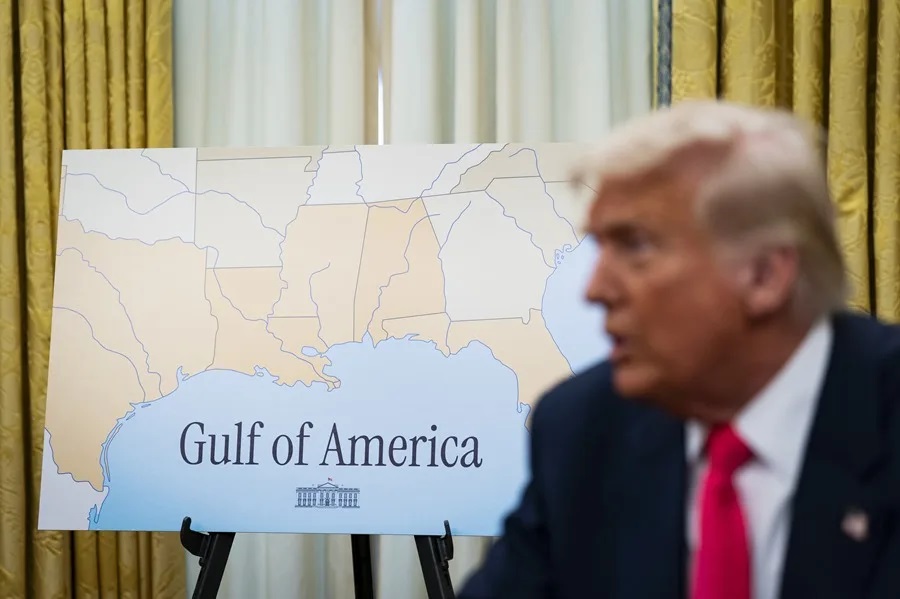
Imagen tomada de https://efe.com
U.S. President Donald Trump's tendency to rename natural features to underscore his country's dominance—among them the recent change of the border lake Ontario to Lake America—evokes the way the nation has for years claimed the name of an entire continent as its own.
On his first day back in the White House, Trump signed an executive order to rename the Gulf of Mexico as the Gulf of America in a demonstration of power and political pressure to "restore" the appellations that "honor the greatness" of the U.S., even though the waters of the inlet also wash the coasts of Mexico and Cuba.
Amid a trade war with Ottawa, the Republican also ordered the renaming of Lake Ontario, on the border with Canada, to Lake America, and a few days ago floated the possibility of changing the name of the state of New Mexico to New America—initiatives with little reach outside U.S. territory.
How to Name an Experiment?
Although it was born from the erroneous attribution of its "discovery" to the Italian explorer Amerigo Vespucci, the continent spanning from Canada in the north to the southern tip of Argentina and Chile is known as America, and the vast majority of its inhabitants call themselves Americans.
The name United States of America already appears in the Declaration of Independence of the then-Thirteen British Colonies, the origin of the "great experiment of democracy" that turned 250 this July.
"As (George) Washington's generation well knew, the United States did not encompass all of the Americas. Hence they used other names: the United States, the Republic, the Union," explains historian and professor Daniel Immerwahr in an article published in the independent outlet Mother Jones.
Immerwahr, author of How to Hide an Empire: A History of the Greater United States, warns that although some used it, America was not the universal term, and recalls that Fredonia or Columbia were among the names proposed by 19th-century intellectuals to name the country.
The Northwestern University professor warns that what "changed the situation was the United States' leap into overseas colonialism," with the annexation of former Spanish territories such as the Philippines, Puerto Rico, and Guam, along with so-called American Samoa and Hawaii.
The name that ultimately prevailed during this imperial expansion was that of America, which thus served to name a nation that was no longer just "a republic, was not a union (a term suggesting voluntary adherence) and encompassed both colonies and states."
If before 1898 United States was the term most used by the country's citizens, after wresting from Spain what remained of its empire, U.S. leaders and orators such as President Teddy Roosevelt invariably began referring to the nation as America, more in tune with its expansionist aspirations.
Today, this designation is used almost exclusively by Americans despite protests from a large part of the continent's inhabitants, who also consider themselves Americans.
The 'Donroe' Doctrine Applied to Names
During his second term, Donald Trump has promoted what he calls the "Donroe doctrine," his reinterpretation of the "Monroe doctrine" with which the United States has justified its hegemony over the Americas since 1823.
The name changes of the Gulf of America and Lake America have only been made effective within the country in official documents and several popular map applications such as those of Apple and Google, although these only appear when searches are made within the U.S.
Hours after suggesting renaming New Mexico as New America, Trump shared on his Truth Social network a map in which the red and white stripes of the U.S. flag cover Mexico, the Caribbean, and Canada, in addition to Greenland and Iceland.
The president's actions have served as the basis for parody. The creators of the hit comedy series South Park announced that the show will change its name to South America, "inspired by the bravery and patriotism of Apple and Google," on the occasion of the premiere of its new season in mid-September.
Add new comment