
Fernando Ortiz Foundation to Discuss Seminal Work by Miguel Barnet
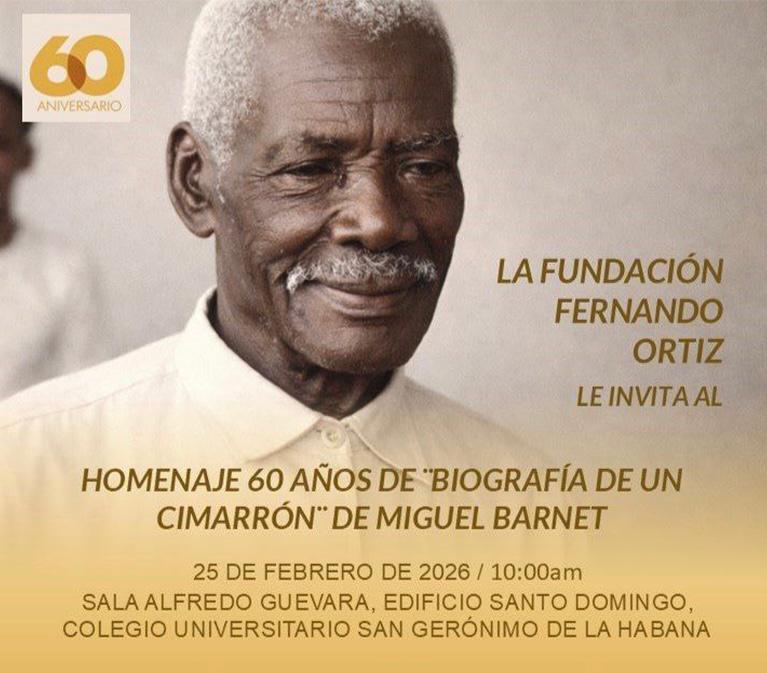
In the context of the 30th anniversary of the creation of the Fernando Ortiz Foundation (FFO), the institution will commemorate next Wednesday, February 25, at the Colegio Universitario de San Gerónimo de La Habana, the 60th anniversary of the publication of Biografía de un Cimarrón (1966), the landmark work of Cuban narrator, poet, and ethnologist Miguel Barnet.
The Alfredo Guevara cinema hall of the Santo Domingo building of that center will host the academic forum "Biografía de un Cimarrón (1966-2026): A Work of Cultural Emancipation," an opportunity to delve into this classic of Cuban and universal literature, with 90 editions and translations into several languages.
During the session, in special collaboration with the Ministry of Culture, the Union of Writers and Artists of Cuba, the Fernando Ortiz Chair of Anthropological Studies at the University of the Arts, and the Office of the City Historian of Havana, academics, intellectuals, researchers, and writers from Cuban and foreign institutions will be present, Lázaro Elizardo Castilla Pérez, vice president of the FFO, told the Cuban News Agency.
The researcher, poet, and critic noted that the creator of the celebrated testimonial novel has contributed, through the construction of his characters, to revisiting the historical and sociocultural memory of Cuba; a work in which the author anticipates his concerns by giving voice to historically and socioculturally silenced subjects: cimarrones, immigrants, marginal women, among others.
Barnet, with Cimarrón, distinguishes himself because he has a literary, rhythmic style that draws heavily on expressive Cubanidad and oral communication, and manages to turn life history into narrative work, he added.
Castilla Pérez assured that the writer returns the inarticulate biography in the form of narration, without having to resort to fanciful invention, which is why this work has had international significance.
Anthropologically speaking, he said, Miguel makes a specific and original contribution: he becomes—thanks to his connection with the thought of Fernando Ortiz—the creator of a foundational work, always with an eye on "the others," since his obsession was to tell us and record to tell others, and even give literary coherence to the vital incoherence of his informants, until finding a search for Cuban cultural identity throughout his work, perhaps his greatest concern.
For the expert—whose doctoral thesis focused precisely on Barnet's work—in Biografía de un Cimarrón one can appreciate a underlying tendency to string together events from the perspective of class struggle, which is why it is important to reaffirm that there is a continuity of themes, motifs, and episodes that mark the cultural memory of a nation.
In this same sense, Miguel Barnet constructed a model of cultural resistance and ethical values that function as attributes of Cuban culture; this imparts an artistic and intellectual value with the socio-cultural, to the testimonial novel, Castilla Pérez explained.
What is distinctive about Esteban Montejo—the protagonist, a freed slave, the last cimarrón—lies in the way of narrating events: in the dialogue of the subaltern, majestic descriptions of nature, of the richness and diversity of animals and plants, of religion are noted; Black, Creole, cimarrón, mambí, worker, and patriot validate the lineage of Cubanidad, its cultural resilience in the face of hegemonic power, concluded the distinguished researcher.
During the prelude to the academic forum that will take place next Wednesday, the 25th, at San Gerónimo with the presence of experts from Mexico, Chile, and Spain, there will be a screening of an audiovisual for the three decades of the FFO, and recognitions will be awarded to institutions and organizations that have had a working relationship with the prominent center that bears the name of the so-called "third discoverer of Cuba."
Add new comment