
Epstein's Shadow Looms Over Trump and the Power Elite
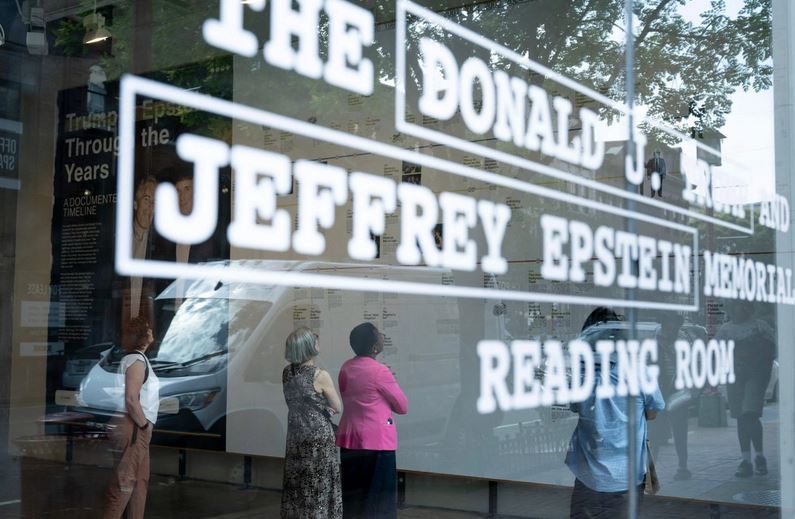
La gente que acude a la Sala de lectura Donald J. Trump y Jeffrey Esptein, auspiciada por el Institute for Primary Facts, en la capital de Estados Unidos se percata de la cantidad de documentos que tratan del caso, los cuales suman 7 toneladas. Foto: Afp
Less than 10 blocks from the White House, an exhibition has been installed that offers, in paper form, the archive of 3.5 million documents related to the crimes of financier Jeffrey Epstein, who, along with a circle of men from the political and economic elite—including Donald Trump—sexually abused more than 1,000 women, many of them minors.
While almost all those who participated in the sexual abuse and exploitation for years remain unpunished, 23 victims whose names were released by the government without their permission are now being threatened with death. Some have even been forced to acquire firearms for their protection.
The "Donald J. Trump and Jeffrey Epstein Memorial Reading Room" offers documents bound into 3,400 volumes that together weigh more than 7 tons. This project of the Institute for Primary Facts first launched in New York, then moved to the capital, and is now planning a tour through other U.S. cities. In these documents, there are more than 38,000 references to Trump, his wife Melania, and his private club Mar-a-Lago in Florida. On a second floor, there are 1,400 candles, one for each victim, "Epstein survivors. Each candle represents the life of a girl," commented David Garrett, one of the project's organizers.
A timeline accompanying the exhibition details how Epstein pleaded guilty to paying underage women for sex in 2008 but served only a brief sentence. He was arrested again in July 2019 based on a formal indictment from the Department of Justice. One month later, he was found dead in his cell, with his death officially ruled a suicide. In 2022, his assistant and sometimes girlfriend, Ghislaine Maxwell, was sentenced to 20 years in prison for conspiring with Epstein to sexually abuse multiple women, nearly all of them minors.
The exhibition's objective is to make accessible the documentation, in great detail, of the relationship between Epstein and Trump, as well as other powerful men who to date have refused to acknowledge participating in sexual relations with minors. Photos of the two friends, already in their fifties, embracing young women are found in these archives. Trump has stated his association with Epstein ended in the early 2000s and claimed to have no knowledge of the financier's sex crimes.
“I’ve known Jeff for 15 years. Terrific guy. He’s a lot of fun to be with. It is even said that he likes beautiful women as much as I do, and many of them are on the younger side,” Trump told The New York Times magazine in 2002.
Beyond the exhibition's documents, in March 2026, the Justice Department published additional FBI files after initially withholding them due to being "incorrectly coded as duplicative". These files describe interviews with an unnamed woman who alleged that Epstein introduced her to Trump when she was a teenager and that Trump sexually assaulted her when she was between 13 and 15 years old. The White House has called the claims "completely baseless" and backed by zero credible evidence. The FBI agents did not have further contact with the woman after the interviews, and no charges have been brought.
Other prominent figures within Epstein's circle mentioned in the documents include former President Bill Clinton, former Treasury Secretary Larry Summers, Microsoft's Bill Gates, and former Prince Andrew, brother of the current King of England, among others. Only two have faced consequences so far: Summers and the former president of Bard College, Leon Botstein, both resigned from their posts.
The release of the files has been marred by redaction errors, inadvertently exposing the personal information of victims on a massive scale. In at least 6,250 instances, names, addresses, phone numbers, and birthdates of at least 177 women were exposed. This has led to a new wave of threats, harassment, and doxing against survivors, with at least 10 women now reporting they own weapons for protection. The Justice Department has acknowledged the errors, stating that victim safety is paramount and that they work to fix issues when reported. Nevertheless, critics have accused the administration of both hiding records and negligently exposing survivors to danger.
Add new comment