
Breaking Down Argentina
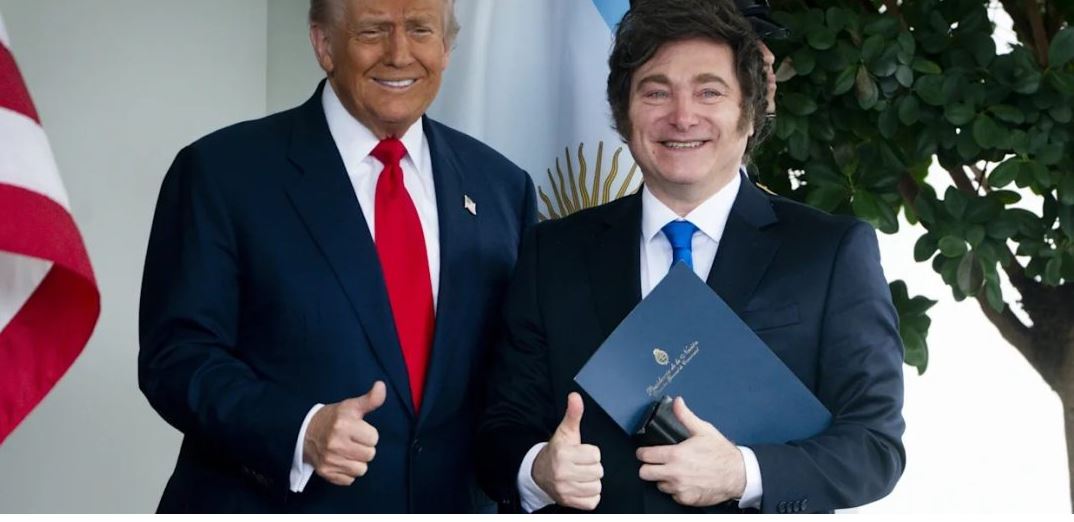
Well, he must have a truthful explanation for why two universities in Peru and Colombia awarded honorary doctorates to the president of Argentina, Javier Milei, because the claim that it was due to his good performance in the libertarian policies he applies to his country only benefits the privileged classes and further lines the pockets of those who apply them rigidly.
Because, in reality, the economic progress in this regard has only added to the anxiety of those who barely have enough to live on each day.
Let's remember that Milei fulfilled the expectations of a large part of society, weary of the economic mistakes of previous administrations and confident that the long-haired leader would achieve stabilization. However, he weakened the state structure, strained relations with social sectors, and stagnated the professionalization of the administration.
In other words, Milei assumed the presidency in December 2023, inheriting an extremely complex situation. Inflation had exceeded 200% annually, net reserves were negative, and the fiscal deficit had become very high. His response was a drastic adjustment: cuts to transfers to provinces, suspension of public works projects, reductions in subsidies, and downsizing of the public sector. Simultaneously, in April 2025, he negotiated an extraordinary $20 billion loan from the International Monetary Fund (IMF). The impact was immediate, and inflation slowed sharply during this period.
This achievement earned him political capital. For much of 2024 and early 2025, Milei maintained high approval ratings, fueled by the expectation of stabilization that had seemed unattainable under previous administrations. Furthermore, social data showed improvement: the poverty rate, which had climbed to 53% in the first half of 2024, fell to a still-high 38% by the end of that year, according to the National Institute of Statistics and Surveys. Markets also responded positively, with an initial recovery in sovereign bonds and investor confidence.
THE COST
However, the costs of the adjustment quickly became apparent. The cuts affected national universities, leading hospitals like the Garrahan, pensions, disability programs, and the operational capacity of the provinces.
The national government drastically reduced its workforce: in June 2025, the National Public Administration had 35,500 fewer employees than in November 2023, a 15.2% drop. But this reduction was not accompanied by institutional redesign or transparent hiring mechanisms: public competitions remained suspended, and discretionary appointments continued to be the predominant method. Instead of professionalizing the system, the strategy focused on cuts, weakening the public administration in sensitive areas such as health, science, and public works.
With nearly twenty subservient trips to Washington to provide financial support, its alliance with Trump takes on a new dimension. The agreement with the United States involves the use of the Treasury's Exchange Stabilization Fund, an unusual instrument in the region, to transfer dollars to the Argentine Central Bank in exchange for peso deposits in New York. The logic is twofold: to maintain Argentina's financial stability while simultaneously reinforcing Washington's strategy of limiting Chinese influence in Latin America. Milei presents himself as a reliable partner in ideological and geopolitical terms, thus providing him with external support at a time when his domestic capital is beginning to erode.
This US backing comes at a delicate moment. Financial indicators showed fragility following the electoral defeat in the Province of Buenos Aires and a corruption scandal that implicated Karina Milei, the president's sister and closest confidante, who is also the chief of staff. For the first time, presidential approval fell below 40%, and markets reacted with a drop in bond prices and a depreciation of the peso, forcing the Central Bank to intervene to support the exchange rate. At the same time, the lack of a majority in Congress limits the passage of legislation and makes the course of reforms uncertain.
The fundamental question is whether the model can be sustained over time. The initial stabilization achieved some positive results in terms of inflation, but it was based on an adjustment with a high social cost and on external support. The United States supports Milei in part because it perceives him as a fortification against China, but that support is neither unconditional nor permanent. Domestically, political erosion and social tensions could limit the government's ability to deepen reforms without generating new crises.
CONTRAST
The Argentine economy in August 2026 shows moderate growth, a sharp reduction in inflation, and an improvement in fiscal and energy balances under Milei's reforms.
The Argentine economy is projected to grow around 2.7–3.5% in 2026, following a 4.4% expansion in 2025, representing a recovery from the 1.7% contraction in 2024. Analysts recently revised their 2026 growth forecast downward to 2.7%, reflecting slower-than-expected growth in some sectors, although the IMF continues to anticipate projected global growth of 3.5%.
Annual inflation has fallen dramatically from 211% in 2023 to approximately 33–34% by mid-2026, with monthly inflation rates stabilizing near 1.9–2.9%. This represents the fastest disinflation in Argentina’s modern history, although it remains high by global standards and above the government’s 10% target.
Unemployment remains elevated, reaching 7.8% by early 2026, up from 5.7% in 2023, reflecting structural labor market challenges.
Despite significant reforms, risks persist: monthly inflation remains high, structural poverty persists, reserves are low, and the monetary regime is relatively untested. Historical patterns suggest that Argentina may struggle to sustain reforms after initial successes.
BANKRUPTCIES
INFOBAE and other infamous agencies in the service of imperialism pay no attention to an uncomfortable truth for the economic policies of the eccentric president, suspected of corrupt dealings:
Since Milei took office, 30,633 companies have been lost, 6% of the total. “This is the worst decline in the first 30 months of a government,” stated the Fundar think tank in a recent report, with data up to last May.
In May alone, 2,371 companies closed, at a rate of 76 per day.
According to Fundar's data, there are currently a total of 481,724 companies in Argentina, the lowest number in almost twenty years, even below the level recorded in 2021, following the COVID pandemic and the severe health restrictions that hit the South American country's economy.
“The number of business closures is much higher than in other periods. There are several reasons, but all are linked to the current government's economic policy, which promotes a neoliberalism of indiscriminate economic liberalization,” economist Hernán Bergstein, a professor at the National University of Lanús and an expert on SMEs, told EFE.
The Center for Argentine Political Economy (CEPA), which agrees with the figure of 30,633 businesses lost so far during Milei's administration, indicated in a report a few days ago that the most affected sector is commerce, with a loss of 8,408 productive units.
Thus, AP explains how Milei went from enjoying support and economic success to the worst moment of his presidency. The fascist-leaning leader of La Libertad Avanza (Freedom Advances) is overwhelmed by political and economic adversities that raise fears that the current stagnation will lead to a recession and that the devaluation of the peso due to the rise of the dollar will once again inflate prices, among other problems.
There’s a political erosion of support for Milei among broad sectors who, despite the drop in inflation, feel their economic situation has worsened within the framework of an austerity plan unlike anything Argentina has experienced in recent memory.
Translated by Amilkal Labañino / CubaSí Translation Staff
Add new comment