
 English
 Español
Trump's Candidate Leads Questionable Honduran Presidential Election
especiales
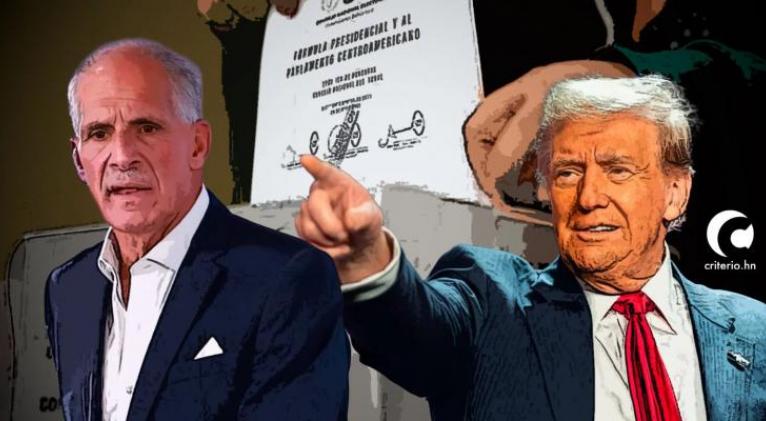
“Papi at your service”… Trump’s? “Papi at your service” was the campaign slogan of Nasry “Tito” Asfura, former mayor of Tegucigalpa.
President Xiomara Castro and the ruling party candidate Rixi Moncada questioned the results of Sunday's presidential elections, which gave the victory to the far-right candidate Nasry Asfura of the National Party, whom Trump had endorsed in elections where 128 members of Congress and 20 representatives to the Central American Parliament were chosen. More than 6.5 million people were eligible to vote to choose the successor to Xiomara Castro, whose term ends on January 27, 2026.
These elections were marked by a cocktail of democratic fragility, political violence, and accusations of illicit campaign financing by the National Party.
So much so that the ruling party candidate, Rixi Moncada of the leftist Libre Party, who had led in the polls, was relegated to third place. She warned that she might not recognize the results.
Moncada and Honduran President Xiomara Castro had already warned of electoral fraud and denounced an attack on the Preliminary Electoral Results Transmission System (TREP for its acronym in Spanish). They also asserted that there was a sabotage plan and a psychological warfare campaign aimed at manipulating the popular will.
In turn, Libre Party leader Ricardo Salgado stated: "All of this was planned; it unfolded like clockwork by the fascist right. Days ago, we REJECTED THE TREP because we knew their entire PLAN. We are going to count ALL THE BALLOT STATS, and we will fight tirelessly to defend OUR VICTORY. Today more than ever, fighting against the two-party system is an act of patriotism; sending the media rabble to the dustbin of history is our categorical imperative."
The electoral campaign has also been called into question by recent criminal investigations against authorities of the National Electoral Council (NEC). The discredited organization Human Rights Watch (funded by the United States) warned of “excessive judicial intervention” in the process and emphasized the importance of observer missions, such as those from the Organization of American States (OAS) and the European Union, to guarantee transparency, which, as we know, is questionable.
The ballot featured five candidates representing different visions for the country: Rixi Ramona Moncada Godoy, of the Liberty and Refoundation Party (Libre); Salvador Alejandro César Nasralla Salum, representing the Liberal Party (PLH); Nasry Juan Asfura Zablah, of the National Party (PNH); Jorge Nelson Ávila Gutiérrez, of the Innovation and Unity Party (Pinu); and Mario Enrique 'Chano' Rivera Callejas, who until recently was running on behalf of the Christian Democratic Party (DC).
'Chano' Rivera announced his withdrawal on November 22. The statement came during Salvador Nasralla's campaign closing rally, where the former candidate affirmed that his decision stemmed from the need to strengthen an opposition front capable of competing more effectively against the ruling party.
The tension surrounding these elections has been evident in several regions of the country, where reports of technical failures, power outages, and connectivity difficulties delayed data transmission.
These incidents fueled suspicions of fraud among sectors of the population, who expressed their concerns on social media and to the press.
Total number of voters: 6,425,707, with a participation of 2.8 million.
After 43% of the ballots were counted, the National Electoral Council reported that "Tito" Asfura, of the conservative National Party, had 40.54% of the votes counted, while Nasralla, of the Liberal Party, followed with 38.99%. Rixi Moncada, of the ruling Liberty and Refoundation Party (Libre), a left-wing party, was in third place with 19.49%.
“PAPI AT YOUR SERVICE”… TRUMP’S?
“Papi at your service” was the campaign slogan of Nasry “Tito” Asfura, former mayor of Tegucigalpa and candidate for the National Party (NP). The 67-year-old businessman sought the presidency for the second time with a platform focused on economic reactivation and employment. His political career is characterized by a focus on infrastructure projects during his time as mayor.
Asfura’s campaign centered on attracting foreign investment and promoting the development of social and housing programs. The candidate, who has received controversial public endorsements from Donald Trump, seeks to distance himself from his party’s previous administration, which was convicted of drug trafficking in the United States. His proposals also includes concrete plans to fight corruption and violence, although the focus… The main priority remains macroeconomic stability. Last Sunday, November 30, Asfura sought to convince voters to guarantee US economic support.
TRUMP'S "SHOWDOWNS"
Asfura, the son of Palestinian parents, received public support this week from Trump, who, in addition to urging voters to support the conservative candidate, assured them that "there will be a lot of support" for Honduras should he win.
Trump described Asfura as "the only true friend of freedom in Honduras" and stated that he sees the possibility of "working together to fight the narco-communists" and confront Venezuelan President Nicolás Maduro.
Asfura would assume the presidency backed by the National Party, a party that has suffered losses during its three terms in office between 2010 and 2022, after being mired in corruption and links to drug trafficking networks.
Trump also reaffirmed his intention to pardon former Honduran President Juan Orlando Hernández.
“The people of Honduras really thought they were framed… framed by the Biden Administration, and I looked at the facts and agreed with them,” the US president stated.
He thus justified the decision to grant a pardon, despite the fact that the former Honduran head of state received a 2024 conviction in US courts on three drug trafficking charges. The pardon announcement was made on Friday, but the president elaborated on his arguments this Sunday during a press conference on Air Force One.
The president avoided directly blaming Biden and directed his criticism at the team that served with the Democrat during his administration. Trump mentioned that Biden's advisors were part of the alleged setup, although he did not name names or specify positions. The accusation comes amid a political backdrop marked by the Honduran elections, held this Sunday, in which Trump reiterated his support for Nasry “Tito” Asfura, the conservative candidate of the National Party.
The president furthered on his stance regarding Hernández's case and questioned the grounds for the Honduran's conviction. “If someone sells drugs (in a country), that doesn't mean the president should be arrested and imprisoned for life,” he stated. The remark referred to the accusations made by the U.S. Attorney's Office, which linked the former president to drug trafficking activities dating back to 2013.
Hernández's extradition was finalized in April 2022, when he traveled from Tegucigalpa to New York to face charges in federal court. In March 2024, the judge imposed a 45-year prison sentence for crimes related to cocaine and weapons trafficking, followed by five years of supervised release. The sentence was based on testimony and documents presented by the U.S. Attorney's Office for the Southern District of New York.
The former Honduran president appeared in court records as early as 2019, when the Department of Justice submitted a dossier to New York courts mentioning his name. The document was added to the case against his brother, Juan Antonio “Tony” Hernández Alvarado, who was sentenced to life imprisonment for crimes related to cocaine trafficking to the United States.
According to the U.S. Attorney's Office and the Drug Enforcement Administration (DEA), Juan Orlando Hernández was part of a group of individuals under investigation since the year he won the presidential election, with allegations linked to operations involving the importation of cocaine into the United States. The indictment described contacts, political protection, and alliances between criminal organizations and figures in the former president's inner circle, according to the Associated Press.
The pardon announced by Trump abruptly changed the legal status of the former Honduran president, although it did not alter the documented facts in the courts. The decision was made without the public presentation of new evidence or additional reports that would alter the basis of the sentence imposed in 2024.




Add new comment