
Right Advances in Latin America, Retreats in the U.S.
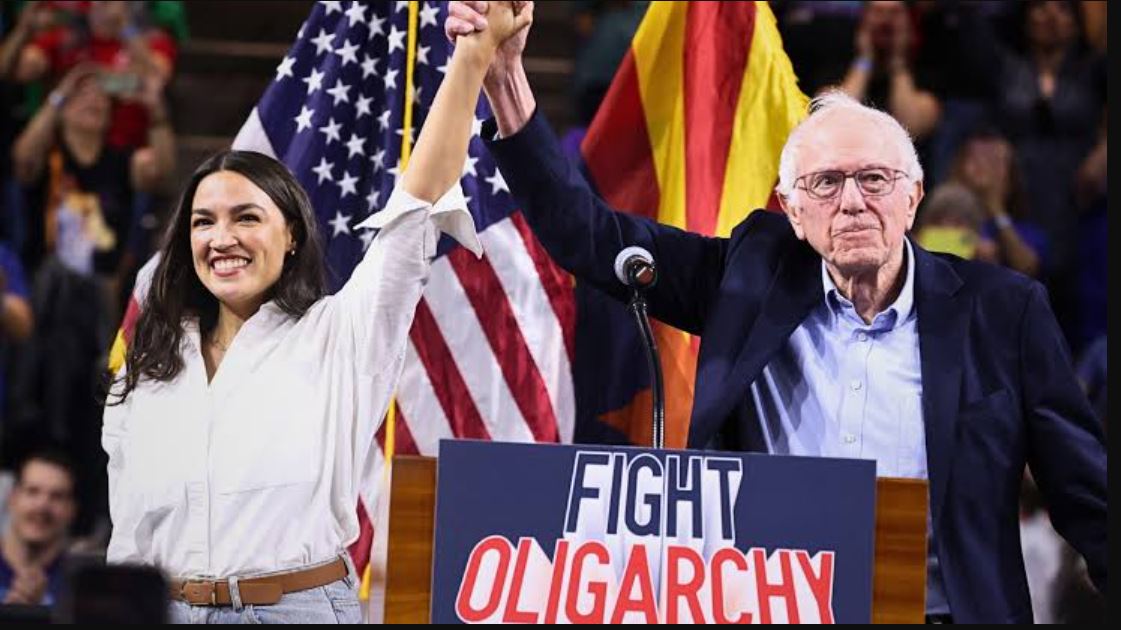
La congresista Allexandria Ocasio Cortez y Bernie Sanders
Product of his deceitful style, with tricks and sophisticated, brazen frauds, Donald Trump has imposed his favored candidates across much of Latin America, even securing a so-called Shield of the Americas to supposedly combat narcoterrorism—but with the goal of subjugating peoples, seizing their main resources, halting China's growing influence, and securing a "yes" to the tightening of the blockade that has suffocated Cuba for nearly seven decades.
But the U.S. president, a champion of broken promises regarding wars, persecutions, racial respect, and lowering the cost of living, is having serious trouble maintaining the popularity that brought him to the presidency. He now holds only a 36% approval rating, facing a strong challenge to keep his Republican Party majority in the upcoming midterm congressional elections.
Perhaps the paradox may be that the rise of the left within the opposition Democratic Party could cause a fracture in that political entity, and help maintain the Republican majority. As the elite remains the elite regardless of party affiliation, a possible opposition fracture could favor the president's fortunes. However, this left has continued to grow and increasingly gain a majority of supporters.
What Lies Ahead
On November 3, elections will be held for 435 seats in the House of Representatives and 35 of the 100 Senate seats; additionally, 39 state and territorial governors will be elected, along with the attorney general and many state and local races. One factor that will impact results is Trump's image, whose prominence and personality will influence voters' decisions.
In that regard, polls published in 2026 show that many hold a negative view of his performance on the economy and immigration—two issues that propelled him to win the 2024 election for the Oval Office.
It is also worth recalling the immediate precedent of the November 2025 elections, which did not go well for the Republican Party. For example, Democratic gubernatorial candidates in Virginia and New Jersey won against their Republican opponents by larger-than-expected margins, also securing legislative supermajorities in both states.
Another significant sign of the left's advance in the U.S. is undoubtedly that in New York City, Democrat Zohran Mamdani—who has consistently identified as a democratic socialist—won decisively at the polls, and the leftist current has harvested other major victories, including that of Congresswoman Alexandria Ocasio-Cortez.
She is a 39-year-old woman of Puerto Rican descent who has consolidated a distinctive and disruptive style within the Democratic Party, speaking out against oligarchy, and is building a national leadership that could lead her to a presidential candidacy in 2030. Also notable is Colorado Congresswoman Melat Kiroz, 29, born in Addis Ababa, Ethiopia, who arrived in the U.S. with her family as an infant; her campaign focused on economic populism and rejection of donations from corporate political action committees (PACs).
She has the backing of progressive figures like Bernie Sanders and organizations such as Justice Democrats, and champions proposals including Medicare for All, federal rent control, abolition of Immigration and Customs Enforcement (ICE), and an embargo on arms sales to Israel.
Already a Political Force
The leftist current now counts 97 lawmakers in the Progressive Caucus who disagree with campaign financing, as it leaves them bound to group interests. This political conglomerate has taken health care as a banner in a country facing a serious crisis, with over 100 million people lacking guaranteed access to free health system services.
In short, Donald Trump's right-wing radicalism is confronting a radical leftist current within the United States. The Democratic Socialists of America (DSA) grew from about 6,000 members in 2015 to over 120,000 in 2026, becoming the largest and most influential socialist organization in contemporary U.S. history, centered on the ideological dispute against the polarization led by the president with a duck-like name.
The DSA now has a structure known as a "big tent," organized as a broad coalition with local chapters and internal currents coexisting under one identity, using Democratic Party primaries to gain spaces of power. Today, some 250 elected leftist candidates have been endorsed by the DSA (including mayors and council members) and hold public office in more than 40 states—nearly 90% won after 2019.
An Uneasy "Whisperer"
Faced with this leftist advance, Secretary of State Marco Rubio—of a very regrettable Cuban origin—fears that any favorable shift to the left could make him lose power and influence within the Trump family and put at risk his ambitions for greater power, influence, and money.
Thus, at a ministerial meeting at the State Department, he painted a grim picture of the threat of "far-left terror" to the United States, while urging diplomats worldwide to "defend" their civilizations against the "scourge." There, in remarks focused almost entirely on the U.S. before representatives from over 60 countries and other Trump administration officials, he spoke of the need to combat the "mortal cancer of civilization," asserting that so-called left-wing terrorism, when "allowed to run its course, always becomes a gulag." He contended that the U.S. political, legal, and judicial systems do not work "if the threat of violence and terror continues unchecked." He denounced Antifa protesters as "deformed," saying: "Their outward appearance becomes a manifestation of their inner hatred."
Added to the Trumpian poison was the claim that "the greatest risk we have is that our institutions have become too soft and too cowardly to defend themselves against a deadly threat."
The fight against the supposed rise of "violent left-wing extremists, including anarchists and anti-fascists," is a key priority of the Trump administration, which has argued they constitute one of the main terrorist threats to the United States.
However, multiple former officials said the issue has been politicized by the administration and that the threat of the "far-left" does not reach the level posed by groups like ISIS or right-wing extremists—the latter entirely absent from the government's counterterrorism strategy published in May. That is, a strategy that amplifies the threat and targets those on the political left who oppose President Donald Trump's policies.
Translated by Sergio A. Paneque Díaz / CubaSí Translation Staff
Add new comment