
Noboa Bloodying Ecuador
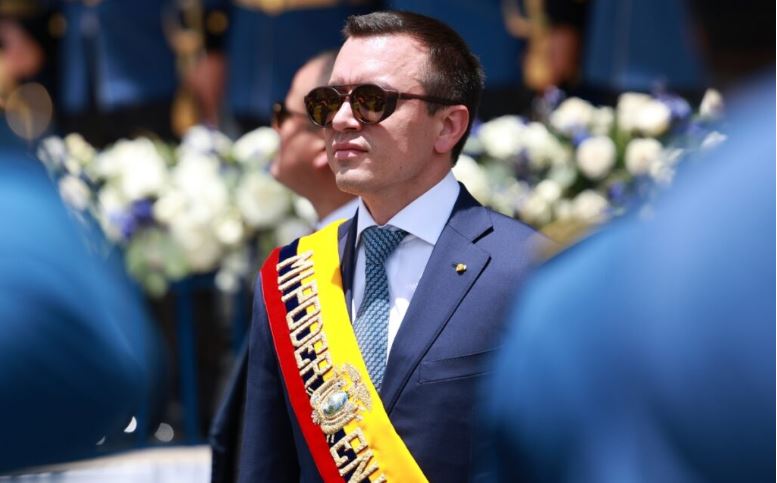
An unjustly convicted former vice president in critical health condition in prison, maneuvers to prevent opposition correísta candidates from running for office at any level, intensifying criminal violence across all sectors, and the involvement of invading U.S. forces in the deaths of fishermen and other skilled workers falsely labeled as drug traffickers are part of the landscape surrounding current Ecuadorian President Daniel Noboa, who makes no secret of his attempt to remain in power indefinitely.
Former Vice President of Ecuador Jorge Glas is facing a delicate health situation in prison, having experienced fainting spells and memory loss.
Attorneys for Glas, who was sentenced to 13 years in prison for alleged embezzlement, emphasize that the Inter-American Court of Human Rights maintains “provisional measures issued in his favor, after verifying that the risky situation that prompted his international protection persists.”
The Court required the Ecuadorian state to fulfill its obligations to “protect his rights to life, personal integrity, and health,” while considering that his transfer to the prison where he is currently held “contributes to the persistence of the risky situation.”
Glas was betrayed by his running mate Lenín Moreno, who, after securing the presidency, aligned himself with the defeated opposition candidate—the right-wing banking millionaire Guillermo Lasso—and adopted his neoliberal policies, plunging the country into debt and fabricating false testimony against former allies like Glas. Glas was considered one of the most honest politicians during his ten years with the Revolución Ciudadana government, a period free of the issues currently plaguing Ecuador. Incidentally, in a strange act of justice, Moreno was recently sentenced to five years in prison for accepting bribes.
Trump-Style Violence
U.S. strikes targeting vessels in the Caribbean and Eastern Pacific have killed at least 221 people since September 2025. To date, the Trump administration has provided no evidence linking the vessels or their passengers to drug trafficking.
A hitman shot and killed Ecuadorian prosecutor Alexandra Bravo in the city of Manta. Bravo was investigating U.S. attacks on three Ecuadorian vessels that left 36 surviving passengers, many of whom report being tortured by armed U.S. men wearing military uniforms aboard a U.S.-flagged patrol boat.
The allegations Bravo was investigating regarding vessel attacks and U.S.-committed torture reflect the consolidation of a U.S.-backed military dictatorship in Ecuador, argued Camila Lourdes Galarza, an investigative journalist and trade union activist from Quito. She recalled that during the elections in which Ecuadorian President Daniel Noboa was reelected, former Blackwater mercenaries patrolled polling centers at gunpoint.
The murder of prosecutor Alexandra Bravo and the complaints regarding U.S. vessel attacks and torture she was investigating point to an advancing U.S.-backed military dictatorship in Ecuador. Alexandra Bravo was investigating attacks on three vessels that exhibited a consistent attack pattern: they were surrounded by drones and other U.S. aircraft, intercepted by a blue patrol boat, and subsequently struck by drones.
The crews of two vessels returned and reported being kidnapped, hooded, beaten, and deprived of food for eight days by armed men wearing U.S. military uniforms aboard a U.S.-flagged patrol boat before being abandoned in El Salvador. Eight fishermen remain missing, and the survivors' descriptions of uniforms and aircraft match publicly released images from U.S. Southern Command.
One fisherman, Hernán Flores, stated: “They handcuffed us; they put hoods on us. Right there through the hood, you could barely see, clearly, they had their beards, their hair pulled back, their hair and white, blond, yellow beards; how they spoke in English, but we didn't understand, but there was one translating into Spanish for them. What they committed was a mistake, because if we had illegal items, they had drones, they had the spy plane, if we had anything illegal, they would have found something, but they never found anything, because the captain from El Salvador was surprised, he asked them for proof of something, but they never gave him any, they just said we were shipwreck victims.”
Furthermore, evidence continues to accumulate and raises serious questions regarding U.S. involvement. Video footage exists of U.S. Coast Guard activities, alongside police interviews with eyewitnesses corroborating the U.S. involvement reported by survivors. Additionally, open-source intelligence analyst Tomi McCluskey identified NASA thermal imagery consistent with the bombing of one of the vessels.
Unfortunately, the prosecutor was murdered before the investigation could progress, and in the days preceding her murder, she was reassigned to another office in Manta to prevent her from investigating these cases.
Noboa the Miamian
President Daniel Noboa, a far-right billionaire born in Miami, has declared an internal armed conflict in Ecuador, claiming he is targeting criminal gangs, even though massive quantities of cocaine bound for Croatia were discovered aboard his own family's ships, among numerous similar prior incidents.
This process toward a U.S.-backed military dictatorship began a year ago when the aforementioned Blackwater mercenaries patrolled the elections and pointed weapons at the public. Today, it is sustained through the unconstitutional restructuring of the electoral calendar, 22 state-of-exception decrees, widespread hunger imposed on the incarcerated population, the suspension and dissolution of four major opposition parties, and the granting of diplomatic immunity to all U.S. military personnel.
Even traditionally conservative figures like former President Osvaldo Hurtado have labeled President Noboa a “dictator.” None of these draconian measures—reminiscent of Operation Condor tactics—nor the curfews and military checkpoints enforced across 70% of the national territory have made Ecuador safer.
In fact, a recent report by the Quincy Institute for Responsible Statecraft revealed that Ecuador is now the most violent country in the Western Hemisphere, despite the opening of an FBI office on Ecuadorian soil and 75,000 Ecuadorian troops patrolling to combat drug trafficking.
The drug trafficking economy has expanded to the point where Ecuador currently accounts for 70% of global cocaine distribution, most of which is distributed by banana companies. Noboa comes from a billionaire family that built its wealth exporting bananas, which remains their primary enterprise.
Journalist Camila Lourdes Galarza recently received death threats if she continues investigating the president, joining independent prosecutors tackling criminality in Ecuador who face similar dangers.
JUAN GONZÁLEZ: Can you speak briefly about the threats against your life and the dangers facing independent prosecutors investigating crime in Ecuador?
As is known, the prosecutor investigating these events was murdered; furthermore, whistleblower Mónika Silva, who uncovered evidence linking President Noboa to the drug trafficking economy, was also killed. The following day, Interior Minister John Reimberg stated her death was a suicide, but police later determined she had been murdered.
There are over four hundred recorded attacks against journalists in Ecuador; more than twenty have been forced to leave the country, and their bank accounts have been frozen. Doing journalism in Ecuador means risking death.
Translated by Sergio A. Paneque Díaz / CubaSí Translation Staff
Add new comment