
THE LIBRARY: Querelle, by Jean Genet.
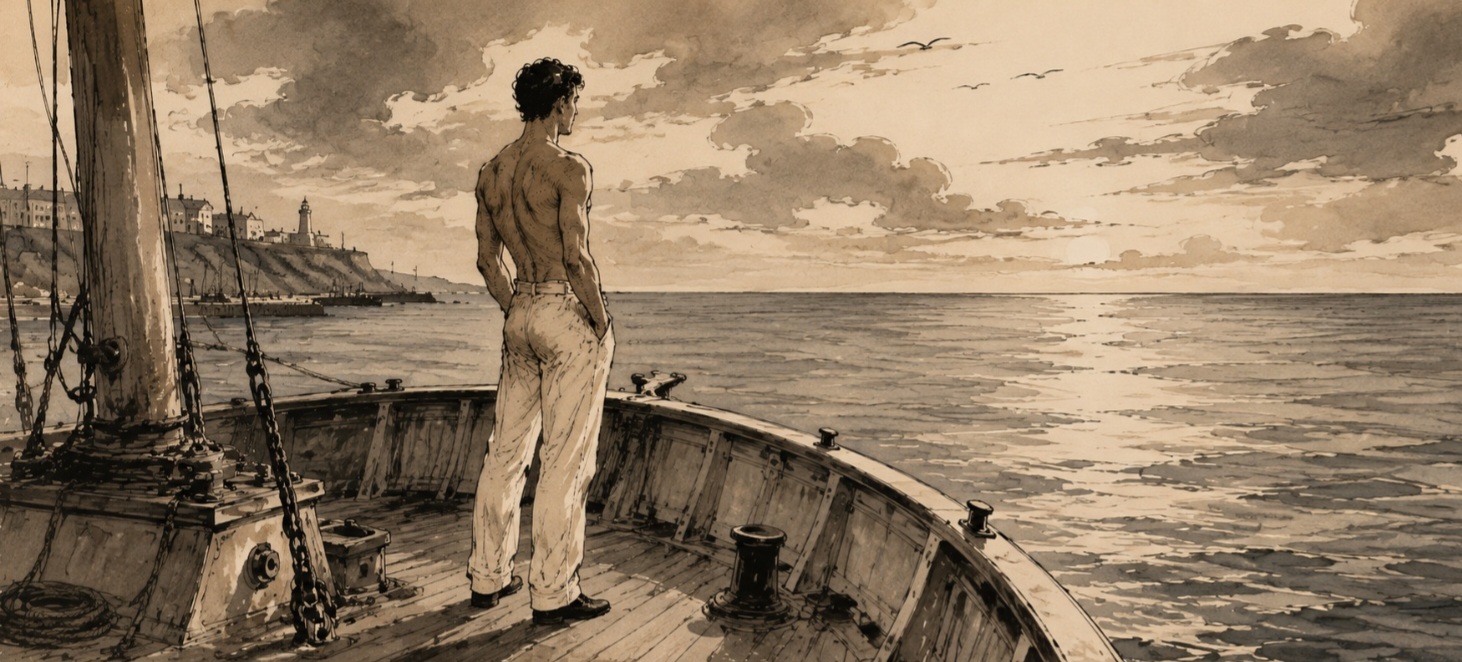
In this novel, the author does not intend to please anyone, except perhaps those who share many of his anxieties, tensions, and doubts. With Querelle, Jean Genet offered a complex and controversial perspective, presented with extraordinary frankness and clarity.
The text may at times be arduous and demanding for the reader, even excessive in its attempt to take certain situations to their ultimate consequences, but the forcefulness of its premise saves it from the most predictable moral judgments. Genet doesn't try to teach us a lesson: he hands us his territory, his obsessions, his characters, and his own contradictions, and lets us decide what to do with them.
Querelle is undoubtedly a transgressive novel, but to reduce it to its provocative nature would be to impoverish it. It holds an overwhelming philosophical depth, a reflection on desire, guilt, violence, freedom, and the conventions with which we construct what we call morality.
The protagonist—this "hero"—is a criminal, a murderer, a man who moves in a universe where conventional values seem to have lost their authority. But precisely for this reason, he can pose uncomfortable questions: Where do our criteria for judgment come from? To what extent does our morality depend on circumstances? What do we do when what we condemn, appears clothed in beauty, desire, or even a particular kind of dignity?
There’s also a powerful lyricism in Genet's writing, as if sordidness and beauty were condemned to coexist on the same page.
This lyricism is punctuated by expressions, images, and situations that deliberately border on the unacceptable, seeking to unsettle and even provoke rejection. But behind this provocation lies an extraordinary literary truth: the will to name what we normally prefer to conceal. Genet does not soften his world to make it acceptable. On the contrary, he seems to know that precisely in what disturbs us, we can find a source of self-knowledge.
That’s why Querelle remains an extraordinary and difficult novel to tame. It may bore us at times, disconcert us, irritate us, or seem excessive; but even these resistances are part of the reading experience.
Genet does not grant us the comfort of a safe distance from his characters or from the passions that drive them. He forces us into a universe where the boundaries between victim and perpetrator, desire and violence, guilt and freedom become deliberately unstable. Querelle forces us to look, without much certainty, at that which we would prefer to judge from afar.

Querelle (1947) is one of the most provocative and complex novels by Jean Genet (1910-1986), a French writer, playwright, and poet whose work was marked by marginality, crime, desire, and the transgression of the social and moral conventions of his time. The novel follows Georges Querelle, a sailor and criminal, during his wanderings through the port of Brest and other spaces dominated by crime, desire, and violence. Through his encounters, murders, sexual relationships, betrayals, and connections with other characters, Genet constructs a deliberately ambiguous universe, in which beauty coexists with sordidness and conventional morality loses much of its authority. Written in prose of intense lyricism and strong symbolism, Querelle transforms the life of a criminal into a subject for philosophical and literary exploration of desire, guilt, identity, violence, and freedom.
Add new comment