
Fidel and Peace
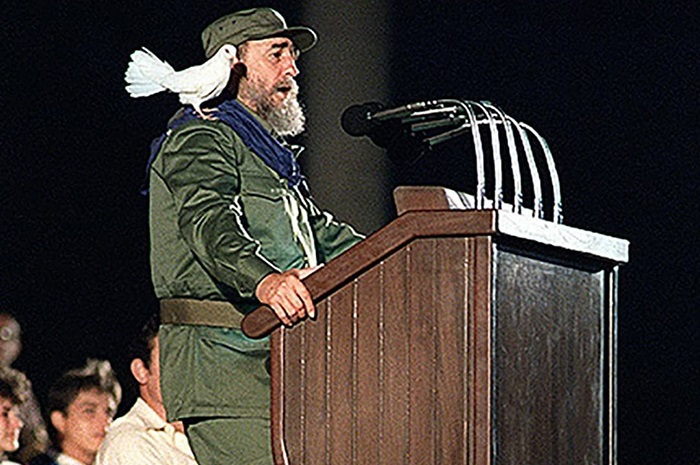
Imagen tomada de https://www.acn.cu
Regarding the efforts of current U.S. Secretary of State Marco Rubio to seize any pretext to attack Cuba, disseminating ideas drawn from a history parallel to reality, it is obligatory to refer those interested in the subject to the thought of Fidel Castro Ruz, the historic leader of the Cuban Revolution. Among his numerous contributions to universal political thought and action, one of the most urgent to disseminate concerns his work and actions in favor of peace.
The word peace is often reduced, in general, to the absence of war, the use of violence, or weapons to resolve certain contradictions. This type of peace, according to Norwegian thinker Johan Galtung, is called "negative" peace, or the absence of direct violence—that is, peace sought in response to or as a necessity to end a warlike confrontation. Regarding "negative peace" in the world, Fidel Castro made notable efforts as head of state. He shone with his own light during his presidency of the Non-Aligned Movement (NAM), placing Cuba at the pinnacle of international relations among nations; he also assumed a supporting and even leading role in peace processes in Central America, backing the so-called Contadora Group and the Esquipulas Accords, and promoted, like few others, a peaceful solution to the historic internal conflict in Colombia.
Another core issue related to so-called "negative" peace was the historic leader's unceasing struggle for nuclear disarmament, an issue he linked, for obvious reasons, to the survival of the human species. Regarding a possible conflagration involving atomic weapons, Fidel reflected that peace must be defended at all costs... "when the word war can mean the end of the human species." For Fidel, the nuclear arms race was absolute nonsense, not only because it implied the extermination of the human race but also because, due to the above, these were weapons without practical use, based on the logic of the so-called catastrophic stalemate between powers, according to which neither side can defeat the other without succumbing.
For the Commander in Chief, it was clear that the only country that had used nuclear weapons, the United States, was also trapped in its own imperial arrogance, unable to resort to such weaponry; however, it had forced its adversaries, for example the USSR, to possess their own nuclear program, which posed a challenge to their economy, but not to the U.S. economy, whose "prosperity" depends on the so-called military-industrial complex—in other words, on the existence of wars, for now only conventional ones.
One of the strategic criticisms of imperialism, among many other issues, had to do, for Fidel, with the premises under which its economy functions—"dependent" war—which is the basis for U.S. involvement in practically all armed conflicts that have occurred in the world, with particular evidence after World War II.
Strictly speaking, and even though Fidel was no longer at the helm of the Cuban state, his imprint, orientations, and personal collaboration are in the letter and the decision to establish Our America as a region where peace prevails—that is, the unanimous approval of the Proclamation of Latin America and the Caribbean as a Zone of Peace, at the emblematic II CELAC summit, held just as the 135th anniversary of the birth of hero José Martí was being commemorated, in Havana, in 2014.
Without detracting from Fidel's contributions to the search for so-called "negative" peace, what he bequeathed regarding the search for so-called "positive" peace is truly essential, indeed paradigmatic. The Commander in Chief's approach to "positive peace" is perhaps the most relevant part of his legacy as a political leader and thinker. Yes, because "positive peace" is that situation in which there exists a reality that prevents the eventual impulse or "need" for a military conflict or conflagration from prospering—which Galtung conceptualizes as the absence of structural violence.
Seen this way, the very work of the Cuban Revolution is a magnificent proposal for "positive peace." Of course, the best and probably the only lasting condition to eradicate the reasons for wars, and even social violence, is the existence of the greatest possible social justice, the broadest equity and socioeconomic development—in other words, the smallest dose of capitalism, according to historical and social circumstances. And that this be manifested in a context where peace is a global responsibility, which cannot be achieved if some nations prosper at the expense of the suffering of others.
Another core issue for achieving "positive" peace is what has been called environmental sustainability. A particularly memorable moment in this regard can be read in Fidel's speech at the so-called Earth Summit, held in 1992 in the Brazilian city of Rio de Janeiro. On that occasion, Fidel linked world peace both to social justice and to not renouncing the care and sustainability of nature, of the environment where all species live. For Fidel, therefore, this social justice was not possible unless accompanied by respect for the full dignity of man, for his inalienable rights to a full life in a prosperous and sustainable society, respectful of Mother Nature.
On the occasion of his historic speech before the United Nations General Assembly on October 12, 1979, the Commander in Chief, in his capacity as president of the NAM, expressed: "We want a world of peace, justice, and dignity, in which all, without exception, can enjoy human rights."
The enemy of the Cuban Revolution, U.S. imperialism, has historically attempted to distort the work and thought of the Commander in Chief. In that course, all its communications capacities were put into function of portraying the Cuban leader as a politician prone to violence, even a promoter of terrorism and armed conflicts, both in Our America and elsewhere. To impose this opinion matrix, they rely, through historical manipulation, on the role played by Cuba in solidarity with national liberation movements in the Latin American region, or support for struggles for full independence in Africa. It has been repeated to the point of absurdity that Cuba "exports its Revolution" and more recently, that it is a promoter of terrorism. In a point of feigned paroxysm, the current Trump administration asserts that the small island of Cuba constitutes a threat to the world's greatest military power.
But history is what it is, and the Commander in Chief himself took care to explain Cuba's position, that of Cuban revolutionaries, in the emergence and rise of national liberation movements, which precisely owed that universally admitted term to the fact that their struggle was authentic, in response to the absence of "positive" peace in their countries. Exporting a Revolution is a practical and theoretical absurdity, and in any case, the reality is that the Cuban one served as an example—that is perhaps its main contribution.
It should be added that as soon as the Revolution triumphed, the most ruthless comprehensive aggression from the empire began, as recorded in the contemporary history of the Latin American region. Within that hostility stands out the attempt, which continues today, to isolate Cuba from the rest of the nations of Our America. Hence the drift in the OAS, the ministry of colonies, as defined by Raúl Roa, the Cuban foreign minister of those 1960s, which early on "suspended" Cuba from its membership. In unison, practically all governments in the region broke relations with the nascent revolutionary government and, in some cases, served as platforms for attacks and aggressions.
The Revolution took on the challenge and, determined to defend itself from the imperial offensive, issued in a mass rally the "First Declaration of Havana," where in addition to explaining Cuba's and other peoples' right to their sovereignty and to "positive" peace, it also defended another right: that of self-defense and non-tolerance toward governments particularly subordinated to Washington that lent their territories to attack Cuba.
Regarding the efforts of current U.S. Secretary of State Marco Rubio to seize any pretext to attack Cuba, disseminating ideas drawn from a history parallel to reality, it is obligatory to refer those interested in the subject to Fidel's thought, which, as is well known, due to his talent for foreseeing what would come later, took care to explain in depth many of the things that now the imperial secretary of state, without ethics or any responsibility, distorts. Secretary Rubio must understand that he holds an ephemeral position, and that Cuba will neither forget nor forgive the cruelty he has managed against the Cuban family.
In summary, the concept of peace, seen from the life and ideas of the Commander in Chief, dialectically fuses what Galtung separated into "negative" peace and "positive" peace. The first cannot exist—basically, it cannot endure—unless the second, "positive" peace, is guaranteed. Thus, the Cuban leader himself gives an integral and indivisible meaning to the word peace, establishing a kind of equation according to which peace equals disarmament, plus social justice, plus sovereignty, plus dignity, plus solidarity, and also respect for Mother Nature.
Translated by Sergio A. Paneque Díaz / CubaSí Translation Staff
Add new comment