
“A Human Injustice that Must be Denounced in Every Possible Forum”
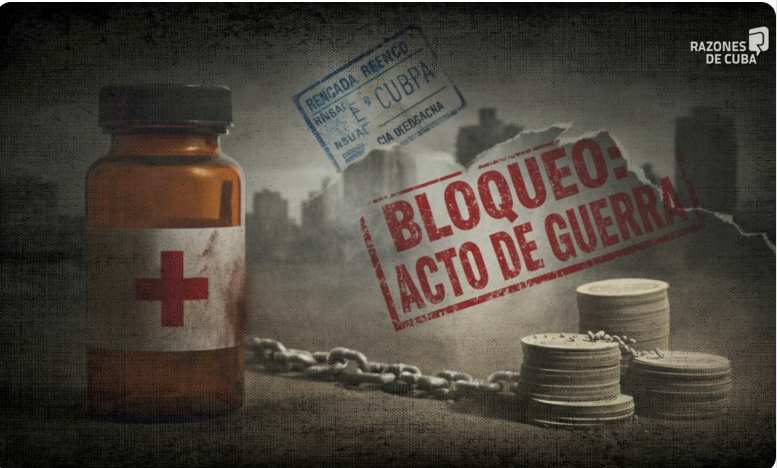
Throughout 2026, the blockade against Cuba has continued to be an increasingly suffocating burden that conditions the daily lives of millions of people. Financial and commercial restrictions have limited access to medicines, medical supplies, and basic technologies for various sectors of national development.
However, far from breaking the will of the people, this policy has strengthened resistance and solidarity, both within the archipelago and in the diaspora. For example, in Grenada, the young Cuban lawyer Lizandra Linares Romero, now living on this island in the southeastern Caribbean Sea, recently spoke about the effects of the unilateral coercive measures imposed by the United States government on Cuba. After concluding her presentation at an event attended by Cubans and Grenadians, she shared her thoughts on the subject.
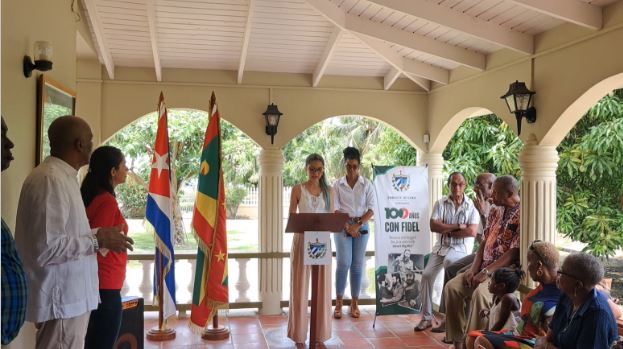
The young Cuban lawyer Lizandra Linares Romero, now living in Grenada, spoke about the effects of the unilateral coercive measures imposed by the United States government on Cuba. Photo by the author
What does it mean to you to speak about the blockade in a space where Cubans and Grenadians who feel Cuba is part of their identity come together?
The blockade is not a political abstraction; it’s a reality that impacts the daily lives of our families in Cuba and is also felt in the diaspora. Even though we live in Grenada, Cuba remains our homeland, and for many Grenadians, Cuba has also been their homeland in times of solidarity. Speaking of the blockade means remembering hospitals that perform miracles with limited resources, young people whose opportunities are restricted, patients waiting for medicine, and mothers waiting for phone calls that are becoming increasingly expensive or difficult to make. It means acknowledging that, despite these difficulties, Cuba has shared doctors, knowledge, and hope with other nations, such as Grenada.
From Grenada, in the presence of fellow Cubans, political authorities of that nation, and friends of Cuba, the young Cuban jurist Lizandra Linares recently spoke about the effects of the US blockade against her country. pic.twitter.com/gtsq1DuOK4
How do the effects of the blockade manifest themselves in daily life in sectors such as education and health?
In education, children and young people face power outages that interrupt their studies and limitations in accessing digital platforms, software licenses, or devices that in other circumstances might be considered basic needs. In health, hospitals lack essential supplies, medical equipment, and medications because supplier companies fear sanctions or because the set of hostile measures has made it difficult for the healthcare system to obtain the financial resources it needs to function with the quality to which the Cuban people have become accustomed and legitimately aspire. All of this delays treatments and forces the improvisation of solutions. The blockade turns basic needs into daily obstacles.
Beyond the shortages, what values have strengthened the Cuban people in the face of the blockade? How is this the case for Cubans residing abroad?
The blockade has been a test of resilience that has taught us to share what we have and to never give up. In Cuba, this resilience translates into creativity to overcome shortages, solidarity to ensure no one is left without support, and the conviction that justice cannot be blocked. For nearly seven decades, Cuba has sent healthcare workers where others sent soldiers, shared vaccines and knowledge, and extended a helping hand to those who suffer. But the blockade doesn't only affect Cubans living in the country. For Cubans residing abroad, the blockade is also felt in their bones: in the difficulties of communicating with their families, in the high costs of basic services that they try to help cover from here, in the impossibility of sending resources without obstacles. But far from weakening them, these limitations have strengthened their identity and their commitment to the homeland. They have taught them that love for the homeland does not depend on the distance that separates them from it, but on the will to defend it.
What is the point of denouncing and speaking out about the effects of the US blockade against Cuba from communities of Cubans who are not currently residing on the island?
From Grenada, many Cubans living outside our homeland also raise their voices against the unilateral coercive measures that harm the country and the lives of our families. We are not asking for crumbs; we are asking for respect for our country, for our people... This year, when the executive measures of imperialism against key sectors of the Cuban economy have increased to an unprecedented level, some of our compatriots have even participated in solidarity activities promoted by Grenadian civil society itself.
In turn, discussing the effects of the US embargo on Cuba helps spread awareness of its practical implications. Everyone has heard of the embargo, but many are unaware of its true impacts, and this risks the embargo becoming ingrained in people's minds as if it were merely rhetorical, as if it were a normalized variable that Cubans must accept.
Many of us living abroad want the voices of our people to be heard—a people who yearn to live without punishment or threats. Sometimes we encounter contradictory arguments that seek to justify the embargo because, according to some, it’s a weapon to force change in Cuba, to harm a supposed political or bureaucratic elite. But in practice, it goes far beyond a stance against the Cuban government. In practice, the embargo is not a political measure: it’s a human injustice that must be denounced in every possible forum.
And doing so from the diaspora has special value, because this denunciation demonstrates that the homeland is not limited to a physical territory, but expands wherever there are Cubans willing to defend it. In spaces shared with Grenadians and other Caribbean peoples, the denunciation acquires a collective meaning, because regional solidarity has always been a shield against external hostility. It must continue to be so.
What does resistance to the blockade mean today for new generations, even in the difficult circumstances they are experiencing?
I believe that for the kind of people we Cubans are, resisting is not just about surviving. Cubans are characterized by their inventiveness; they have aspirations and tend to develop talents and skills to achieve their goals. Therefore, the resistance we have had to maintain in moments as dramatic as this year of 2026 is equivalent to continuing to believe in hope, even when imperialism tries to block it. We must continue to believe in hope and, at the same time, be aware of our immediate material limitations, but also of our potential if the appropriate decisions are made at the suitable times.
Translated by Amilkal Labañino / CubaSí Translation Staff
Añadir nuevo comentario