
Counter-critique: Reappearance of Jardín
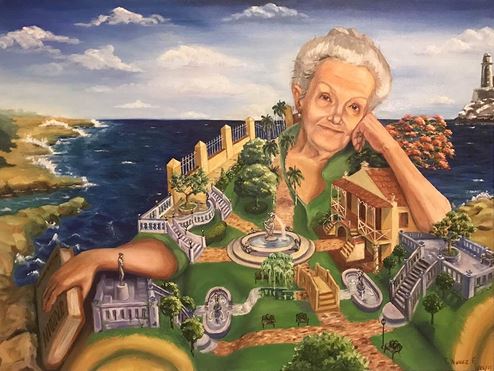
The Biblioteca del Pueblo collection has seen fit to reissue Dulce María Loynaz's lyrical novel "Jardín" (Garden). For those of us who have approached the author's work with the devotion it deserves, this gesture does not go unnoticed. Our gratitude for the reappearance of this narrative piece in bookstores must be explicit. In a recent article published in Cubaliteraria, I emphasized the symbolic power of the poet's legacy. Her two houses in Vedado, with their respective histories, transport us to a period in national history whose shadows are more than just persistent in the present. Dulce María not only wrote for the readers of her time, but the transcendence of her writing placed her at the forefront of the most original and powerful expressions of Cuban literature.
In "Jardín" (Garden), whose long struggle in a drawer in the author's house was followed by a delayed editing process and a more extended delivery to the printing houses, we perceive a gesture that, despite its grandiloquence, possesses poetic weight. It’s a novel that does not pretend to be one. It unfolds within the formal corpus, but metamorphoses it into something else, deforming it as needed when poetry takes hold. And this last aspect bestows upon it a mark of magnificence. Dulce María Loynaz is a product of the intellectual class of the early 20th century, one that was linked to the crucibles of national identity. In her environment, there were both Martí-inspired and Catholic thinkers, as well as Lorca and Carpentier (closer to socialist ideas). Therefore, the girl grew up in an environment where delicacy and depth prevailed, where the reading of the classics and the understanding of books were not through philological study, but rather through the preponderance of the image. And this substantial reality, this elusive metaphysics, determines the creation of a sensibility A life linked to poetry.
Dulce María Loynaz might seem like an author confined to verse, but she escapes that territory and weaves Bárbara's story through the years. There's a distance between the character and the real woman, yet it seems that—as the story unfolds—a self-fulfilling promise is being created: the house deteriorates, the neighborhood swallows her up, time passes, everything decays. This oppressive reality, portrayed through metaphors in the novel, forms the core of the conflict. The character evolves in an environment—her house—that is situated in another environment. The clash of worlds surrounds Bárbara, just as it did Dulce María.
Perhaps not even the author herself anticipated the thesis that history would bestow upon her novel. Time speaks for itself and possesses silent laws. Sometimes one writes as if guided by an entity—the famous demon that spoke to Socrates—and the result becomes something entirely different, disparate, but fruitful. Undoubtedly, "Garden" uses narrative as a vehicle to give us not a fictional realm, but one where the lyrical subject prevails. Therein lies its brilliance. It’s not a novel we read as a succession of events, but as the miraculous appearance of an image. This mysticism draws on the tradition of the Origenists, but places it in a much more domestic setting: the garden and the house are—obviously—the story of a family that is disappearing—the Loynaz family?—as the changes of the century unfold. Bárbara, in her confinement and her tension with freedom, replaces the metaphor of learning with that of rediscovering authenticity. Her journey is static, and here the resonance with Lezama Lima is obvious.
"Garden" should not be read only from the first page. Sometimes you have to return, take diagonal paths, stop, look inward, position yourself on the margins. Her itinerant nature marks an oblique style. As a narrative, it would have been effective, but as a poem in the form of a novel, it's a blow to the conscience. Perhaps the success of the Biblioteca del Pueblo collection lies not only in the possibility of making a classic reappear, but also in the fact that the substance of art demonstrates—once again—that it’s not dependent on time. Dulce María can speak to today's youth, even though her upbringing and voice belong to the mansions that fade into the shadows. There’s no doubt that we are partly ignorant of the history and essence of a world that no longer entirely belongs to us, because it has evaporated.
With this Cuban reissue, exquisite beyond measure, we hold in our hands a treasure to give away. Anyone who wants to know Cuba should read Dulce María and immerse themselves in its stormy waters, in the solitude of its pain, in the shadow of its end. There is, in the moon falling into the wells and casting its light upon Barbara, something of that Lorca-like fatalism of death and mourning. Perhaps the re-edition comes to settle that lost justice.
Translated by Amilkal Labañino / CubaSí Translation Staff
Añadir nuevo comentario