
Neither Cuba Nor Its Sports System Stop
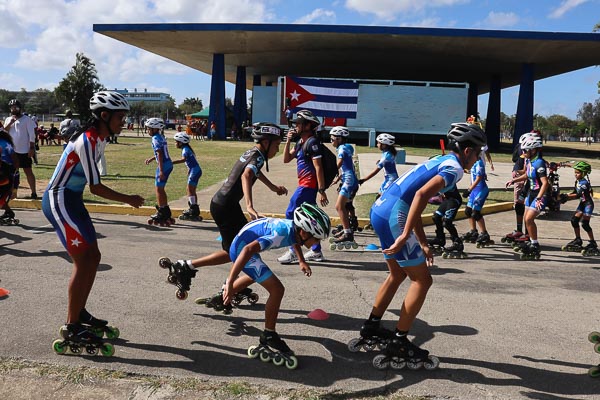
Foto: Calixto N. Llanes
The rigors of this season's temperatures are already being felt, but they will increase even more, because Cuba will experience an eminently sports-filled summer. Those who do not know this indomitable island might say we live in a crazy country—how could we think of such a thing with blackouts, sky-high prices, or water shortages? It's simple: no one is crazy; rather, it is the sanity of those of us who live here that drives crazy those who confront it.
In every province, municipality, and popular council, there will be recreational sports and physical options to spend the summer season exercising, peacefully competing, and making good use of free time.
José Cedeño, general director of Sports for All at Inder, considers this summer to be of singular significance. "We will inaugurate it across the country on Sunday, June 28—the same day the School Sports Festivals kick off in every corner of our geography, with the family and the community at the epicenter of that other great celebration."
Cedeño notes that the Festivals—as a modality of the School Games (whose 62nd edition could not be held in its usual format due to the intensified blockade, with its genocidal and suffocating energy and financial siege)—"are now multiplied, as there will be activities in all the country's municipalities."
He told JIT that Inder is the primary entity before the government's recreation commission to coordinate with all agencies the options for the population. For example, he stated, Havana has scheduled the summer opening for this Saturday with diverse physical, recreational, and sports activities, and on that day there will also be a major concert at the Anti-Imperialist Tribune, with emblematic orchestras and musical groups.
That is to say, it is a country united by the recreation of its people, in which all State agencies, the Government, the Party, and the neighborhood are integrated, in order to provide leisure spaces for children, youth, adults, seniors, and people with disabilities.
He stressed that each territory will deploy activities according to its conditions, arguing that "it is a beautiful work, with the human being at its center, and in which Inder has a great responsibility—not only in its coordination and support but also in the activation of its facilities and the availability of its technical staff, namely Physical Education teachers, Recreation instructors, and coaches."
Regarding the coincidence of the School Sports Festivals with the summer opening, he explained that it holds great significance. "Student-athletes will showcase the skills they have acquired in a competition where the audience will be their family and neighbors, as they will be competing at home."
He assured that this is a special opportunity for talent detection for the Cuban Sports System, because the pool multiplies in each municipality, expanding the talent pipeline. "They also become a unique summer sports offering, as the pioneer, school, and youth categories, through competition, provide the show that only those ages can give with their unconditional commitment to the competitive stage," Cedeño expressed.
For the summer, Cuba and its Sports System count on more than 17,000 facilities—over 5,500 physical recreation areas, more than 200 physical activity spaces, over 250 chess areas, and more than 560 sports complexes. Cedeño specified that the latter will be the main venues for the School Sports Festival, adding that for this and for summer options, the participation of over 26,700 teachers, over 54,000 activists, over 3,500 students from Physical Education teacher schools and Physical Culture faculties is guaranteed, and the country counts on over 3,000 sports legends.
This summer, as a result of the efforts of a country where every cent is pursued, we are already enjoying the FIFA World Cup—and starting from the Round of 32, all matches will be broadcast live. "But there is also the IV Elite League of Cuban Baseball, already in its playoffs; starting July 24, Cuba's representation at the Santo Domingo 2026 Central American and Caribbean Games will be followed by the population; and on June 23, in the midst of this stage, we celebrated Olympic Day," the Inder executive recalled.
Let those sensible people who do not understand this magical madness for life and for the well-being of every family look elsewhere. The challenges we face—a war scenario created by the U.S. government's aggressiveness against Cuba, a global economic crisis, and complex international conflicts—impact Cuba with a difficult energy situation, shortages, and financial inflation. However, the Greater Antilles does not stop; it resists, fights, and creates; it does not renounce its joy or the right of its sons and daughters. These are the reasons why the Cuban Sports System does not stop either.
Alongside the competitive commitment of Santo Domingo 2026, it stands beside its people in its streets, bringing through physical activity, recreation, and sport an inexhaustible source of hope.
Añadir nuevo comentario