
Bolshoi Theatre: 250 Years of Russian Art on Stage
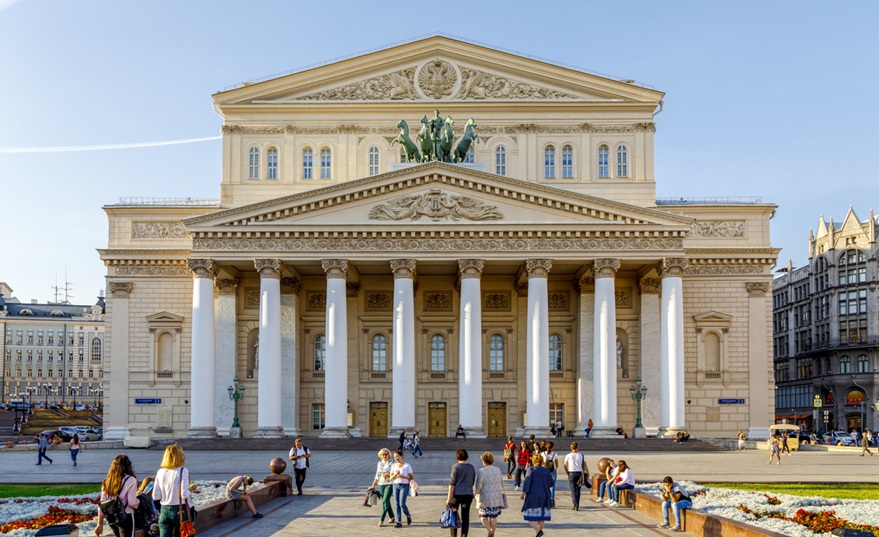
Teatro Bolshói. Foto: KarSol / Gettyimages.ru
At the heart of the Russian capital, along avenues steeped in centuries of history, the Bolshoi Theatre stands as a resounding declaration of permanence, marking this Saturday its 250th anniversary since its founding.
Two and a half centuries are not merely a number: they represent an accumulation of voices, bodies in motion, political tragedies, and cultural triumphs that have transformed this institution into something far greater than a stage. The Bolshoi is not visited — it is interpreted.
Founded in 1776, at a time when the Russian Empire was seeking to define itself culturally in the face of Europe, the theatre was born of an ambition: to demonstrate that Russia could not only import art, but produce it with an identity of its own.
Since then, each of its reconstructions — because the Bolshoi has burned, crumbled, and risen again — seems to repeat the same idea: culture, here, does not surrender.
The current building, with its imposing neoclassical portico and the quadriga of Apollo crowning the façade, is itself an aesthetic statement. But it is inside that the essential occurs. In its main hall, that deep crimson and ceremonial gold are no mere ornament: they are part of the ritual. The audience does not enter to watch a performance — it enters a tradition.
Throughout its 250 years, the Bolshoi has been both witness and protagonist of Russian history. Under the tsars, it served as a symbol of imperial refinement; during the Revolution, it survived as a cultural space amid radical change; in the Soviet era, it became an ideological showcase. At each stage, the theatre did not merely present spectacles — it reflected the condition of the nation.
Within its walls, some of the most iconic works in the universal repertoire were consolidated, and Pyotr Ilyich Tchaikovsky was not simply performed there — he was made part of its DNA. Swan Lake, The Sleeping Beauty, and The Nutcracker ceased to be ballets and became cultural symbols. Each generation of dancers has engaged with those works, reinterpreting them without betraying their essence.
On that stage, figures were forged who transcended dance to become legends. Among them, Maya Plisetskaya, whose name still resonates as a synonym for rupture. Her presence was a jolt to established forms, a demonstration that even within the most venerable institutions, rebellion can find its home.
Today, well into the 21st century, the Bolshoi is undergoing another transformation. Restored, technologically updated, and open to new audiences, it coexists with a world in which art no longer belongs exclusively to elites. Yet something remains intact: the sensation that, as the curtain rises, a collective memory is set in motion.
The first-time visitor perceives the beauty; the seasoned spectator recognizes the nuances; the historian discerns the layers of time. This place is not merely a theatre — it is a continuous narrative in which the great Eurasian nation has told its own story, again and again, through art.
In a world changing at dizzying speed, the Bolshoi Theatre insists on something essential: there are stories that can only be understood when they are danced, when they are sung, when they are performed. And Russia, for two and a half centuries, has chosen this stage to declare who it is.
Añadir nuevo comentario