
Cuba and its Example for Confronting and Winning this War
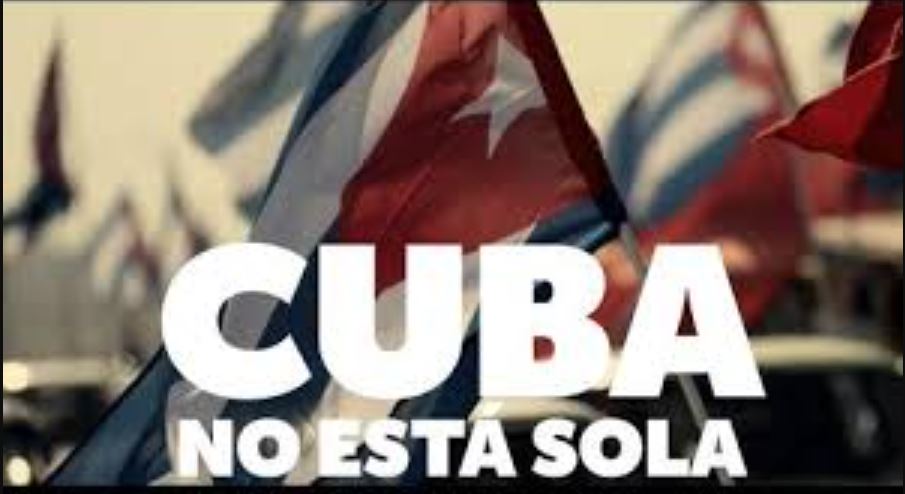
It’s a war. This phrase stands out in a post by Manolo De los Santos on the digital network X. De los Santos is a member of the Party for Socialism and Liberation (PSPL) and is in Cuba, along with representatives of other parties and social movements, as part of a delegation seeking to understand firsthand the impact of the new imperialist escalation against Cuba and to show solidarity with the people and government of the Caribbean nation.
Trump is waging a brutal campaign of suffocation and psychological warfare in which he presents himself as a friend and savior. The people are tired, yes, but not defeated. Resistance is palpable. These ideas are also taken from De los Santos's profile, who, along with the delegation he is part of, met with the First Secretary and President of the Republic, Miguel Díaz-Canel Bermúdez, a few hours ago.
Regarding this, the president posted: “The support of organizations like the International Peoples' Assembly demonstrates the broad backing the revolution enjoys and that we are never, nor will we ever be, alone in the struggle to defend our sovereignty against constant imperial pressures.”
And indeed, expressions of solidarity and support for the Cuban people and government are arriving from all corners of the world: from close neighbors like Mexico, to those across the Atlantic, such as France. There, on March 9, Jean-Luc Mélenchon, leader of the La France Insoumise party, sent a clear message: “We are here, comrades! Onward!” In a debate in Paris, before thousands of people, Mélenchon declared: “Our thoughts today turn to the martyrdom suffered by the Cuban people, deprived of everything. Long live Cuba, long live its people, long live its resistance!”
Days earlier, the French politician and dozens of other figures from the European country called on French President Emmanuel Macron to adopt a firm and unambiguous stance against the US blockade of Cuba and its extraterritorial nature, calling it a clear violation of international law.
It’s worth noting that this March 12 marks another anniversary of the infamous Helms-Burton Act, which provided the blockade with tools to persecute not only Cuba, but all countries that trade with or maintain relations with it, affecting the interests of millions of Europeans. For this reason, in the letter in question, the signatories ask the French government to guarantee legal protection for companies and banks interested in cooperating with Cuba, activating the mechanisms that the European Union has designed to protect itself from the extraterritorial nature of the blockade.
The Spanish Communist Party also reacted from the so-called Old Continent. Its Secretary General, Enrique Santiago, announced how the Spanish Congress rejected Trump's executive order against Cuba, deeming it a violation of international law and worsening the conditions of the Cuban people, already suffering under a blockade that has lasted more than 60 years. "All democratic political forces have said that Cuba is not alone," he posted, along with an image of the letter in which Congress urges the government to take the lead in the European Union and multilateral organizations in a firm stance against all measures that violate international law, such as external interference in Cuba. They also agree on the need to confront the extraterritorial nature of such interference.
For his part, the party's Secretary of Foreign Affairs, Manu Pineda, said: “We owe Cuba solidarity, example, and consistency. We owe it to them for having shown that humanity is worth more than the market. We owe it to them for having put life at the center, even under siege. Today it’s our turn to reciprocate: love is repaid with love. With Cuba, onward to victory, always.”
And this is how we learned from Martí, and how it enriched revolutionary practice: Cuba has gone out into the world as a sister, sharing what it has, not what it has to spare. Therefore, it’s no surprise that words of encouragement have arrived from the Pan-African Women's Organization, making clear their conviction not to stand idly by while attempts are made to annihilate a sister nation.
It’s worth remembering that even within the US political establishment, the harmful impact of the blockade has been understood and condemned, as in the case of Senator Jim McGovern, who acknowledged that the “embargo” against Cuba has brought nothing but misery and pain to Cuban families.
Since the beginning of the attempted energy blockade against Cuba, thousands of voices around the world have reaffirmed their commitment to an archipelago that inspires resolve and sovereignty. For every lackey who has yielded and for every threat, many have stood with the indomitable island. And we are not only talking about heads of state, about politicians: we are talking about workers, intellectuals, ordinary people who feel a deep connection to this land and who have stood in front of US embassies, in the cold or the rain, to say: “Let Cuba live.” They are elderly and young people who promote fundraising campaigns to send medical supplies, who teach about Cuba and its solidarity, who do not give up and do not stop fighting for just causes.
Añadir nuevo comentario