
Cuba Has Provided More Medical Personnel to Low-Income Countries Than All G7 Nations Combined
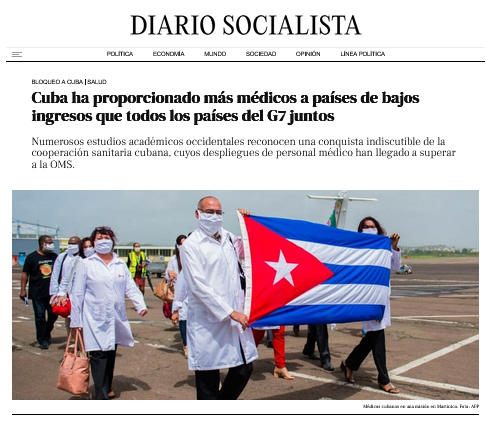
Despite mounting international pressure and a reduction in missions driven by economic crisis and sanctions, Cuba's medical internationalism program continues to rank among the most remarkable humanitarian endeavors on the global stage — and one of the Cuban Revolution's most widely acknowledged achievements.
A recurring finding in independent academic analyses holds that Cuba has deployed more medical personnel to low-income countries than all G7 nations — the United States, Canada, Japan, Germany, France, Italy, and the United Kingdom — combined. This comparison, which gained widespread currency from the mid-2010s onward, is grounded in data from the period when Cuba's overseas deployments reached their peak.
A December 2016 article published by The New Humanitarian reported approximately 55,000 Cuban health professionals deployed across 67 countries as of March of that year, with roughly half stationed in Venezuela. The piece noted that for a nation of just 11 million inhabitants, this constituted a remarkable record, encompassing missions to Africa, Latin America, and the Caribbean in response to both disasters and structural health deficits.
The academic volume Healthcare Without Borders: Understanding Cuban Medical Internationalism by John M. Kirk, published by the University Press of Florida in 2015 and among the most cited works on the subject, states explicitly that Cuba had more medical personnel serving abroad — across 66 countries — "than all the G-7 combined and more than the World Health Organization." A London School of Economics blog from 2017 corroborated the same figures.
The program traces its origins to 1963, when Fidel Castro dispatched 56 physicians to Algeria. Since then, more than 600,000 Cuban professionals have served in over 160 countries, with particular emphasis on primary care, emergency response — including the Ebola outbreak, earthquake relief, and the COVID-19 pandemic — and the training of local physicians through the Latin American School of Medicine.
The current picture reflects the severe toll of the U.S. energy blockade on the island. According to Al Jazeera reporting from February 2026, more than 24,000 Cuban doctors are now working in 56 countries, primarily in Latin America, Africa, and the Caribbean. Data drawn from Cuban state media and UN sources indicate a decline from roughly 50,000 personnel in 2015 to approximately 28,000 in 2020, with more recent estimates ranging between 22,000 and 30,000.
The program also generates foreign currency income for Cuba's constrained economy — a dynamic that Washington has characterized as forced labor, though critics of that framing note that Cuban medical brigades train tens of thousands of foreign physicians, fill critical gaps in rural and underserved health systems, and provide free services to those most in need, with virtually no individual financial enrichment involved.
Political pressure from the United States has prompted some governments, including Guatemala, to discontinue Cuban medical collaboration, while other jurisdictions — such as the Calabria region of Italy — have resisted similar pressure to preserve their Cuban medical brigades.
Despite ongoing controversies regarding working conditions and geopolitical motivations, Cuba's medical internationalism endures as a singular model of South-South cooperation — one whose legacy, at its peak, far surpassed the direct medical contributions of the world's wealthiest nations to the countries that need it most.
Añadir nuevo comentario