
Díaz-Canel on "Criterio Compartido": Respond to the People with Actions
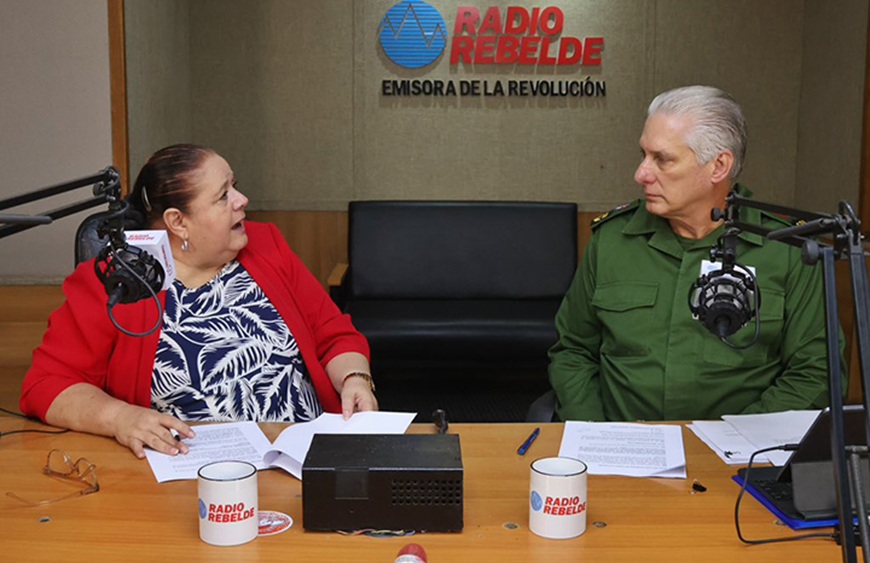
Miguel Díaz-Canel Bermúdez, First Secretary of the Central Committee of the Communist Party of Cuba and President of the Republic, called today from the radio program "Criterio Compartido" to address the issues related to the water supply to the population with actions and not with rhetoric.
Water supply difficulties, the impact of blackouts, and the responsibility of institutions regarding citizen demands centered the fourth broadcast of the show, hosted by Bárbara Betancourt and featuring Díaz-Canel's participation.
The leader acknowledged the severity of a situation that affects the daily lives of families and demanded combining investments and technical solutions with systematic, sensitive, and responsible attention to the population.
Díaz-Canel highlighted the respect with which people convey their concerns, even after long periods without receiving the service and with all the complications this entails for daily life, emphasizing that those who reach out to the program are exercising a legitimate right.
"They are exercising their right to demand, and we have the duty to listen to them with humility and to respond to them with actions and not with rhetoric," he asserted.
When assessing the causes that complicate the situation, he pointed to aging networks, investments, and maintenance that could not be carried out to the necessary extent, the consequences of the embargo, and the lack of fuel and electricity to sustain energy backup for pumping equipment.
He recognized that the problem "is real, serious, and complex," explaining that its solution requires a comprehensive program and time to execute planned investments so they can achieve their expected impact on the population.
The Cuban President insisted that material difficulties cannot always become a justification for a lack of attention, delayed answers, or the absence of officials in affected locations.
"We are not going to pause at external causes either to justify the lack of an institutional response," he added.
Faced with testimonies from communities that remain without explanations, he demanded listening, visiting, sharing the situation with neighbors, and searching for alternatives.
He also called for demanding accountability wherever negligence, indolence, or mistreatment against affected residents exists.
"The population is not a nuisance; it is the reason for our institutions' existence," he emphasized.
During the exchange, warnings about stolen pipes and improper valve manipulations were also addressed.
Díaz-Canel instructed officials to address what neighbors report and to consider their proposals to prevent the recurrence of issues they had previously pointed out.
One of the cases analyzed involved a resident of Mantilla, in the capital municipality of Arroyo Naranjo, who reported going more than six months without receiving service as before and finding no answers from the authorities she approached.
Assessing what occurred, Díaz-Canel noted that the investigation made it possible to identify problems with the valves and that a technical solution existed that could have been implemented in hours; however, bureaucracy and a lack of follow-up unnecessarily delayed the resolution of the matter, causing an unjustifiable delay in handling the reported disruption.
In this regard, he characterized the six months without a response as an institutional failure: "Six months of silence are not justified by any technical complexity. Technical complexity may exist, but silence is not justified," he stated.
The First Secretary of the Party warned that the institutional response must also reach those who do not call, cannot get through, or are unable to listen to the program.
"Attention to a case and its solution cannot depend on the media visibility of a person," he evaluated.
He explained that "Criterio Compartido" must contribute to multiplying a way of acting based on listening, visiting, evaluating, seeking solutions, and assuming the role of public servants.
Nevertheless, addressing people's problems, he reiterated, constitutes a permanent institutional duty.
Añadir nuevo comentario