
U.S. Attacks Iranian Island as Trump Touts Diplomatic Progress
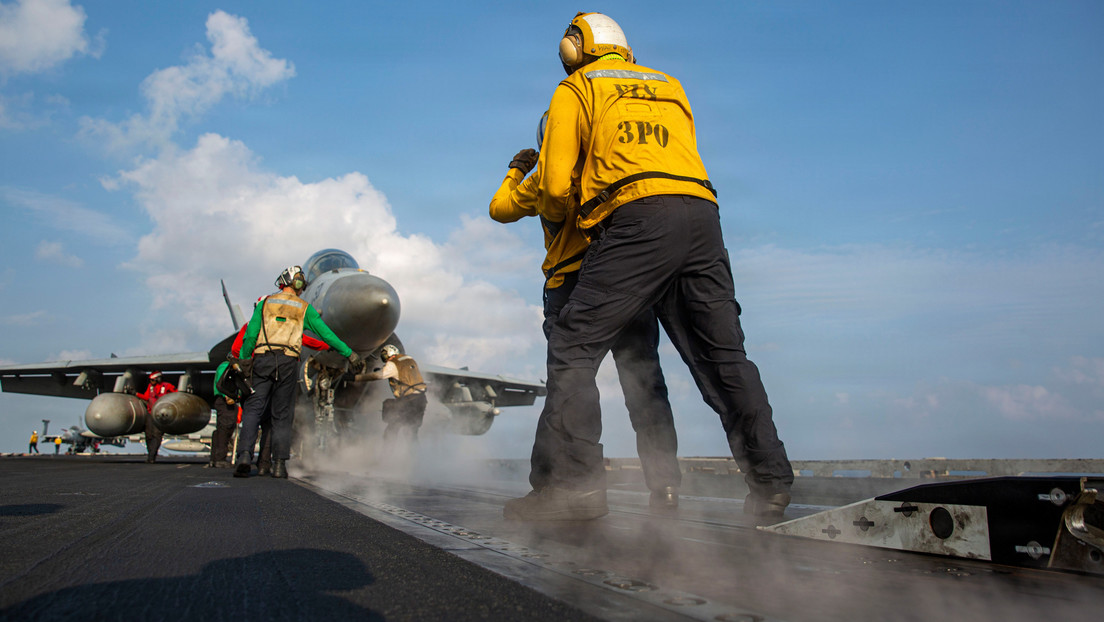
Washington launched limited attacks this Tuesday against an Iranian island in the Strait of Hormuz, according to U.S. media, hours after President Donald Trump praised diplomatic progress with Tehran, just hours before the midterm elections.
The bombings, first reported by The Wall Street Journal, hit the island of Qeshm, where Iranian state media reported five explosions in rapid succession.
Anonymous U.S. officials cited by The Wall Street Journal and other media described the attacks as defensive in nature. The newspaper noted that it was simply the latest of several undeclared offensives.
The daily stated that they had not been publicly announced to avoid giving the impression that Washington intended to resume large-scale combat operations.
The U.S. Central Command (Centcom), responsible for operations in the Middle East, did not immediately respond to a request for comment from AFP.
The United States, with Israel's help, began the war with a massive wave of surprise attacks against Iran at the end of February, but has not achieved its war objectives and the conflict has been stalled for months.
On Monday, a day before voters are forecast to give his Republican Party a drubbing in the midterm elections over discontent with the war and the inflation it has caused, Trump said an agreement with Tehran "could happen."
"Iran wants a deal as soon as possible," he added on his Truth Social network.
For his part, Iranian Foreign Minister Abbas Araghchi said indirect talks were underway.
"Given the sensitivity and seriousness of the current situation, the consultations and deliberations are very intense," the foreign minister told state media.
This Tuesday, the speaker of Iran's Parliament and chief negotiator in the talks with the United States, Mohammad Baqer Qalibaf, said that while Iran was ready for war, it had given Washington a "rational response."
"The ball is now in the United States' court to avoid war," he declared.
Amid this tug-of-war, oil prices plummeted more than 7% on Monday due to the rapprochement toward a possible end to the conflict, which has now lasted eight months.
Reopening the Strait
U.S. Vice President JD Vance stated that both he and Trump are optimistic about reaching an agreement.
"We have certainly made some progress. We will see if we can make more," he told journalists.
According to the U.S. outlet Axios, citing U.S. and Israeli sources, Trump wants for now to let the negotiations run their course, despite having spoken by telephone with outgoing Israeli Prime Minister Benjamin Netanyahu, a supporter of an offensive.
A senior Iranian official indicated that Tehran was willing to open the Strait of Hormuz, a key export route for the Gulf's hydrocarbons, within two days, as long as Washington accepted its list of demands.
In September, Tehran proposed a seven-day plan to reopen that route, with demands that included an end to the war on all fronts, the unfreezing of Iranian assets, the lifting of oil sanctions and an end to the U.S. counter-blockade of Iranian ports.
Trump did not accept.
"The possibility of implementing this plan in two days is another sign of Iran's good-faith approach," Iranian Foreign Ministry spokesman Esmail Baqai told journalists at a press conference.
Diplomatic Signals
China held meetings with Iranian and Saudi officials in Beijing on Monday.
The Asian giant supports Tehran in the "defense of its own sovereignty and security," Foreign Minister Wang Yi told Ali Baqeri, deputy secretary of Iran's Supreme National Security Council, according to a Chinese statement.
In an interview with the Al Jazeera network on Sunday, Araghchi added that Washington must accept a "new route agreed between Iran and Oman for transit through the Strait of Hormuz."
Although a military de-escalation has been observed since September, the United States and Israel have intensified their threats in recent days, in a context marked by major electoral appointments in both countries.
Trump declared on Saturday that he still has to "take care of one or two" nuclear facilities in Iran.
The Islamic Republic, which denies that it wants to acquire atomic weapons, has repeatedly warned of far-reaching retaliation if the United States resumes the war.
Authorities installed a giant banner in the heart of Tehran, AFP journalists confirmed this Tuesday, on which can be read over a photo of the U.S. president: "We will kill Trump."
Añadir nuevo comentario