
Díaz-Canel Checks Cosculluela Water Supply System
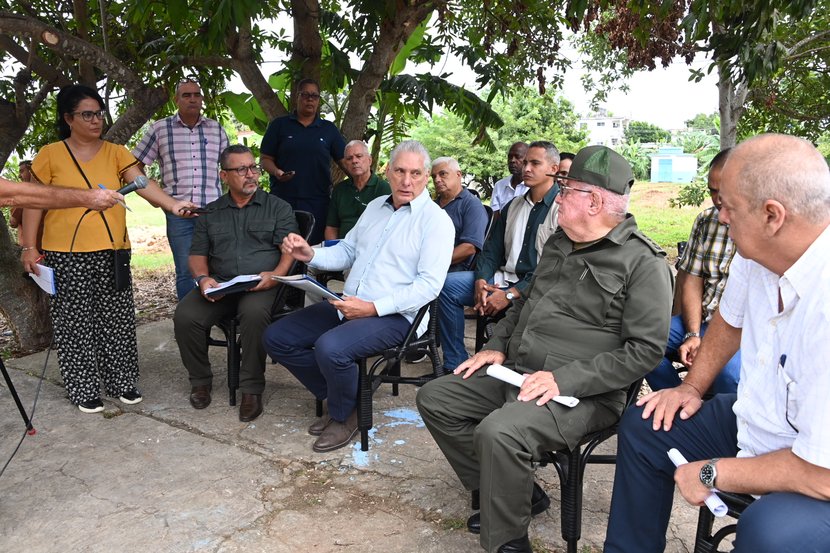
Desde el campo de pozos -segunda fuente de abasto en importancia del sistema oeste de la capital, cuyos beneficiarios son los pobladores de los municipios de Playa y Marianao-, el Jefe de Estado pasó revista a cómo marchan las acciones cuya meta es la mejoría de un servicio vital.
Week after week, the country's leadership monitors the Comprehensive Program for Water Supply Assurance in Havana. For that reason, on Tuesday morning, the First Secretary of the Central Committee of the Communist Party of Cuba and President of the Republic, Miguel Díaz-Canel Bermúdez, visited the Cosculluela system, located in the municipality of Boyeros.
From the well field—the second most important supply source of the capital's western system, whose beneficiaries are the residents of the Playa and Marianao municipalities—the head of state reviewed the progress of actions aimed at improving a vital service.
It was a day that also included the presence of Politburo member and Minister of the Revolutionary Armed Forces (FAR), Army Corps General Álvaro López Miera; Minister of Energy and Mines Vicente de la O Levy; President of the National Institute of Hydraulic Resources Antonio Rodríguez Rodríguez; First Secretary of the Provincial Committee of the Communist Party in Havana Liván Izquierdo Alonso; and the capital's governor, Yanet Hernández Pérez, among other officials and experts.
Díaz-Canel Bermúdez emphasized the importance of constantly informing the public about the water supply situation in the country and in Havana. He spoke of taking advantage of all possible spaces, and that this action, which in his view should be daily, also take place on digital networks and institutional websites, without losing sight of the value of permanent interaction with the population.
Regarding the actions that have been deployed as part of the Comprehensive Program for Water Supply Assurance in Havana, the president referred to an effort he deemed fundamental and that will make possible, he said, an improvement in the coming weeks.
Once the president's visit concluded, the general director of Aguas de La Habana, Yosvani Rubí Bazail, offered statements to the press team of the Presidency of the Republic of Cuba: "There are four major water supply systems in the capital," he said, "that we are working on jointly with the Electric Union. And there are also other associated agencies."
The official explained that "the idea is to stabilize the electrical service in these four major systems," for which "a group of important alternatives is being sought." In that regard, Yosvani referred to solar energy, and also to generator sets; and mentioned that, in parallel, hydraulic resources forces have focused on improving infrastructure, which—he affirmed—will progressively lead to an improvement.
The general director of Aguas de La Habana emphasized that the improvement will not be instantaneous, "because all these works involve an impact on pumping. For example, yesterday we were here working in Cosculluela and an express electrical line is being installed, and the line had to be cooled. Right there the pumping system stopped, and that implies an impact."
Regarding what has been done to reverse a situation that came to affect some 500,000 people in the capital, Yosvany Rubí told reporters that "we already have four major works completed on conduits," which seeks "to save the water that is spilled," thereby making supply systems more efficient.
"We are working on pumping equipment," detailed the official, who also spoke about work on distribution networks. Regarding this last purpose, he reasoned that it is the most visible, because it is the one related to water deficit problems in the city. All are—he said—highly complex works.
In the specific case of the Cosculluela system, Yosvany Rubí Bazail referred to efforts such as civil maintenance of the infrastructure, "which is already completed"; and mentioned that internal roads are being improved, while work is being undertaken where there are leaks of the precious liquid.
"We still have automation pending," affirmed the official, who spoke about the search for alternatives "to recover the automation that this well field had," which, he said, reduces the gaps for human error and makes possible a faster recovery from supply disruptions.
Añadir nuevo comentario