
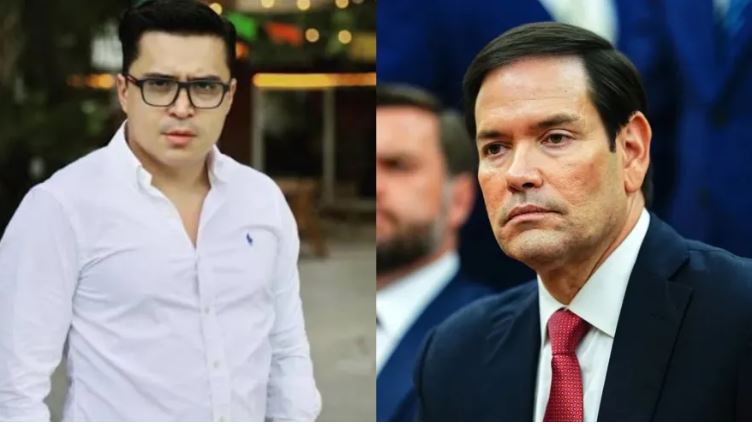
From Beto Coral to the Infamous Marco Rubio
Comments on the same topic never sound repetitive when they present aspects that move us and provoke outrage, especially when they are addressed by publications like Democracy Now!, directed by Amy Goodman, a good friend of Cuba, as well as the notoriously unfriendly The New York Times, which must be acknowledged for its objectivity on several issues.
In this context, the topic resurfaced regarding Colombia, after the far-right president, Abelardo de la Espriella, supported by Trump, claimed that God “in his wisdom” decided to send an earthquake to the South American nation on the very day he took office.
Thus, political activist Beto Coral shared a video reminding viewers of the president's atheist stance and criticizing the use of religious arguments to explain tragedies, urging him not to employ faith as a political tool.
In that clip, a journalist questioned De la Espriella about his beliefs. “So, you literally deny the presence of God,” inquired journalist Viviana Marín. The president responded, “Absolutely.” The journalist emphasized in the video, “He doesn’t even question it.” De la Espriella reaffirmed, “Nothing. I don’t believe in anything that reason can’t explain.” The exchange included a personal reference. The journalist asked, “How did you manage to get married in a church?” The current head of state’s response was blunt: “Because for love, one does stupid and foolish things.”
The journalist Marco Rubio had her visa revoked in the United States for saying that she was going to make the country “unlivable” for Abelardo de la Espriella.
In turn, Beto, whose full name is Franklin Humberto Coral Garrido, used this material to further his criticism. “There you have this man. Were the dead part of the presidential test? What about the wounded, the children, the families who lost their homes?” questioned Coral, who rejected the idea of a punitive or punishing God involved in natural disasters.
“Stop bringing God into these things, especially when religious discourse is used to harm others, wish them ill, or even as a political tool,” he remarked.
Beto returned to Colombia after being detained by immigration agents. Coral was living in Phoenix, Arizona, when federal immigration agents from Homeland Security Investigations arrested him at his home in June after he criticized then-Colombian far-right presidential candidate and now president-elect Abelardo de la Espriella.
In a memo obtained by The New York Times in June, U.S. Secretary of State Marco Rubio wrote: “Coral Garrido has used his presence in the United States to conduct political activities in support of the Petro government,” and accused Coral of undermining U.S. foreign policy interests in Colombia.
Since Trump’s return to office, Rubio has used his powers as Secretary of State to pursue and deport immigrants, including student protesters like Palestinian activist Mahmoud Khalil. But, according to The New York Times, this memo appears to be the first to recommend the deportation of an activist in connection with a presidential election in a foreign country, in this case, Colombia.
Coral had arrived in the United States in 2015 on a tourist visa and had a pending asylum application. After a month in an immigration detention center, Beto withdrew his asylum application and voluntarily returned to Colombia on July 16.
“They weren’t ICE agents, they were HSI (Homeland Security Investigations) agents. At one point they showed me their weapons, and as soon as they saw my son and my dog, Logan, they lowered their weapons and allowed me to go into the apartment to drop them off and call my ex-wife so she could come and take care of my dog and my son. They let me get some documents, and then they took me out and handcuffed me inside the vehicle. They never showed me a warrant, never showed me any documents, and never read me my rights.
“They took me to the Central Phoenix Detention Center, and there they didn’t give me food or water. While I was inside the bulletproof cell, an HSI agent placed Marco Rubio’s document on the bulletproof screen. I tried to read it and saw that it said, ‘Memorandum… Marco Rubio…’ and…” I was very confused because it didn't seem like an arrest warrant. I called Daniel Coronel, a Colombian journalist and former president of Univision News in the United States, and said, "Hey, Daniel, I just saw a memo from Marco Rubio, but I didn't read it." He was incredulous, but well, it was proven true when the New York Times revealed that document days later.
“After that, I was transported to Florence, Arizona, where I was beaten and deprived of water and food. Then they moved me to El Paso, by land, all by myself. I arrived in El Paso. Then I was there for a day and a half. They put me in solitary confinement. They took me by plane to Omaha, Nebraska; Minneapolis, Minnesota; then to Alexandria, Louisiana; then by bus to Mississippi; and then back to Jena, Louisiana. On all the journeys, they never gave me water or food, and I was always handcuffed at my feet, waist, and hands.
“After I arrived in Jena, where I was held for more than 20 days, they handcuffed me at my feet, hands, and waist and put me in solitary confinement for no reason. When I was checking in at the transfer station, at the jail, I had a string or cord around my deodorant.” I don't know who put that there, but I'm absolutely certain the intention was to hurt me—who knows why—to make it look like a suicide. I reported it, called my lawyer, told her what happened, and they put me in solitary confinement. Those were pretty awful days. They treated me terribly. I was handcuffed and shackled to go to the bathroom, to clean up, to meetings with my lawyers; I was handcuffed and shackled, and I really didn't understand why.
The New York Times notes that Coral faced risks in his home country due to his political activism and was threatened after investigating the death of his father, a police officer who was part of the operation to capture Pablo Escobar, the notorious head of the Medellín cartel in the 1990s.
Regarding this, Beto emphasizes that nothing was ever clarified, leading him to understand that the United States is the most dangerous place for immigrants in the world. “Therefore,” he said, “I withdrew my asylum application and urgently requested my voluntary departure from that country.”
Now, with De Espriella in power, protected by Trump and Marco Rubio, he fears for himself and his family. “Mr. Abelardo de la Espriella, throughout his life, defended drug traffickers, thugs, murderers, and criminals… The problem is the lawyers who end up behaving like criminals, and that’s what Abelardo de la Espriella is. I filed a complaint against Mr. Abelardo in Miami, in South Florida, for illegally recording me… I also filed a complaint against him for extortion, for trying to blackmail me into making certain statements. I filed a complaint against him; that’s also in the memorandum. Marco Rubio says that Beto Coral initiated legal action against a candidate in Colombia, denying me a fundamental right: access to justice.
“Of course I’m afraid because I can’t go out on the street. I’ve received various death threats, but more than for myself, it’s for my son Juan Manuel, for my son’s mother, for my mother, for everyone around me, because they’ve all received death threats.”
De la Espriella is a lawyer and businessman who has been under scrutiny regarding the origins of his fortune and his alleged ties to Colombian clients. In this regard, Coral made a video about a Miami apartment in Bristol Tower that belonged to De la Espriella and was sold for a sum four times below its real value to right-wing activist Luis Carlos Vélez. Later, after an investigation by Daniel Coronel and also by Cuestión Pública, it was revealed that Abelardo de la Espriella acquired this apartment after several companies transferred approximately $370,000 to accounts linked to him.
Beto Coral is simply a political activist, without extensive revolutionary background, and even misunderstands many realities. But his actions have angered individuals like former President Álvaro Uribe, and he has received death threats, primarily in Miami. Now, in Colombia, he is certain that Abelardo de la Espriella, or his team, or his supporters, will try to harm him and his family. So, taking a deep breath, he reflects:
“I do want to fight, I want to struggle, I want to keep speaking out louder, harder, because fear feeds fascism, so the more they try to silence us, the louder we have to speak out.”
Translated by Amilkal Labañino / CubaSí Translation Staff
Añadir nuevo comentario