
Díaz-Canel: U.S. Has No Moral Authority to Demand Concessions from Cuba
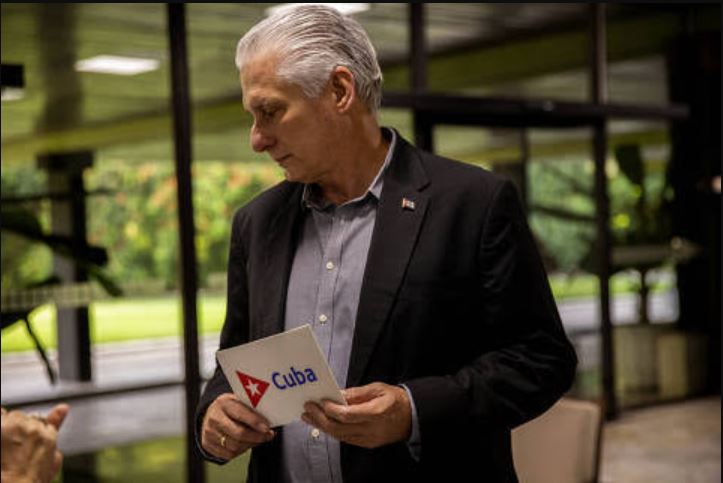
In an interview granted to the Brazilian newspaper Folha de S.Paulo, the president rejected the notion that the economic transformations represent an abandonment of the socialist construction process.
"The 176 economic measures announced are the result of a debate on improvement that has been taking place for more than 10 years," he explained.
Díaz-Canel noted that the current economic situation has granted greater urgency to changes that were already being studied, and he defended the incorporation of different economic actors as a means to increase production, attract investments, and generate resources for development.
Among the measures are a greater participation of the private sector, new possibilities for foreign investment, and the opening to investments from Cubans residing abroad.
According to his explanation, the principal means of production remain in the hands of the State, while the new economic actors must contribute to the objective of increasing production and generating benefits for the population.
Díaz-Canel expressly rejected that the measures respond to demands from Washington. "The United States has no moral authority to demand any concession from us, nor are we willing to make them," he asserted.
The president insisted that the reforms form part of a national process of economic improvement and not a negotiation with the U.S. government.
Furthermore, he maintained that social justice continues to be a central principle of the Cuban project and highlighted the social programs supported by the state budget.
During the interview, the president was also asked about the possibility of a U.S. military intervention in Cuba, in a context marked by threats and pressure measures from Washington.
"From this U.S. administration, we can expect anything," the head of state responded.
He also stated that Cuba is a country of peace, but noted that there is a constant rhetoric of threats and that, for that reason, the island is preparing, with actions such as the National Defense Day held each week.
When asked about what would happen to him personally in the event of a military action against the island, he responded: "If my time comes, it comes. But it will not be with weakness and cowardice. It will be fighting."
The president reiterated that Cuba does not seek confrontation and maintains a willingness to dialogue with Washington, but without prior conditions or subordination to external interests.
Díaz-Canel maintained that the defense of independence and sovereignty is directly related, under Cuba's conditions, to socialist construction.
He also referred to the teachings of the historic leader of the Cuban Revolution, Fidel Castro, who "taught us that setbacks can be transformed into victories and that no enemy, no matter how powerful, is invincible."
"We know it will be difficult. Yes, it is. But look: here we are, standing, fighting, without giving up," the Cuban president concluded.
Añadir nuevo comentario