
The Global Consequences of a Record-Breaking El Niño Event
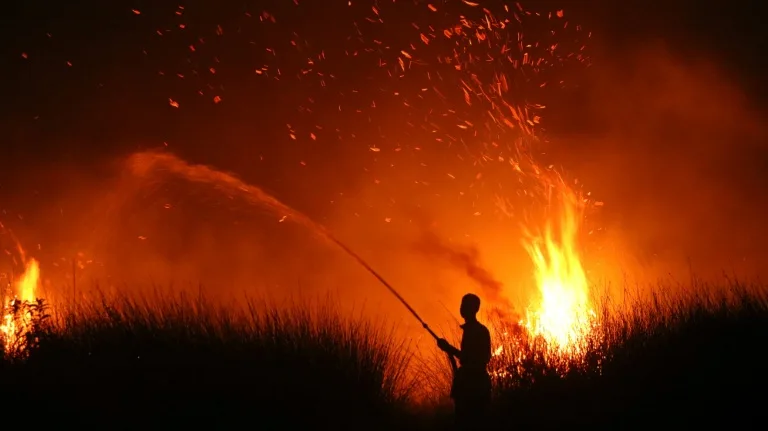
Incendios forestales
The current El Niño phenomenon is shaping up to be the most intense ever documented, with the potential to trigger extreme meteorological events across various regions of the planet and to make 2027 the hottest year on record. According to experts, combined with human-caused global warming, this episode offers a preview of the heat levels that could become routine by the end of the 2030s.
What Is El Niño?
El Niño is a natural climate variation that warms sea surface temperatures in the central and eastern equatorial Pacific Ocean. It occurs when the easterly trade winds that normally keep warm waters in the western Pacific temporarily weaken, allowing those waters to reach the surface and shift eastward. When surface temperatures remain above normal for several months, this generates more storms over the region, "which has repercussions across the entire Earth's atmosphere," explains Emily Becker, a climatologist at the University of Miami. As a consequence, warmer and drier conditions arise in certain locations, while cooler and wetter conditions develop in others. With stronger El Niño episodes, "we can expect to see more of these consequences," Michelle L'Heureux, an official at the U.S. National Oceanic and Atmospheric Administration's (NOAA) Climate Prediction Center, told AFP. She added, however, that these repercussions are not guaranteed.
What to Expect This Year
Sea surface temperatures in the Niño 3.4 region—a benchmark area in the Pacific—are currently about 2.6°C above the 30-year average, according to the Climate Brink monitoring panel, which relies on NOAA data. The panel also compiles forecasts indicating that the phenomenon could reach a November peak of 3.9°C, well above the 3°C anomaly recorded in 2015, the current record year. That should make 2027 the warmest year ever registered, as El Niño's impact is felt mainly in the year following its onset. According to calculations by climatologists Zeke Hausfather and Andrew Dessler, El Niño would drive a global average temperature increase of about 0.3°C in 2027. "It's like a preview of the future," Dessler, a professor at Texas A&M University, told AFP. Such a magnitude of increase on a long-term basis would not otherwise be expected until 2037. He clarified, however, that this warming will be concentrated essentially in the equatorial Pacific.
Mike McPhaden, a researcher at NOAA's Pacific Marine Environmental Laboratory, offers similar estimates: "It is not inconceivable that 2027 could be 1.7°C above pre-industrial levels," he assured AFP. There is no single method for measuring El Niño. In February, NOAA adopted a new metric—the Relative Oceanic Niño Index (RONI)—which compares the temperature anomaly in the 3.4 region with the rest of the tropical belt. Under this classification, NOAA estimates a 69% probability that this year's El Niño will be the most intense since records began in 1950.
For its part, the U.K. Met Office also warned on Friday that this year's El Niño will likely be "the strongest in more than a century." Adam Scaife, head of long-range forecasting at the Met Office, highlighted that the consequences will be "especially strong around the tropics," with drastic droughts in South America and the western Pacific.
And Climate Change?
Scientists agree that climate change amplifies El Niño's effects. The Earth's atmosphere, warmed by greenhouse gases, holds more moisture, which can make the rainfall associated with the phenomenon more extreme. Conversely, where El Niño already causes drought, it can dry out soils even further. There is no consensus, however, on whether climate change strengthens El Niño itself, although evidence is beginning to emerge in that direction. According to McPhaden, the warming of tropical seas makes the winds that feed El Niño more sensitive, which through convection can accelerate the phenomenon's development. He draws on various indicators—from paleoclimate records obtained from coral skeletons, to instrumental measurements from the 19th century, to climate simulations—to support his conclusions: the intensity of El Niño episodes has likely increased by approximately 10% over the past century.
Añadir nuevo comentario