
Trump-Noboa: Alliance of Insecurity
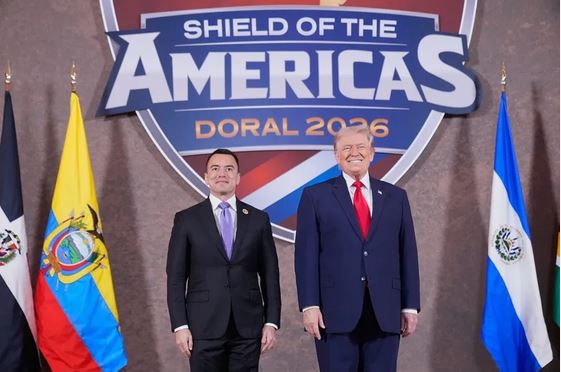
After 34 months in power, the government of Daniel Noboa published its first National Security Plan, making international cooperation one of its pillars in the fight against organized crime. However, the document does not detail the oversight and accountability mechanisms that will govern this collaboration, precisely when the alliance with the United States is facing the greatest scrutiny since the beginning of the internal armed conflict. Meanwhile, homicides remain at historically high levels, and reports of human rights violations are mounting.
Ecuador ended 2025 with 9,216 homicides, the highest figure in its history, and this year's numbers are following the same trend, despite the presence of U.S. troops on the ground. Guayas, Los Ríos, and Manabí are the areas with the highest concentration of violence, while organized crime has expanded its control across almost the entire country.
The increase in homicides in Ecuador has generated political and social pressure on the government. During 2025, the Executive Branch reinforced military operations, prison controls, and states of emergency in several provinces.
Despite these actions, security analysts warned that violence persisted due to structural factors. These include corruption, institutional weakness, and the growth of drug trafficking as the cornerstone of criminal economy.
In other words, conditions are created within the government itself that allow this violence to persist and serve as an official shield in electoral contests, which the current president consistently exploits.
IN TRUMP'S ORBIT
The war against organized crime and the government's machinations to maintain power by exploiting public fear have served as a pretext for Noboa to directly align himself with Trump, bringing Ecuador closer to the United States than ever before. Since Daniel Noboa came to power, the two countries have signed 67 bilateral agreements, double the number signed during the two previous administrations.
Security is the central focus of that relationship, having become the cornerstone of the official strategy after the declaration of internal armed conflict in January 2024 and reinforced by Donald Trump's return to the White House. That alliance, which the government presents as indispensable for fighting drug trafficking, now faces unprecedented scrutiny following a report by the decidedly anti-American Human Rights Watch (HRW) that raises questions about the United States' role in attacks against a farm in the Ecuadorian Amazon and in three incidents against fishing vessels in the Pacific.
The HRW report, titled "A Dangerous Alliance: Abuses, Unanswered Questions, and Security Cooperation Between the United States and Ecuador," documents four military operations in which it identifies human rights violations and questions the lack of transparency, accountability, and oversight of security cooperation between the two countries.
The document records four incidents. The first occurred between March 1 and 6, 2026, in San Martín, a rural settlement of 27 families in the province of Sucumbíos, on the border between Colombia and Ecuador, whose livelihood depends on agricultural activities and which was bombed by Ecuadorian soldiers.
The Ecuadorian government presented the operation as a “success”—a claim also made by the United States—through a 4-second trailer featuring footage of a helicopter flying over the jungle, a group of soldiers, and then an explosion. A bomb was aimed directly at what the government described as a rest and training center for drug traffickers belonging to the criminal organization Comandos de la Frontera.
Days later, testimonies of what happened told a different story. Four farm workers reported that they were detained and tortured at the 56th Jungle Battalion, a military base located about 32 kilometers south of the farm, where they were taken by Ecuadorian soldiers, according to a police report accessed by Human Rights Watch and documentation provided by the Attorney General's Office. “They threw water on me and then splattered me with electric shocks,” one of them told the organization. Another said that soldiers threatened him with a firearm and said they would cut off his fingers or pull out his fingernails. The men were released without charges being filed against them.
The Ecuadorian government claimed that a prosecutor refused to press charges against the men “out of fear,” but what she told HRW was quite different: “The soldiers did not provide sufficient information or evidence to charge the workers, who had no criminal record.” It was ultimately proven that neither the farm nor its workers had any ties to the Border Commandos or other organized crime groups.
“This alliance has not made Ecuadorians any safer to date,” says Juanita Goebertus, Americas director at HRW. “Far from cooperation based on high-quality intelligence that would actually lead to the prosecution of organized crime structures, what we have is the use of US and Ecuadorian resources to bomb properties and torture. Neither side has contributed anything to dismantling an organized crime network,” she says.
COMPLICITY
The opposition pressured the ruling party legislators, who hold a majority thanks to corrupt leaders of indigenous organizations, to launch an investigation. However, when the Noboista faction is reluctant to investigate, the requests are stalled. This is a strategy that is repeated in several controversial cases involving the Executive branch.
The ruling party legislators appear open to investigations, in order to create the impression in the public eye that they are exercising oversight, but in reality, they are preventing the opposition from gaining control, and the cases remain stagnant.
In other cases, the ruling party assembly members have not even allowed for debate on the possibility of an investigation into the limits of the agreements Ecuador maintains with the United States, such as the bombing of three Ecuadorian fishing vessels in the Pacific, near the Galapagos Islands, which left four workers injured. They didn't even allow a change to the agenda.
Private security companies, including Vectus Global, linked to Erik Prince, founder of Blackwater, are involved in widespread repression in the South American nation's maritime operations. Noboa and Prince met in March 2025, during the height of the election campaign, when the president announced a "strategic alliance" to strengthen the fight against narcoterrorism and combat illegal fishing.
Ultimately, Ecuador's relationship with its main ally, the United States, leaves several questions unanswered: what role did the United States play in the operations under investigation, what are the limits of this cooperation, and who oversees the actions of foreign forces when they operate in support of Ecuador's strategy against organized crime?
This and other important issues, such as the almost dictatorial pressure exerted against the opposition... These will be topics to be addressed in a future article.
Translated by Amilkal Labañino / CubaSí Translation Staff
Añadir nuevo comentario