
Cuba Is Not a Threat to the United States, Nor Does It Wish to Be Its Adversary or Enemy, Says Foreign Minister
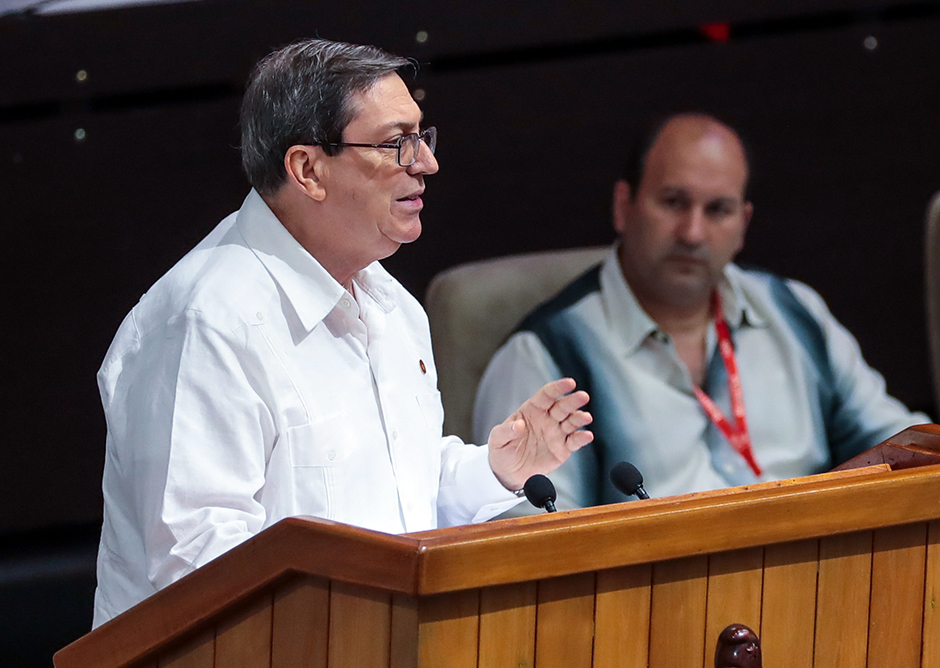
Bruno Rodríguez Parrilla, ministro de Relaciones Exteriores. Foto: Abel Padrón Padilla
Foreign Minister Bruno Rodríguez Parrilla stated on Wednesday before the National Assembly of People's Power that the international political context in which the Cuban Revolution defends and represents the interests of the people "has worsened significantly," as he addressed the current situation and the international scenario regarding Cuba.
At the start of his address, the foreign minister highlighted that the recent speech delivered by the President of the Republic, Miguel Díaz-Canel Bermúdez, on July 26, as well as the debate held on July 7 at the United Nations General Assembly, demonstrated, in his view, the nature of the blockade and U.S. policy against Cuba.
Rodríguez also emphasized the role played by the National Assembly of People's Power, the Council of State, the Commission on International Relations, and the deputies in carrying out the Cuban state's foreign action and in developing the country's foreign policy.
In his remarks, he asserted that the U.S. government "has made the decision to break down and destroy international law, the United Nations Charter, and the pillars that, for more than 80 years, have guided relations between States on the basis of respect for sovereignty and sovereign equality."
The Blockade as a Tool of Pressure Against Cuba
The minister said that Washington has resorted to intimidation, coercion, unilateral coercive measures, trade tariffs, and military force to impose its will, and noted that this conduct reflects a doctrine he described as "peace through force."
He also criticized a recent U.S. State Department report on Cuba, which he described as "superficial, petty, and inconsistent," aimed at portraying the island as a threat to the United States and discrediting expressions of solidarity with Cuba.
The foreign minister said the report also seeks to "criminalize sympathy for the Cuban Revolution" and the causes it defends, including social justice, civil rights, the fight against racism, Zionism, war, and oppression. He argued that the report questions Cuba's right to defend itself against imperialist aggression, attacks the humanitarian and solidarity-based work the country has carried out in various regions of the world, and condemns its internationalist contribution to the liberation of African peoples and the fight against apartheid.
Rodríguez said that, for the United States, Cuba represents "a danger because of its example, its resistance, its dignity, and its work of social justice."
In this context, he recalled remarks made by a former Mexican president in July 2021, who said that, regardless of one's position on the Cuban Revolution and its government, the Cuban people "deserve the prize of dignity" for having resisted for decades without submitting. He also recalled that the former president proposed that Cuba be considered a "heritage of humanity" as an example of resistance.
Rodríguez said the hardening of U.S. policy toward Cuba also responds to interests seeking to reverse the revolutionary process, and argued that Washington's current strategy seeks to inflict suffering on the population in order to bring about a change in the political system.
In that regard, he said Washington's aggressive conduct has allowed it to intensify the economic war against Cuba "to the extreme," tighten the energy blockade, restrict opportunities for interaction with other countries, and advance efforts to isolate Cuba from the international economy. He also rejected claims that the country is not facing an energy blockade, calling such assertions false.
The foreign minister described the international scenario as "very dangerous" and recalled words spoken by President Miguel Díaz-Canel Bermúdez on July 26, when he said that "Cuba is waging a historic battle today, a new Moncada" against "a genocidal policy that seeks to suffocate the entire population in order to seize control of the country."
Nonetheless, he noted that Cuba maintains broad relations of friendship and cooperation with the international community, based on mutual respect, even with countries with which it has political differences.
As an example of international support for the island, he cited the vote held on July 7 at the United Nations General Assembly, when 136 states supported holding a debate on the consequences of the U.S. blockade against Cuba, compared with nine votes against.
Rodríguez said the Cuban people are well aware of the characteristics of U.S. policy toward the island and reiterated that the blockade remains the principal cause of the country's economic difficulties. He also said there is a plan aimed at restricting sources of financial income and access to markets, technology, and essential supplies, including food, medicine, fuel, spare parts, solar panels, and other inputs related to energy generation.
Cuba's Response: Sovereignty, Dialogue, and Peace
The foreign minister said the threat of military aggression against Cuba "remains in effect" and stated that anti-Cuban sectors based in the United States "appear to have no limits" in their intent to intensify pressure on the island.
Rodríguez denounced that Washington's policy seeks to deepen the country's economic and social hardships, and said that those who promote it welcome the difficulties facing the Cuban population, including problems with electricity generation, supply shortages, and other essential services.
The foreign minister reiterated that Cuba remains open to dialogue with the United States on the basis of mutual respect, and noted that the Cuban government has patiently accepted proposals for talks put forward by Washington. At the same time, he questioned the scope of the humanitarian aid offered by the United States and argued that Washington's true policy toward the island is expressed through coercion and an intensified blockade, aimed at inflicting the greatest possible punishment on the Cuban people in order to force their surrender.
"Cuba is not a threat to the United States, nor does it wish to be its adversary or its enemy," said Rodríguez, who emphasized that the country's vocation is peace and recalled the Proclamation of Latin America and the Caribbean as a Zone of Peace, signed by the region's heads of state and government in Havana.
He also stressed that the Cuban state's only commitment is to the people and to the defense of national sovereignty. In that regard, he said the country has the right and the duty to confront any aggression and defend itself if it were the target of a military attack, while reiterating the aspiration to build a respectful and constructive relationship with the United States, based on full respect for the sovereignty of both nations.
The minister also addressed the Cuban community residing in the United States, highlighting the government's efforts to strengthen ties with Cubans abroad. He noted that measures adopted in recent years aim to facilitate their relationship with the country and stem from the conviction that Cubans living outside the island have an important role to play in the nation's development, whether from abroad or should they decide to return to Cuba.
International Support and the Conviction to Resist
In the final part of his address, Rodríguez expressed the gratitude of the Cuban government and people for the shows of solidarity received from every continent. He highlighted the support of governments, parliaments, international organizations, social movements, political parties, friendship associations, civil society organizations, intellectuals, artists, academics, and numerous individuals who, from diverse political and ideological positions, agree in rejecting the blockade and the measures imposed against Cuba.
The foreign minister recalled words spoken by Commander in Chief Fidel Castro Ruz in the early years of the Revolution, when he said the Cuban people would resist the blockade "for as long as necessary" without giving up their independence or their principles.
Rodríguez stated that defending independence, the Revolution, socialism, and the very existence of the Cuban nation requires understanding the complex international scenario and acting accordingly.
He also reaffirmed Fidel's conviction that "a better world is possible," free of blockades and policies that punish peoples.
As a closing note to his address, he called for maintaining confidence in victory and in the Cuban people's capacity for resistance, and quoted José Martí to reaffirm the commitment to continue the struggle for a "free and prosperous" homeland.
Añadir nuevo comentario