
Thousands March in Mexico City Against the Embargo and War: "Oil for Cuba!"
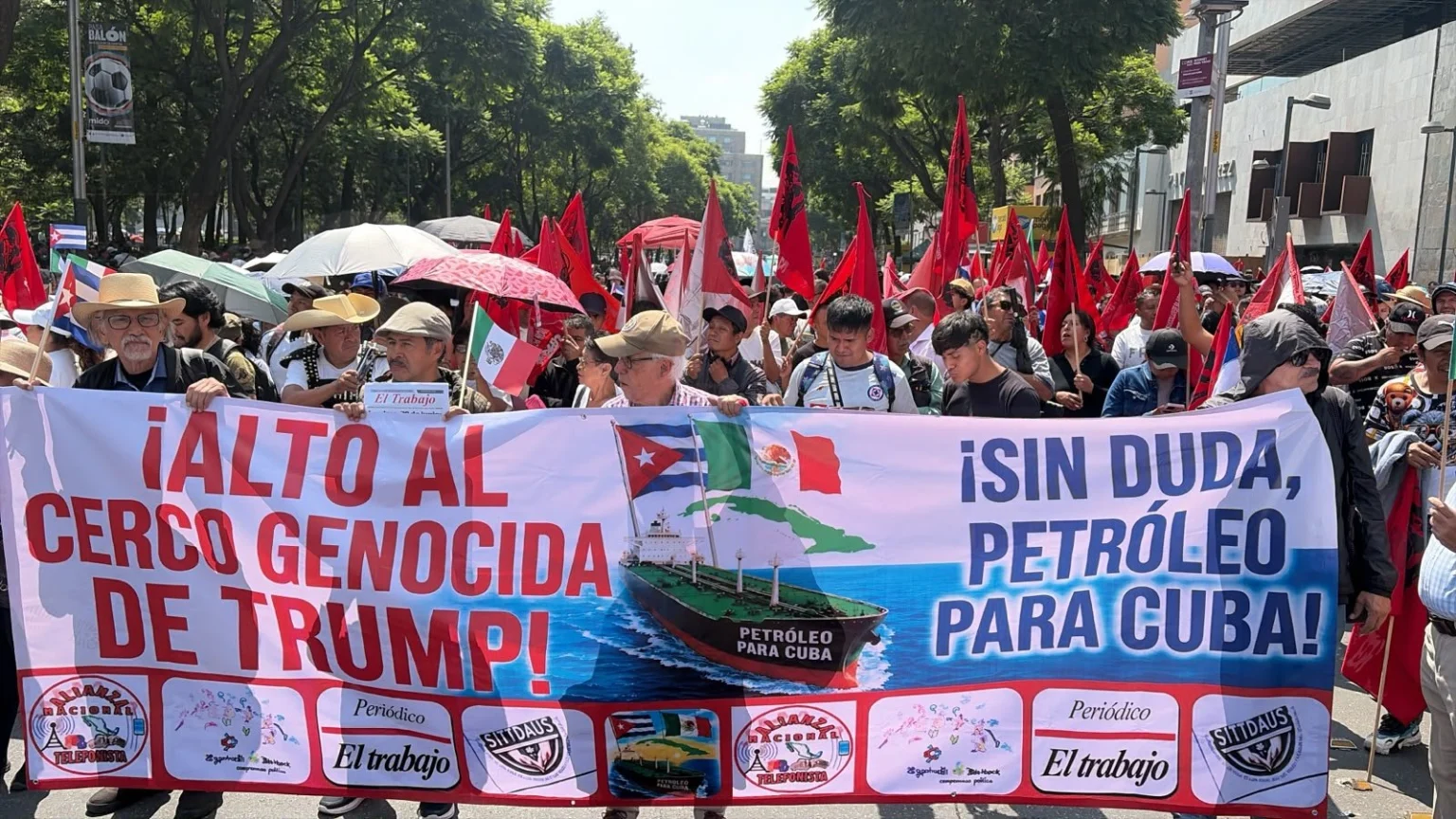
Entre las pancartas desplegadas por miles de manifestantes se leían mensajes como «No a la guerra contra Cuba ¡Abajo el bloqueo! ¡Defender a Cuba es defender a México», «Unidos por Cuba. ¡Abajo el bloqueo!», «Alto al cerco genocida de Trump. Sin duda, Petróleo para Cuba», «¡Alto al Sionismo y al Imperialismo! ¡Vivan los pueblos que Resisten!», «No a la Invasión» y «¡No a la guerra contra Cuba! ¡Abajo el Bloqueo! ¡Defender a Cuba es Defender a México!». Foto: EmbaCuba México.
A march and solidarity rally brought together thousands of people in Mexico City this Sunday during an event for the 73rd anniversary of the assault on the Moncada and Céspedes barracks—which in 1953 initiated the path to the 1959 Revolution—where growing international rejection was expressed against the United States blockade of Cuba, pushed to extremes in 2026.
The mobilization, backed by more than 100 organizations, began in the morning, heading toward the former US Embassy. The massive parade along Paseo de la Reforma and the solidarity gathering served to demonstrate support for peoples in resistance, including Palestine, and to repudiate Zionism and imperialism.
“The solidarity mobilization of all sister nations is becoming urgent, because we must defend Cuban sovereignty, but in that process, also the sovereignty of all countries and the right to self-determination,” Francisco Rosas, coordinator of the Colectivo Solidaridad Militante Va Por Cuba, stated to La Jornada.
Olivia Garza, vice president of the José Martí Association of Cuban Residents in Mexico, affirmed that this July 26th they took to the streets in a unified march to denounce that the true threat is the blockade imposed by the United States on the Caribbean country for more than six decades.
“Cuba is not alone. Cuba is not a threat; the blockade is. The solidarity of the Mexican people is present in this battle that we must make grand in the face of imperialist aggression,” the activist affirmed.
Among the banners displayed by thousands of demonstrators were messages such as “No to the war against Cuba! Down with the blockade! Defending Cuba is defending Mexico,” “United for Cuba. Down with the blockade!” “Stop Trump’s genocidal siege. Without a doubt, Oil for Cuba,” “Stop Zionism and Imperialism! Long live the resisting peoples!” “No to the Invasion,” and “No to the war against Cuba! Down with the blockade! Defending Cuba is Defending Mexico!”
Members of the Association of Cuban Residents in Mexico gathered at the Hemiciclo a Juárez alongside agricultural and solidarity organizations, waving Cuban flags, demanding respect for the island's sovereignty, and chanting slogans such as “Cuba yes, Yankees no!”
At the monument, a Tlalmanali altar (from the Náhuatl “offering to the earth”) was also set up, where attendees performed a ritual honoring the cardinal directions of Indigenous peoples.
During the peaceful mobilization of civil and solidarity organizations, there were also graphic displays rejecting Donald Trump and his Secretary of State, Marco Rubio, the main proponents of the genocidal escalation against Cuba; denunciations of the blockade's effects on the Cuban population; and calls to end the unilateral coercive measures seeking to suffocate the Caribbean nation.
Other banners unfolded in the massive demonstration along Mexico City's iconic avenue recalled the threats of invasion hanging over Cuba—threats increasingly frequent in the rhetoric of Trump, Marco Rubio, other members of the Republican administration, and even media outlets.
The mobilization in the Mexican capital was one of several that took place this Sunday on the occasion of National Rebellion Day in Cuba and in rejection of the increasingly tight economic and energy siege by the US against the island, which uses collective punishment, shortages of food, medicine, and oil, and permanent hostility to force a social explosion and regime change.
National Rebellion Day and solidarity with Cuba also brought together social and political movements in cities across Europe and Latin America, such as Paris, Rome, Milan, and Valparaíso.
Cuba: Decades of Giving Solidarity, Even Under Blockade and Aggression
In many of these events, alongside reviews of the Revolution's history, milestones were remembered, such as Cuba's care for thousands of children affected by the Chernobyl nuclear disaster, the more than 200,000 Cuban doctors and health specialists who have supported more than 160 nations since the 1960s—including disaster situations and the COVID-19 pandemic—and the thousands of children and youth from the Global South who have studied on the island.
Participants in the mobilization recalled that the Revolution led by Fidel Castro and the reforms it undertook (from agrarian reform to the nationalization of banks, sugar mills, and strategic companies) ran counter to US interests, which from the very beginning sought to overthrow the emancipatory process.
In a statement signed by a hundred organizations, collectives, trade unions, and political parties, it was noted that Trump's offensive began during his first term, when he implemented more than 240 coercive measures against Cuba—a policy that has been reinforced in 2026 amid an interventionist strategy toward Latin America and the Caribbean, the Trump corollary to the Monroe Doctrine, and the coordination of the far right to criminalize all forms of opposition.
Starting in January 2026, the Trump administration imposed an oil embargo on Cuba, under which the island has received only one tanker of crude oil so far this year. This has been compounded by several waves of sanctions under executive orders, such as the one signed by the US president on May 1st, which reinforces the internationalization of the blockade by threatening sanctions against individuals and companies that maintain relations with the Caribbean nation.
The sanctions have been specifically targeted against areas such as energy, tourism, foreign investment, remittances, finance, and medical services, alongside diplomatic pressure campaigns against Cuban medical cooperation and new attempts to link Havana with terrorism and threats to US security.
The US escalation, denounced as a crime against humanity and a violation of international law and free trade, has driven fuel shortages in Cuba to extremes, causing severe power generation deficits, paralysis in economic activity, and a crisis in transportation, hospital services, food distribution, and water supply, among other vital sectors.
Añadir nuevo comentario