
Michel Moro: "The Mindful Eye"
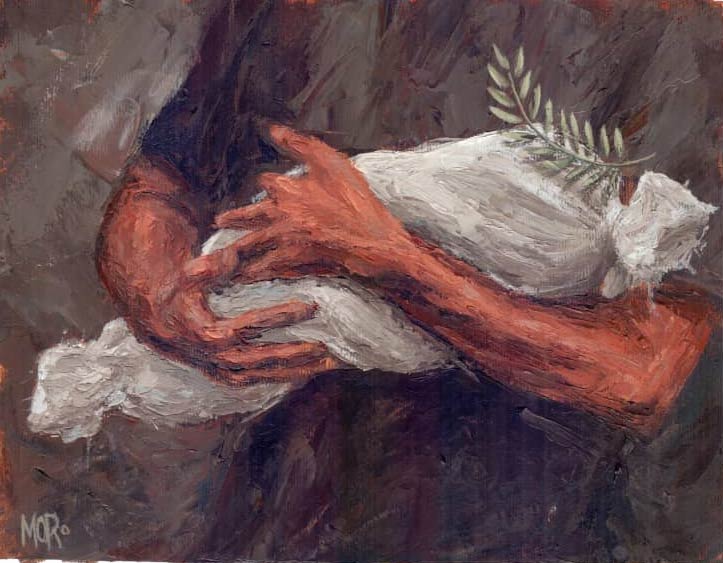
Obra de Michel Moro.
"The Mindful Eye" is the title of the most recent solo exhibition by Michel Moro, which opened at the Galería Espacio Abierto last June as part of the II International Biennial of Political Humor.
Michel Moro (Ciego de Ávila, 1988) graduated with a degree in Conservation and Restoration from the University of the Arts (ISA) in 2016. However, his career as a draftsman, painter, and graphic humorist began a few years earlier while still a student, when he joined the team of the humor supplement "La Ubre" in the newspaper La Calle del Medio, publishing his first satirical drawings. A decade later, his name is an unavoidable benchmark within the Cuban graphic humor landscape and, increasingly, on the international stage as well.
A brief review of his resume yields relevant data for those who prefer to evaluate an artist's work quantitatively: he has won more than forty international awards, including First Prize in the gag category at the World Press Cartoon 2022 (Portugal), First Prize at the 3rd Niko Nikolla International Cartoon Biennial 2024 (Albania), and First Prize at the II LEA Festival Humor Salon 2025 (Athens). In Cuba, he has won the Grand Prize at recognized competitions multiple times and chairs the graphic humor section of the Union of Writers and Artists of Cuba (UNEAC). Additionally, he represents the country at the Union of World Cartoonists (UWC).
The works currently on display at the Espacio Abierto gallery, located at the headquarters of Revolución y Cultura magazine, confirm his maturity as an artist, not only on a formal level but also conceptually. These nearly thirty pieces span his last three years of work—drawings mostly created for publication in various media that address political and social issues of universal scope.
Each work, in the words of critic Maykel José Rodríguez, "tells a story or at least a fragment of it, but all of them force us to decipher possible meanings skillfully camouflaged behind the anecdotal and the everyday, the fantastic and the surreal, with the occasional intertextual nod to significant works within Western art history."
On the occasion of this exhibition, or rather using it as a pretext, I outlined some questions to talk with Michel Moro about topics of interest regarding his work and graphic humor in general.
Let's go back to the beginning. How did you arrive at graphic humor?
Long before I even thought about studying art, I liked graphic humor—the kind that appeared in the press or that I saw in books. I started publishing while studying at the Higher Institute of Art (ISA), searching and observing online the graphic humor made by many authors, what was published in the press, and what was shared on social media. I found a way to express ideas effectively; it became a necessity.
You are a graduate of the "Raúl Corrales" Provincial Academy of Fine Arts in Ciego de Ávila, but later you studied Conservation and Restoration at the University of the Arts (ISA). Do you consider that those studies complement your career as an artist in some way?
Those years were very important to me. Being in a context like ISA—a cultural, academic environment in the capital—was where I decided to start doing graphic humor. I was studying restoration, which is more about craft, knowledge, and technique, but I came across the work of many emerging artists. All of that feeds you. Plus, the technical and historical knowledge from the degree is useful for my own work.
A few years ago you mentioned in an interview that at first you approached humor through drawing, whereas now you develop it much more through painting. What drove that evolution?
I think drawing remains the foundation of my work. I've incorporated more plasticity; let's say visually they are more painterly images, but I still start with a stroke. A few years ago I began illustrating books at a fairly steady pace. To illustrate, I looked for more painterly solutions, and after two hundred illustrations, it was inevitable that it would permeate the overall style of my work, consolidating it.
I'd like you to comment on your creative process, from when you start turning an idea over in your mind until you finally execute it...
I make a lot of sketches. Most of them don't make much sense, and with others I repeat many variations of the same idea. It's the basic exercise, the one that takes the most work and is the most valuable. Sometimes I leave many pages of these sketches to "age" so I can look at what I did later with fresh eyes. Then, creating a piece or a panel takes less time and effort. It's an enjoyable process.
I work mostly with a palette knife and acrylics, with a few touches of a paintbrush.
I assume that publishing regularly in the press and your book illustration work for Grupo Pandora Editorial impose a strong, or at least different, work rhythm. What has this experience brought you?
My experience publishing in the press and editorial work in general have given me the opportunity to draw immediate topics and certain themes I might not have approached through free creation. Although not with the daily consistency I've seen caricature artists work with in other countries, these assignments have acted as creative constraints because I've had little time before publication. That forces me to work quickly, albeit sporadically, on each request.
Overall, I set my own working pace depending on a topic or how the "fishing" for ideas is going. In illustration I work daily, but it's an exercise of pleasure and playing with forms and materials.
Just a few days ago you received a mention at the VI Denizli International Cartoon Contest in Turkey, which focused on soccer this year. Regarding themes, do you prefer working from a specific prompt or spontaneously?
Yes, I really like creative prompts. I see them as a challenge I happily accept because imagination sometimes flies better within those "limits." I also work freely a lot—looking for ideas, making sketches—but in the end, you create your own paths or themes in your mind.
Are there topics that obsess you in particular?
I'm obsessed with themes, even images: objects, war, violence, politics...
What about taboo topics?
Within graphic humor, I don't think there are taboo topics; there shouldn't be. Everything can be addressed: from religious topics to the most tragic or mundane. Where one must be more careful is in how they are addressed—not being crude or simplistic. I say this from personal experience. And I say simplistic, not simple, because simplicity can be very good and has its charm. It must be a reflective exercise on the author's part so that it becomes one for the consumer as well.
Why do you think graphic humor tends to get pigeonholed so much, not only formally, but also regarding distribution spaces?
I think graphic humor gets pigeonholed because traditionally it was made for the press. For many years, that was the case. Since the 19th century, great authors separated their drawings for the press from their works for galleries. Additionally, historiography separates expressions for study. All of this is rooted in tradition. I think it's a debate that should be overcome. Certainly, graphic humor has its own characteristics to function and deliver a message to a broad audience, but in the end, it stems from an idea, an expression, and that is art in general.
Regarding that last idea, does it worry you that your work might be pigeonholed within a reductionist view of graphic humor?
I think getting pigeonholed is inevitable. There are always prejudices and fixed ideas about graphic humor; critics, historians, and many people in artistic circles tend to view graphic humor as a poor cousin of "Grand Art." Fortunately, many of these historians and critics have a broader vision.
That debate stems from its dual condition as both art and editorial/press creation. In Cuba, it is considered more of an art form, but in many Latin American countries and other regions, it is seen simply as drawings for a newspaper or magazine. How many artists over the centuries have had graphics, humor, or illustration as part of their body of work? Many. Among the greatest: Picasso, Daumier; and in Cuba, Abela, Adigio Benítez, just to name a few historical examples.
Cuba is a country with a strong tradition of graphic humor. The large number of international recognitions that most Cuban graphic humorists continually receive is striking, regardless of their generation. Why do you think this is?
Yes, we are a country with a deep tradition in graphic humor. I think it's due, first of all, to the great talent that constantly flourishes in Cuba, and the need to communicate through humor, which is inherent to the Cuban identity. I also think it's due to the many issues that affect us from Cuba and that cultural mix. After the triumph of the Revolution, an immense cultural flow opened up that allowed graphic humor to grow in themes and venues.
When it comes to international exhibitions and awards, our way of making graphic humor—often wordless, a legacy of what was done in Eastern Europe to avoid censorship and express ideas intelligently—is perfectly understandable in any culture or nation. Additionally, our island condition always pushes us to test ourselves in the world through our art.
Do you think that, generally speaking, there is a code or a specific way of creating humor exclusive to Cuban graphic humor?
I don't think so. There are many authors with strong, peculiar, and excellent styles, but generally, I don't think there's something that makes you say, "This was made by a Cuban." We are quite similar to what is done in the rest of the world, though with a lot of talent and a wide variety of styles.
This is a question you've been asked before, but it can be a good exercise to answer it every now and then: what is your opinion on the graphic humor festivals organized on the island?
I think the graphic humor festivals organized in Cuba (Melaíto, San Antonio Biennial...) do not escape the crises that have hit Cuba in recent years regarding logistics and budgets. The survival of these festivals depends heavily on institutional willpower and the reach of national and international calls. Participation is important because it turns graphic humor exhibitions into a showcase for the best being produced. It depends not only on willpower, but also on the sensitivity of those organizing them within institutions. Festivals in Cuba should reflect our vast tradition of graphic humor.
How do you see yourself a few years from now?
I see myself working, drawing, painting, doing graphic humor. I can't imagine or dream of myself any other way. I want to paint more, work in larger formats, and exhibit, of course. In short, continuing to have time and clarity for my work. That simple (or complex).
Translated by Sergio A. Paneque Díaz / CubaSí Translation Staff
Añadir nuevo comentario