
Speech by President Díaz-Canel at the Closing of the PCC Central Committee Plenary
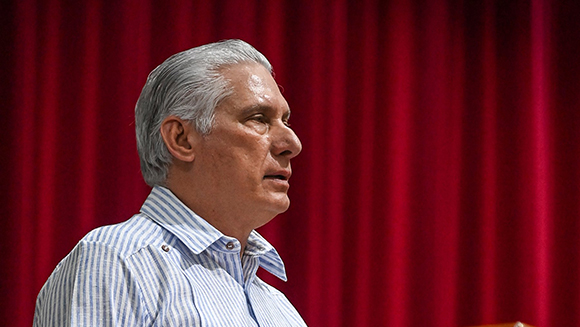
Miguel Díaz-Canel Bermúdez
[The following is a translated and condensed version of the full speech delivered at the Palace of the Revolution on June 17, 2026.]
Comrades and invited guests:
This Extraordinary Plenary takes place on decisive days for Cuba. Proud heirs of the legacy of the Commander in Chief, Cuban revolutionaries today face challenges of enormous magnitude that demand unity, ideological firmness, courage, audacity, and creative resistance. We count on the guidance of our leader, Army General Raúl Castro Ruz, who has taught us every day the sacred value of unity.
The context is extraordinarily complex and challenging due to the incessant aggressiveness of the intensified economic, commercial, and financial blockade imposed by the U.S. government, and the criminal purpose of the hostile actions of the current administration: first, Cuba's inclusion on the infamous and spurious list of state sponsors of terrorism, and other equally false accusations seeking to discredit the authority and management of the Government, while depriving the country of any source of foreign currency income. A blockade further intensified by the Executive Orders of January 29 and May 1, which support the genocidal energy siege and internationalize the blockade with secondary sanctions, financial, energy, and investment persecution to extremes of maximum pressure.
The silent genocide undertaken against Cuba causes immeasurable damage and terrible limitations in our daily life as a people, while its executors lie blatantly to the world denying the energy siege and claiming we prohibit the entry of multimillion-dollar donations they announce loudly but have barely delivered.
Cuba resists heroically and creatively, but suffers for too long a barbaric, undeserved, unbearable punishment, to which is now added the threat of military aggression as a new weapon against collective resistance.
Reality imposes urgent and necessary changes upon us. When the people's life becomes so hard, the first duty of the Communist Party and the revolutionary Government is not to better explain the crisis, but to change what must be changed to overcome it. A deep and agile economic agenda is required, executable in the short term, combining macroeconomic stabilization, incentives to stimulate and promote productive opening, legal security, investment attraction, intensive use of technology, and focused and effective social protection.
The transformations we are presenting are to advance in the defense of socialism, to support and expand social justice, to create economic wealth and distribute it equitably. If there is no wealth, there is nothing to distribute. Social justice as conceived by the Revolution, with its humanist vocation, helping the most disadvantaged through welfare programs and free services, does not cost individuals, but it costs the State. To do it, to deepen it, to sustain it, the State needs wealth. If there is no wealth, there is no social justice, and everything else is a story.
We need to unleash productive forces, more production instead of more restriction, because it is proven that control without supply only displaces operations to the informal market. Equality and integration of economic actors are necessary in function of the National Economic and Social Development Plan until 2030 and territorial and local development strategies by state enterprises, MSMEs, cooperatives, agricultural producers, foreign and Cuban investors, residents or non-residents: all must act and contribute under clear rules to the country's socioeconomic development.
We must export and produce to capture and earn foreign currency and make productive use of it. Legal security must be guaranteed: contracts, usufruct, leases, concessions, surface rights, and licenses, with temporal stability and protection against arbitrary changes. Without legal security, no one invests, no one takes risks.
We need to advance on at least five simultaneous fronts: macroeconomic stabilization and recovery of external income; transformation of the Economic and Social Model; stimulation and recovery of the agricultural productive sector; strengthening of accounting and cost management; and anticipation and mitigation of social costs associated with the necessary transformations.
The Commander in Chief taught us that in times of crisis we could not renounce either development or thought, that there is no insurmountable obstacle and there is always an opportunity to grow. And on that path, the Army General showed us that yes, we can, we could, and we always will be able to.
The people know the causes of many of the difficulties we live, but they also need concrete answers, timely decisions, and results felt in daily life. There are obstacles that do not come from outside or from the blockade. There is slowness, bureaucracy, norms that hold back those who want to produce, and decisions we have postponed. What depends on us, we have to change ourselves, and we have to change it now.
To resistance we owe the homeland, but today resistance alone is not enough. This time demands that we transform, produce more, unblock more, listen more, decide better, and render accounts. What we propose to set in motion is an emergency economic and social agenda, with measures that are part of our Government Program and policies approved by the Party, along with decisions that cannot keep waiting.
Regarding the System of Economic Direction, the most important thing is that central planning, if we adopt these transformations, would not have the function of administering the economy, but of creating an adequate institutional and regulatory environment so that enterprises and workers are stimulated to produce goods and provide services with quality and efficiency, as well as to introduce innovations in their management for these purposes.
We will continue the restructuring of the Government apparatus, the State, the Party, and institutions. We will integrate structures where necessary, review duplicate functions, reduce unnecessary steps, and permanently optimize the way the country is directed and served. One of the most important and urgent tasks is to enhance the country's development from the base, from the municipalities.
No economic change will be sufficient if the socialist state enterprise, which will continue to be the fundamental pillar of the economy, does not have true capacity to manage, innovate, and be accountable for its results. Reforming state enterprise management on the basis of real autonomy, economic-financial evaluation, separation of state and business functions, and application of the principle of compliance or explanation is necessary.
There is no sovereignty with an empty plate. The food of the Cuban people will be treated as what it is: a matter of national security. Idle lands in Cuba must come to an end. Every piece of land today covered in marabú, when it should be producing food, will have to give a clear answer: either it goes into production or it is handed over to someone willing to do so. To the farmer, we cannot keep asking for more food with fewer tools and prices below costs. We have to make land an opportunity, not a burden.
In foreign trade, exports, logistics, and value chains, we must authorize direct import and export for state and non-state enterprises, maintaining technical and fiscal requirements but eliminating mandatory intermediation. We will also significantly streamline the creation of economic associations between state and non-state management forms.
Foreign investment is also trapped in a web of obstacles that hinder its necessary increase. We should not only tell the foreign investor where to invest, but also let them take the initiative to invest in the economic branch of their interest, as well as directly choose their workers without state intermediaries. We will authorize direct foreign investment in the national private sector, including MSMEs, with clear rules on property, repatriation, reinvestment, and dispute resolution.
The blackout is not only a problem of megawatts or generation deficit. The blackout is the child who could not study for the test, the food that spoiled in a refrigerator, the elderly person who spends the night awake without rest and in heat. It is the hospital working at its limit, the clinic that cannot preserve a medication, the worker who loses their workday, and the establishment that has to close. That is why energy is not a technical issue; it is a human, economic, and national issue.
We will accelerate the incorporation of solar energy into the national economy. We will facilitate the direct entry of foreign companies supplying panels, batteries, inverters, and associated solutions. Tariffs on imports of solar technologies, storage systems, and equipment destined for energy savings have already been eliminated. We will also advance in eliminating taxes on their sale and on services linked to installation and maintenance.
We will promote electric transport linked to renewable sources. Any electric vehicle destined for public, private, or light cargo transport that demonstrates it operates totally or mostly with solar energy will be eligible for special incentives.
The first priority, before any other, is people who cannot wait for the economy to improve, because there are pains that do not understand deadlines. True social justice is not sustained on artificial prices that end up becoming scarcity, lines, low wages, and illegal markets. Social justice is built on real bases: income with purchasing power, direct protection for those who need it most, and a national economy capable of producing more. There are no shortcuts.
The basic food basket will be guaranteed to retirees, families with chronically ill children, and vulnerable groups. Focalized programs for social transformation in the poorest neighborhoods will be developed. We will open new channels for safe access to medicines.
Regarding fiscal, tax, monetary, and financial cleanup policy, the main objective to reduce the fiscal deficit lies in increasing production, which is the basis of taxes, and reducing unnecessary budget expenditures. We will also correct a policy that did not yield expected results. Price caps in practice failed to contain inflation. We will advance toward a creditable Value Added Tax (VAT) progressively supported by electronic invoicing, to avoid cascading fiscal imposition. But these decisions can only be applied together with more direct, more effective social protection, transitioning from subsidizing products to subsidizing people, and with the effort to recover the purchasing power of wages and pensions.
We need a financial system that accompanies the economy, that is functional for different economic actors, that reduces lines, facilitates payments, makes operations transparent, and turns savings, credit, and investment into concrete development tools. We will modernize the banking and financial system. Cuba needs more agile, more digital banks, closer to the people and more useful for those who produce, export, import, invest, or undertake.
We will make digital transformation, software, and artificial intelligence transversal tools to develop agriculture, the energy sector, health, education, foreign trade, banking, digital commerce, logistics, tourism, and auditing.
In tourism and real estate, new business modalities must be applied, with participation of all economic actors. A regulated productive real estate market will be developed.
I know there is justified concern about the partial dollarization of the economy, inflation, and the absence of many products in national currency. We will not ignore that problem. The business models we are authorizing in foreign currency must contribute directly and verifiably to an increase in foreign currency income that allows the sustenance of offers in national currency.
We must eliminate salary obstacles that prevent retaining talent and highly qualified labor in productive, export, technological, energy, and agroindustrial sectors.
Comrades:
Cuba does not need more delays; it needs solutions. This is not about creating more offices or multiplying meetings, but about achieving concrete results. Governing is solving, unblocking, accompanying, and making decisions become real improvements.
Alongside economic opportunities, we will also promote concrete spaces so that young people can act from their communities. The Community Youth Network should be a path for a young person to find training, employment, service to their community, and a way to turn an idea into a real project.
We know our country. We know where the obstacle is, where corruption hides, where slowness abounds, and where shame and dignity are lacking.
Each measure we announce will have responsible parties, deadlines, and indicators. We will report on progress, on what is not fulfilled, and on what must be corrected.
As a people, we are not only going to call ourselves to resist; we are going to call ourselves to create, to produce, to decide, to audit, to prosper, and to transform, because what we begin today is not done by a Government alone; we all do it or we do not do it at all.
We are not going to deny problems, we are not going to defend bureaucracy, we are not going to close the door to talent, we are not going to abandon the vulnerable, and we will never allow the suffering of this people caused by the perverse imperialist blockade to be used against the sovereignty of the homeland.
Nothing will be impossible if we assume the challenge as an opportunity and history as inspiration. Céspedes, Agramonte, Maceo, Gómez, Martí, Mella, Villena, Guiteras, Che, Camilo, Almeida, Fidel and Raúl, all our heroes, faced moments as difficult or more so for their time than those the new revolutionary generation faces today, and all emerged from those challenges with honor and glory.
In the Centenary of the birth of Commander in Chief Fidel Castro and the 95th birthday of Army General Raúl Castro Ruz, the best homage we can pay to the admirable work of our two historic leaders is to defend it and preserve its essence of social justice.
We are all called, and together we will overcome.
Viva Cuba Libre!
Viva the heroic Cuban people!
Viva the sovereignty of the Cuban nation!
Socialism or Death!
Homeland or Death!
We shall overcome!
Añadir nuevo comentario