
Impossible to Change Cuba's Destiny by Force of Arms
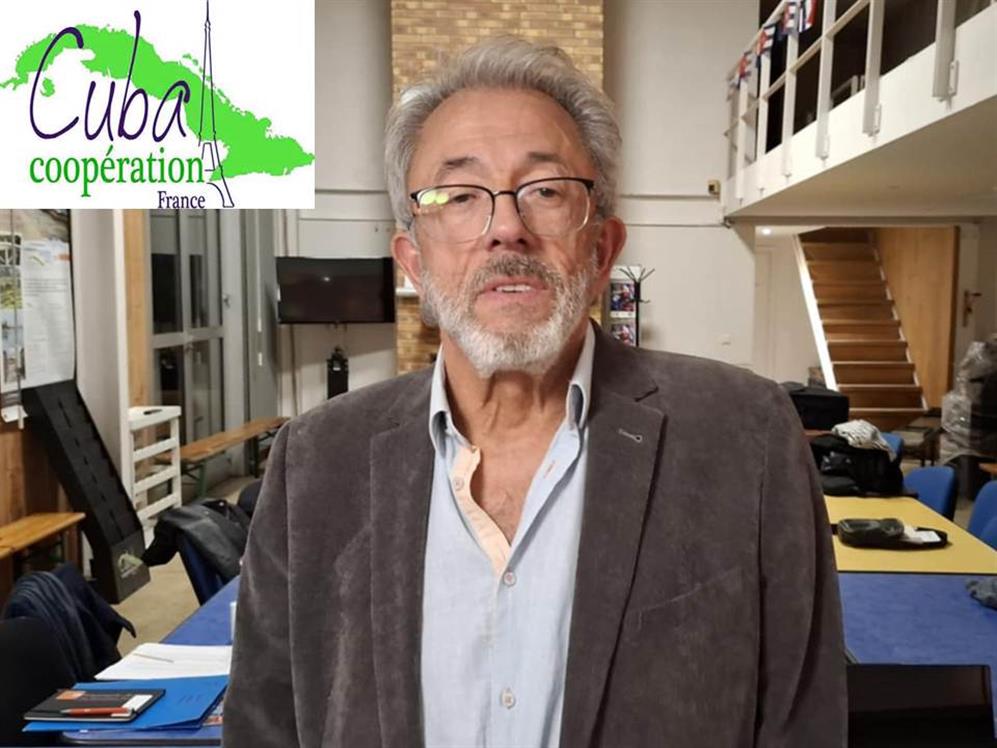
Manuel Pascual, presidente de la Asociación Cuba Cooperación Francia.
It would be impossible to change the destiny of a country like Cuba by force of arms, declared today Manuel Pascual, president of the France-Cuba Cooperation Association, in exclusive statements to Prensa Latina.
Referring to U.S. punitive measures against Cuba's government leadership, including President Miguel Díaz-Canel and Revolution leader Raúl Castro, Pascual asked: "What could one even say about fascism?"
"I think that if tomorrow the United States sent its troops or dropped tons of bombs, we know that Cubans would by no means allow their country's destiny to become part of the United States," he asserted.
The French activist stated that Washington has repeatedly called Cuba a terrorist country, but "what does it mean to be a terrorist?" Pascual asked, alluding to Washington's inclusion of Cuba on the spurious list of countries that support that scourge.
"Is the terrorist the one who defends his country or the one who attacks another nation?" the activist commented, also questioning whether one could be considered a terrorist when acting in defense of one's own land.
"It is precisely the United States that are the terrorists, because they are the ones who invade a country," denounced the president of Cuba Cooperación Francia.
"Although the United States invaded Venezuela, it would be very different if that northern country tried the same in Cuba because it is a sovereign nation, and you cannot change a country's destiny with weapons," he stressed.
Cuba's destiny is not decided by the United States, but by the people of that Caribbean island, the activist added.
Necessary aid in difficult times
Referring to his association's work, he noted that its primary function is to facilitate cooperation between the Cuban and French peoples amid the intensified U.S. blockade against the Caribbean nation.
But now, he clarified, "with the existing situation in Cuba, we also dedicate more time to solidarity work proper."
Thus, in 2025, they sent ten tons of powdered milk for children to Havana, along with the same amount of pasta and rice, through the Quisicuaba association, destined for hospitals in the provinces of Holguín and Camagüey.
They also provided support to Guantánamo province after Hurricane Melisa, the French activist stated.
"The most urgent emergency situation now is the energy sector, so we are seeking ways to send many solar panels because buildings and infrastructure cannot function without energy," Pascual declared.
"We hold conferences and festive events to raise money, to which we invite wealthy individuals, including business owners, for that purpose, and we have had donations for Cuba of up to 10,000 euros," he affirmed.
"On June 11, we are organizing an event dedicated to events on the island," said the president of Cuba Cooperación Francia, referring to a pronouncement against the unprecedented escalation of U.S. aggression.
The task also consists of creating conditions for collecting donations, including medical supplies for hospitals or other types of institutions.
Cuba's requests
Additionally, there is the possibility of receiving requests from Cuba: "They send us a list of needs, and we explore whether there are opportunities to send those materials to the island," Pascual explained.
They are also working with a French province, the Camargue, where 75 percent of the 11,000 hectares dedicated to rice cultivation in that nation are harvested, with plans to send this product to the island.
In these cases, they use a cultivation method over 2,000 years old, in which ducks are employed to digest grass in the fields, and then the birds' excrement is used as natural fertilizer. French specialists are now cooperating with their Cuban counterparts to breed this type of duck — which is banned for consumption but useful for fertilizing crops.
Defense of Cuba becomes a challenge
"Every Thursday, our association issues a document with the most updated information on what is happening on the Caribbean island, because many people in France do not know the reality of that country," he noted.
Pascual clarified that traveling to Cuba was impossible for him due to his association with the organization, whose name has caused problems when dealing with banks for purchases for Cuba or financial donations for projects on the island.
Cooperation with Cuba and efforts to deliver aid, despite obstacles placed by Western banks, is "a true sport," he said, alluding to a long race filled with hurdles to achieve success in that endeavor.
Nationally, the 32 committees that make up the France-Cuba Cooperation Association accumulated 32,000 hours of work in 2025. "Everyone works on a voluntary basis; none are professionals," Pascual clarified.
Añadir nuevo comentario