
The Homeland Honors Martí
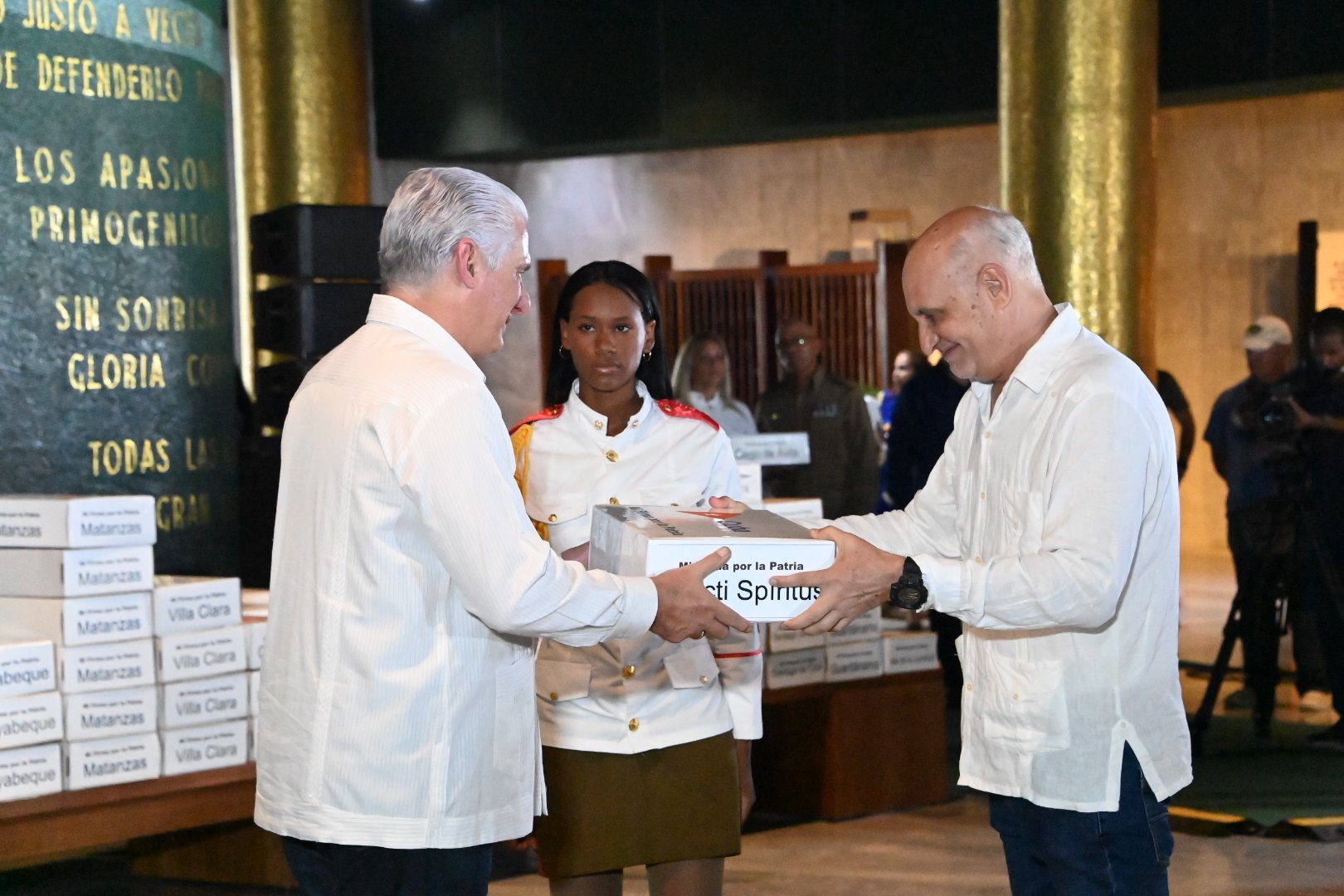
Presidente cubano recibe las Firmas por la Patria de los cubanos.
On this May 19, as the First Secretary of the Communist Party’s Central Committee and President of the Republic, Miguel Díaz-Canel Bermúdez, received the documentary sample of signatures for the homeland, Cuba honored the Apostle of Independence on the 131st anniversary of his fall in combat.
At the José Martí Memorial, representatives of Cuban civil society symbolically placed in the hands of the head of state the forms containing the signatures from the "My Signature for the Homeland" movement, in which more than six million Cubans expressed their rejection of war, the blockade, the energy siege, interference, and annexation.
At the ceremony—also dedicated to Commander in Chief Fidel Castro Ruz in the year of his centennial—the president received a sample of signatures from each province; meanwhile, in the very hall of the Martí and Fidel memorial, all the forms from each territory of the country were present as an expression of a call for peace.
As a prelude to the commemoration, the Cuban president paid tribute to Martí by placing a floral offering at the foot of his monument erected in Revolution Square.
Following that, the solemn ceremony began, with the participation of Politburo members Esteban Lazo Hernández, president of the National Assembly of People’s Power and the Council of State; Manuel Marrero Cruz, prime minister; and Roberto Morales Ojeda, Organization Secretary of the Central Committee.
Also present were other Politburo members, leaders of the Party, the State, the Government, the Young Communists League, mass and social organizations, the Association of Combatants of the Cuban Revolution, the Revolutionary Armed Forces, and the Ministry of the Interior.
The day resonated with Martí’s verses, sung by Annie Garcés, accompanied on piano by musician Daniel Torres and declaimed by actor Denis Ramos, evoking Martí’s thought and his legacy for all time.
MY SIGNATURE FOR THE HOMELAND IS AN EXPRESSION OF DEEP LOVE FOR CUBA
"We are part of a people that has demonstrated an extraordinary capacity to remain steadfast in the face of difficulties and to defend, above all else, independence and national dignity, to the last consequences," began her speech Litza Elena González Desdín, a third-year foreign languages student and president of the University Student Federation.
Representing civil society, the young woman stressed that we live in complex times, marked by economic challenges, external pressures, and constant attempts to discredit the work of the Revolution; but "these are also times that demand we reaffirm our values, our identity, and our deep love for Cuba."
Referring to the "My Signature for the Homeland" movement, she stated that in each signature "the will of millions of Cubans to defend our nation’s right to live in peace and without external interference has been embodied."
"It is also a signature for justice. It is a signature for the defense of our people’s right to life," she asserted.
The student leader emphasized that "it was Fidel who endowed us with that invincible strength, who taught us that the homeland’s freedom must be defended with firmness and consciousness."
"These signatures are also a reaffirmation that we are a generation consistent with the historical continuity of the Revolution," the FEU president stated.
At the end of her remarks, González Desdín affirmed that honoring the legacy of Martí and Fidel, amid threats and aggressions against our country, "means keeping the defense of the homeland alive and firm, with eternal rancor toward those who attack it and confidence in our people’s ability to continue building their future with unity and firmness."
The young Cuban concluded: "My Signature for the Homeland is an expression of deep love for the land that saw us born."
A PEOPLE THAT PUTS ITS SIGNATURE BESIDE MARTÍ DOES NOT BOW OR SELL OUT
"For Cubans, dignity is not an abstract concept: it is the right to independence, to sovereignty, to social justice, to free education, to universal health care, to culture for everyone, to dignified work, to real participation," emphasized Ana María Mari Machado, vice president of the National Assembly of People’s Power and the Council of State, in her speech.
Delivering the central remarks of the ceremony, she said, "Those who from the North try to subjugate us with the cynicism of the blockade, with arbitrary lists, with false democracies and the bartering of consciences, do not understand that a people that has put its signature beside Martí does not bow or sell out."
The legislator recalled that more than six million Cubans—from the young person studying at university to the peasant in the mountains, from the factory worker to the intellectual, from the self-employed worker to the retired combatant, the religious, athletes, artists, laborers, intellectuals—participated in the mobilizing and popular process, where "we put our signature, first name, last name, fingerprints of dignity on every sheet."
Those signatures are the collective consciousness of a nation that says "no to interference," "no to covert colonialism and annexation," "no to exclusion lists," "no to the pretension of governing us from abroad," Mari Machado stated.
Then she noted: "These are not signatures gathered by the Party or the Government. These are signatures driven by the people themselves, by their grassroots organizations, by their communities. They are Cuban civil society—that which is so misunderstood in the North—expressing itself without intermediaries."
"Dignity is not implored; it is exercised. It is not begged for; it is defended. It is not negotiated; it is lived. And as long as there is a dignified Cuban, there will be a homeland," concluded the vice president of the Cuban Parliament.
THE HEART OF THE HOMELAND IS CALLED MARTÍ
On the afternoon of this Tuesday, May 19, before compatriots committed to the defense of the homeland, renowned artist Roly Peña presented his new audiovisual work as a tribute to the Master.
The premiere of the ten-episode series, "The Mystery of a Man," was the result of the passionate dedication of its director and the entire production team, who confirm with their work that, in this hour of the homeland, we recall with Martí that true peace is only possible when peoples conquer their freedom and defend it with decorum.
Then, before delivering to the President of the Republic and other members of the leadership a poster of the audiovisual series that reveres the most universal of Cubans, the renowned artist and filmmaker Roly Peña thanked the audience for allowing him to present the first episode in "this significant place that holds the heart of a people."
"Martí must always be brought closer to children, to young people, to all Cubans, because the heart of the homeland is called Martí." And those deep, heartfelt words gave way to the testimonies of a documentary series that brings us closer to the mysteries of an essential man for Cuba.
Añadir nuevo comentario