
Trump's War Against Iran: Aimless, Chaotic, and Improvised, Warns the NYT
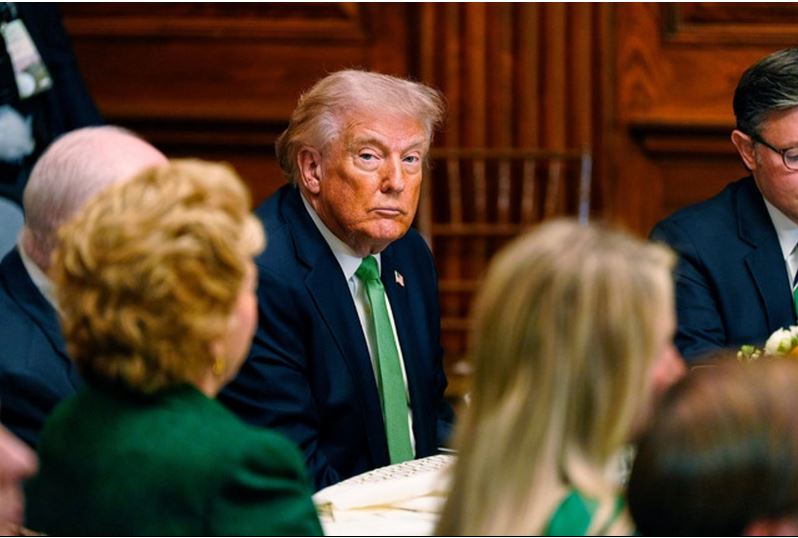
El consejo editorial del diario New York Times, integrado por reconocidos periodistas, publicó un mensaje en el que advierte que el presidente Donald Trump "no tenía ninguna estrategia definida”, al declara la guerra a Irán. Foto: Ap
United States President Donald Trump declared war on Iran "without explaining his strategy to the American people or to the world. Now it appears that, in reality, he had no defined strategy at all," the editorial board of The New York Times wrote on Tuesday.
Nearly three weeks into the conflict, Trump has no apparent plan to bring about the fall of the Iranian regime — something he claims to be seeking. If his objective is more modest, such as the seizure of Iran's nuclear materials, he has offered no credible ideas for achieving it. Nor has he anticipated an inevitable consequence of a war in the Middle East: the disruption of oil supplies, which is driving a sharp increase in prices and damaging the global economy.
Trump has not even begun to explain how he intends to accomplish any of these goals. His supporters argue that his evasiveness is a tactic to preserve his options and keep his adversary in a state of uncertainty. Increasingly, it appears evident that the President of the United States has launched a war with no idea how to end it, the editorial stated.
The conflict has become emblematic of Trump's chaotic and self-centered approach to the presidency. He consulted a narrower circle of advisers than previous presidents when ordering military action, disregarded the rigorous review process designed to surface objections and potential problems, made ridiculous and contradictory public statements — including the claim that the war has nearly achieved its objectives — and attempted to deceive the world regarding the tragic deaths of dozens of Iranian schoolchildren caused by a misdirected American missile. "Almost daily, he demonstrates why he cannot be trusted with the most consequential affairs of government," the board wrote.
Nevertheless, the war has achieved some tactical successes, and the board acknowledged it is important to recognize them, even if they are not tied to any concrete strategy. The Republican's instincts regarding Iran were accurate in several respects. The Iranian government is clearly dangerous, having spent decades oppressing its own people, sponsoring terrorism, attempting to destroy Israel, turning Lebanon into a failed state, protecting an atrocious regime in Syria, and developing a nuclear program. Trump also correctly identified that the Iranian regime was weaker than it appeared and could be further weakened through confrontation.
In recent years, a combination of economic sanctions imposed by the United States and its allies, along with military strikes — primarily by Israel — has eroded Iran's capacity to generate regional instability. The value of its currency has collapsed. Many of its leaders and nuclear scientists have died. Its air defenses are largely destroyed and its missile arsenal has been depleted. Two of its allied terrorist groups, Hamas and Hezbollah, are severely weakened. And its satellite state in Syria has been overthrown by local rebels.
Yet in launching this war two and a half weeks ago, the president claimed to have far more ambitious objectives than simply containing Iran. "To the great and proud people of Iran, I say tonight that the hour of your liberation is near," he declared shortly after the first strikes. He demanded the unconditional surrender of the Iranian government, stated that he must approve the country's next leader, and promised to restore Iran to greatness.
The editorial board is a group of opinion journalists whose perspectives are informed by expertise, research, debate, and certain deeply held values, and operates independently from the newsroom.
Añadir nuevo comentario