
Cuban Authorities Detail Planning and Terrorist Nature of Armed Incursion from U.S. Waters
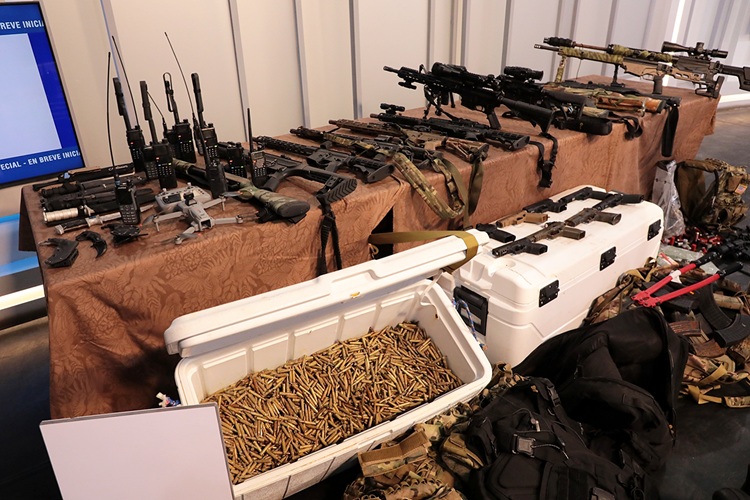
Armamento incautado tras intento de infiltración en Cuba. Foto: Abel Padrón Padilla.
Cuban authorities offered an in-depth account on Friday of the planning, execution, and terrorist nature of the events surrounding a recent armed incursion by a speedboat originating from the United States, as well as the subsequent confrontation following an attack on border guard troops.
Speaking during a special broadcast of the television program Razones de Cuba, First Colonel Ibey Carballo Pérez, Chief of Staff of the Border Guard Troops Directorate, stated that the first alert of the vessel's incursion was issued at 7:10 a.m. on Wednesday, February 25. In response, Border Guard interceptor vessel No. 25 was dispatched to identify the intruder, intercepting the craft near Cayo Falcones, approximately 10 nautical miles from the coastline of the Villa Clara municipality of Corralillo and just one mile north of the outer channel boundary — by which point the vessel had already penetrated 12 miles beyond Cuba's jurisdictional waters.
Carballo Pérez noted that the border guard crew acted in strict accordance with established regulations, under which armed response is considered a last resort and only authorized following a prior aggression. That aggression did occur, resulting in injuries to Captain Yosmany Hernández Hernández, the vessel's commander. Armed with only their standard-issue weapons — three AK rifles and one RPG — the crew returned fire and neutralized the threat. Three of the aggressors were killed at the scene and seven were wounded; one of the wounded later succumbed to his injuries, bringing the total death toll among attackers to four.
Following the confrontation, crews adhered to established protocols for the evacuation of the wounded and the transport of all individuals to shore. Carballo Pérez specifically commended Captain Hernández Hernández, who, despite his injuries, did not relinquish control of the vessel until the engagement had fully concluded, an act he described as one of exceptional valor and patriotism.
Colonel Víctor Álvarez Valle, Deputy Chief of the Specialized Agency for Crimes against State Security of the Ministry of the Interior (MININT), reported that forensic analysis identified 13 bullet impacts on the Cuban interceptor vessel and 21 on the speedboat, which was traveling at 24 knots and carrying over one metric ton of cargo. Seized aboard the vessel were 14 rifles of various calibers — including shotguns, assault rifles, and precision rifles — 12 handguns, 12,846 rounds of ammunition of assorted calibers, 134 magazines, Molotov cocktails, supplies, equipment comprising 10 military combat modules, a drone, and an electric generator, among other materials.
Álvarez Valle confirmed the involvement of Cuban nationals with documented criminal histories in Cuba, including Amijail Sánchez González, identified as a terrorist with a lengthy record of violent acts, and Maritza Lugo Fernández, named as the intellectual author of the operation and leader of the counterrevolutionary movement Movimiento 30 de Noviembre and the terrorist group Nido del Cuervo. Their stated objective, he said, was to infiltrate the country, incite public disorder, and provoke violent actions against the Revolution.
Edward Roberts Campbell, Chief Prosecutor of the Office of the Attorney General of the Republic, confirmed that those detained are facing precautionary measures under proceedings corresponding to acts committed in Cuban national waters, classified under Cuban law as terrorism — offenses carrying lengthy prison sentences and, in some cases, the death penalty. Roberts Campbell further emphasized that the events constitute not only a violation of Cuban law, but of U.S. law as well, given Washington's legal obligation to combat terrorist actions planned, financed, or carried out from its territory — an obligation that, he argued, was not fulfilled in this instance.
Finally, Colonel Juan Antonio Ramírez Aguilera, Chief of Medical Services at MININT, reported that Captain Hernández Hernández is no longer in danger and is showing favorable progress. He also confirmed that the wounded attackers are receiving full medical attention in keeping with Cuban medical ethics, which, he stated, treats all patients without regard to any other consideration.
During the broadcast, seized weapons and materials were displayed publicly to counter what officials described as false narratives that had been circulated regarding the true nature of the events.
Añadir nuevo comentario