
Chronicle of a Victory That Is Also Mine
It was that time on a Sunday when one puts down one’s phone for a while to attend to the demands of real life. I confess: between a sink full of dishes and uniforms waiting to be washed, I had momentarily disconnected from the second round of the Brazilian election—a decisive match against fascism that even the most intense moments at the Maracanã stadium couldn’t rival. Suddenly, my daughter came running out of her room and said, "We won, Mom! Today, Latin America won!"
There are moments when history chooses not to advance with cautious steps, but with the overwhelming force of an embrace long awaited. The night Brazil smiled again, following the victory of Luiz Inácio Lula da Silva, was—for me, a Cuban and a committed advocate for the invincible cause of the Latin American Left—one of those occasions when one’s chest feels too small to contain such a profound sense of relief and dignity.
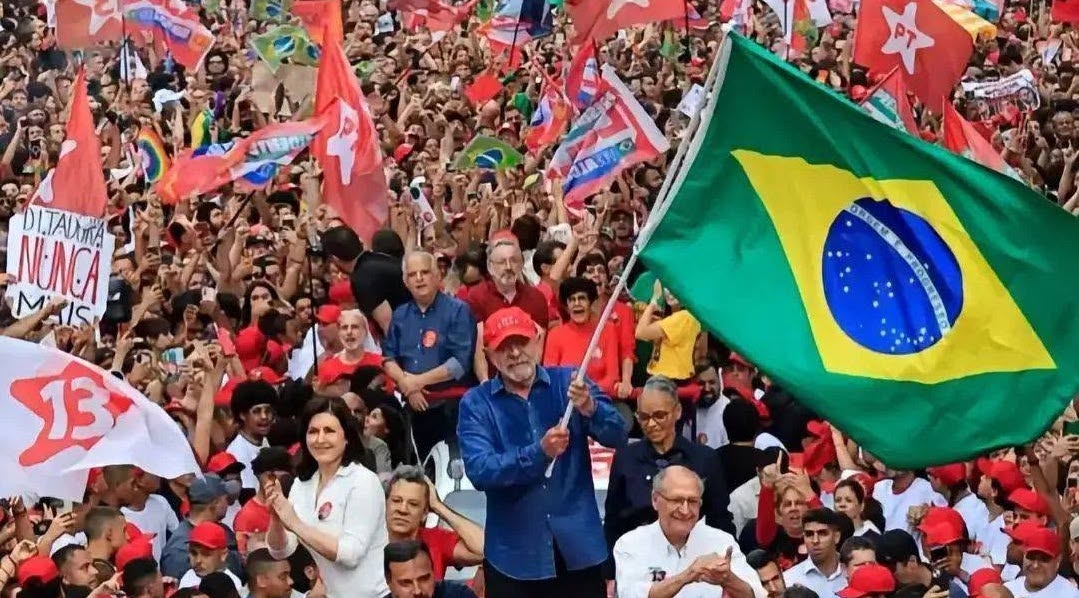
I hadn’t been glued to the screen, holding my breath as the vote count inched forward, number by number, ballot by ballot. Perhaps the pile of household chores was merely a pretext to mask a lack of faith—that pessimism injected directly into our veins by an information machine designed by the "oppressors of any new beginning," intended to steer us away from our essential utopia and extinguish our hope. Yet, this Sunday was one of those days when it feels as though God—or karma, or some other force—is determined to set everything in its right place. Of course, when you see photos of Avenida Paulista or Copacabana Beach—when you look at these scenes, reminiscent of a soap opera, now washed in red and colored by the flags of social movements, of humble people, Black Brazilians, and landless rural workers—you realize that every percentage point gained was not the result of some divine intervention. Rather, it was the pulse of a people refusing to bury their own history; it was the drive of the Brazilian working class, rescuing their destiny from the abyss of hatred, neo-fascism, and barbarism. And when my daughter arrived with the news that the result was irreversible, I felt a vibration that crossed the sea and stirred every corner of my Cuba.
Why do I feel this victory as my own? Because in "Our America," when a worker in São Paulo suffers, so too do the men and women in Havana who resist, day after day, under the siege of a criminal blockade. Because the struggle of Lula—a labor leader born into scarcity, unjustly imprisoned by the same old powers that sought to silence him—summarizes the battles that unite all of us in Latin America. Because Lula’s victory does not belong merely to one man, nor to a single party or nation; it’s a victory of popular resistance against the arrogance of capital and the machinery of manipulation.
Logging onto social media in those first few hours felt like plunging into a much-needed tide of optimism. My feeds were flooded with euphoric images of people in the streets of Brazil—faces streaming with tears, people locked in embraces, united as one. Seeing that surge of love and popular strength not only moved me to my very core, but also shouted out—loud and clear—that yes, another, better world is possible; that there is a viable and urgent response to imperialism, hate speech, and oppression. For the moment, at least, my social media feeds have become a mirror of a continent that refuses to surrender—a continent celebrating how dignity has triumphed over fear.
Lula’s reelection opens a crack through which the light of Latin American integration can shine—another chance for the unfinished dream of the *Patria Grande* (the "Great Homeland") envisioned by Martí, Bolívar, Fidel, and Chávez. It offers a strategic respite for the region, a powerful voice capable of once again articulating unity in the face of imperial ambitions, and a timely bulwark for the rights of the global working class—who now see in this former metalworker-turned-president clear, irrefutable proof that the humble can indeed govern and transform reality.
This is not about placing blind faith in an individual—someone with whom, in fact, we have not always agreed—but rather about embracing the collective hope that has been rekindled across the Global South. Because, yes—while this victory belongs to Brazil, it also belongs to our own wounded and abused Latin America, as it stands up to its old oppressors, now wearing new masks. It belongs to those of us who, despite everything, have refused to throw in the towel. It is mine, too—it is ours.
Añadir nuevo comentario