
Argentines Remember Che Guevara
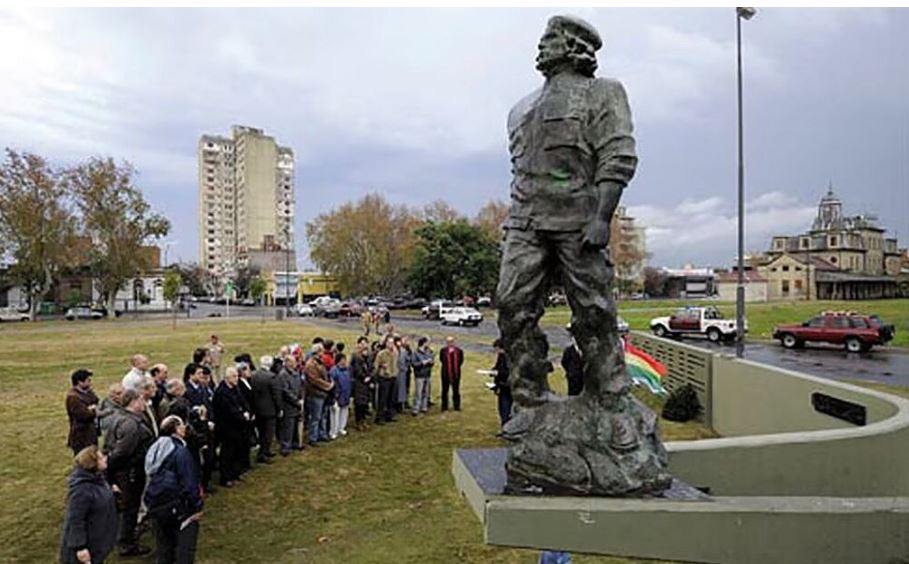
Argentines standing in solidarity with causes they consider just in Latin America remember today the iconic Cuban-Argentine commander Ernesto "Che" Guevara as they commemorate the 59th anniversary of his assassination in La Higuera, Bolivia, on October 8, 1967.
They link the symbolism of the defense of sovereignty championed by Che to the current political circumstances in Argentina, where the government promotes the unrestricted sale of land to foreigners—a measure opposed by popular and political forces.
"Fifty-nine years after Che's assassination, his thought is more alive than ever" is one of the slogans shared by members of the Morenense Association of Argentine-Cuban Friendship (Amaac), which they accompany with the motto "The land belongs to the people."
Members of Amaac organized a ceremony in San Martín Square in the Buenos Aires city of Moreno for Thursday night, October 8, where they will gather to honor the legendary guerrilla fighter and listen to local singer-songwriter Abelardo Martín.
Other organizations have scheduled commemorative events during these days, culminating in an Anti-Imperialist Rally on Sunday, October 11, at Ernesto Che Guevara Square in Rosario, where an imposing four-meter-tall bronze statue allegorical to the iconic revolutionary stands.
The sculptural work, inaugurated on June 14, 2008, to mark the 80th anniversary of Che's birth in his hometown, was sculpted by Argentine artist Andrés Zerneri.
It was a collective effort: it was cast using more than 75,000 bronze keys and objects donated by approximately 15,000 people from various parts of Argentina and around the world. The statue is installed on a pedestal in a square whose layout symbolizes a map of Latin America.
Council members from the ruling party La Libertad Avanza pressed in the Rosario Municipal Council to erase all references to Che in the city—the principal metropolis of Santa Fe province—such as removing the monument, changing the square's name, and removing his image from a mural in another square.
However, they met with firm opposition from other political factions in the legislative assembly and local social groups; even municipal authorities noted that they had no plans to alter public spaces in the city.
On October 8, 1967, Che Guevara was wounded in the leg and captured by the Bolivian army during a battle in the Yuro Ravine (or Churo) while leading a guerrilla movement in that Andean nation. He was detained along with other combatants from his unit and taken to a schoolhouse in the jungle village of La Higuera.
He was executed the following day on the orders of the Bolivian government. Participating in his execution was the so-called "Captain Félix Ramos," who was actually the prominent CIA agent of Cuban origin, Félix Rodríguez.
Añadir nuevo comentario