
Díaz-Canel Assesses the Social Impact of Economic Changes
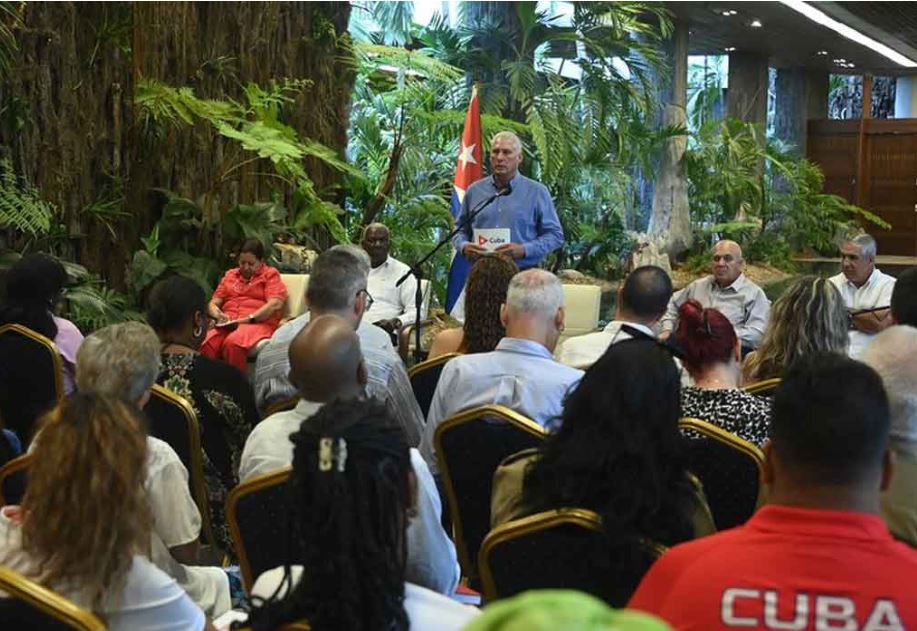
During the exchange, the president reiterated the premise that for the Government, economic growth is meaningless if it does not have a direct impact on social development, according to a report published on the Presidency's website.
"For us, it makes no sense to generate economic wealth if it does not impact and support social programs, and, above all, if that wealth is not distributed under a concept of social justice," Díaz-Canel stated.
He pointed out that it is precisely social justice that gives a socialist character to the 176 Economic and Social Transformations the country is implementing.
"Social justice is what differentiates us from the shock policies of capitalism; those adopted by those who attack us, blockade us, and impose an energy siege on us," reflected the head of state.
At the meeting, the protagonism of the people and their grassroots organizations in applying these changes within communities was highlighted, as well as the social responsibility that state and non-state economic actors must assume.
The President of the Republic stressed that these transformations have followed a process of debate that began with the membership of the Party and the Young Communist League, and extends to workplaces and communities where neighborhood organizations play a fundamental role.
Regarding the importance of control and popular participation, Díaz-Canel underscored that institutions linked to the social sphere must guarantee that economic flexibilization does not deepen inequalities and that structural changes benefit the most vulnerable sectors.
The also First Secretary of the Communist Party of Cuba insisted that all actors must understand their role and contribution in the defense of social justice.
"No institution should limit itself to its specific function; it is necessary to integrate into a network of articulation with the rest to truly achieve social justice," he stressed.
In the president's opinion, the key lies in interdisciplinary coordination at all levels, from the national to the community level, and he emphasized that "the longing for social justice cannot remain only in discourse."
He also proposed a set of concepts to guide daily work in the neighborhoods and urged focusing efforts on people with the greatest needs through differentiated attention.
As for economic actors—both state and private—he clarified that they cannot be considered solely as financial entities, but also as social actors.
Díaz-Canel indicated that another inescapable principle of the process is that "social protection must be accessible and not bureaucratic," while warning that what cannot be fulfilled due to lack of resources must not be promised.
Finally, he assured that these spaces for dialogue are stimulating and demonstrate that, even under the effects of the prolonged blockade and the energy siege imposed by the United States, the country works continuously to build a better society.
Añadir nuevo comentario