
The US, Like An Ostrich
Neither Trump, nor Marco Rubio, nor the legendary figure Sansón Melena have managed to convince Mexican President Claudia Sheinbaum to accept US military participation in the fight against drug trafficking—a ploy intended to facilitate North American interference on Mexican soil with the devious aim of undermining the highly popular leader's hold on power.
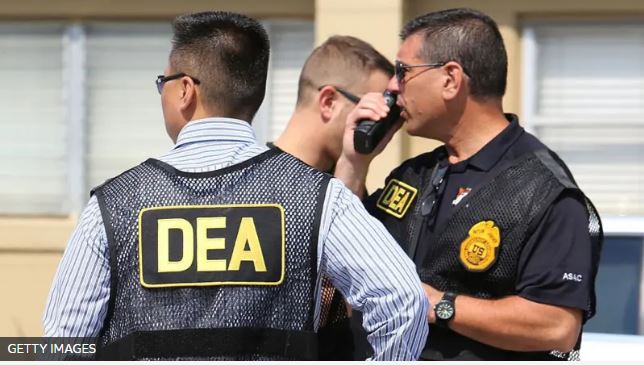
Recent corruption cases involving agents from the US Drug Enforcement Administration (DEA) demonstrate that the country must also address its own responsibilities in fighting drug trafficking, Sheinbaum noted during her regular press conference at the National Palace.
"We insist that they have a very important role to play over there, rather than just constantly bringing up Mexico," she stated when asked during her morning briefing whether the United States was doing "its part" regarding security cooperation. In this context, the president pointed to a recent case in which DEA agents were arrested for corruption.
The president insisted that Washington has outstanding issues to resolve within its own territory. She recalled that the flow of fentanyl from Mexico "has dropped by more than 70%—a fact they themselves acknowledge"—and emphasized that methamphetamine is also produced in the United States ("so much so that there was a TV series dedicated to it"), alongside the distribution and money laundering that take place there, "because that is where the consumption is higher."
In this regard, the Director of the Office of National Drug Control Policy (ONDCP), Sara Carter, has acknowledged the need to address drug use as a public health issue; however, neither the Treasury Department nor the Department of Justice has taken action to combat the money laundering associated with fentanyl trafficking.
DEA IN A HOT SPOT
The U.S. House Oversight Committee is investigating the DEA over a controversial law enforcement tactic that allowed "staggering amounts of deadly fentanyl" to reach the streets while federal authorities sought to build larger-scale anti-drug cases. According to agency informants interviewed by officials from New Mexico—a state considered the epicenter of the fentanyl crisis—their superiors ordered them to stand down rather than seize hundreds of thousands of fentanyl pills, a move that potentially violated Department of Justice policies designed to protect communities.
Two months ago, The Associated Press revealed that between 2023-2025—amid the deadliest drug epidemic in U.S. history—DEA agents allowed more than three million fentanyl pills to reach the streets, allegedly to strengthen criminal cases. In Albuquerque, New Mexico’s most populous city, DEA agents stood by and watched from helicopters and surveillance vehicles as drug dealers entered hotels carrying backpacks believed to contain 100,000 fentanyl pills. According to the agency itself, seven out of ten pills contain enough of the drug to cause a fatal overdose in an average adult; this implies that for every backpack they allowed to pass, they were effectively complicit in 70,000 potential deaths. Of course, it’s absurd to assume that every single dose results in a fatality, yet the DEA and the White House use this metric when discussing the "terrorists" who traffic these narcotics.
The American public might be surprised to learn of the questionable tactics employed by their crime-fighting agencies, but Washington’s double standards are well known in Mexico and Latin America. On this side of Rio Grande, the public remembers Operation Fast and Furious—the nefarious scheme through which, between 2009-2011, the U.S. Bureau of Alcohol, Tobacco, Firearms and Explosives deliberately allowed the sale and illegal trafficking of more than 2,000 firearms into Mexico, fully aware that the buyers were organized crime groups and that the weapons would be used against Mexican police officers and civilians.
This hypocrisy extends to the financial sector: a year ago, the Department of the Treasury forced the closure of two Mexican banks and a brokerage firm for “facilitating the poisoning of countless Americans by moving money for the cartels”; according to the allegations, these entities collectively handled less than $17 million in illicit funds. In contrast, that same Treasury Department... ...imposed a paltry fine of $125 million and allowed UBS Financial Services to continue operating, even though this subsidiary of the Swiss financial group carried out international transfers exceeding $10 billion without monitoring the funds for potential illicit origins.
PRETEXT
This pattern of behavior confirms that Washington is not interested in combating organized crime within its borders or preventing drugs from reaching its citizens; rather, it seeks to use drug trafficking as a pretext to interfere in other countries. In practice, there is systematic, bipartisan protection of the multi-billion-dollar narcotics trade.
From organizing cocaine trafficking to fund the war against the Nicaraguan government in the 1980s to the surge in poppy cultivation during the occupation of Afghanistan; from the pardon of drug trafficker and former Honduran President Juan Orlando Hernández—a close associate of Marco Rubio—to the rewards program for so-called protected witnesses, it is undeniable that for the last half-century, the United States has been a veritable narco-state.
Every year, $100 billion from drug trafficking flows into the U.S. financial system; specifically, the entire supply chain for fentanyl sold in the country—from the acquisition of chemical precursors to money-laundering schemes—passes through this network of lenders, according to official data from the Department of the Treasury.
Yet, to date, no U.S. bank has been implicated, nor has there even been a reported investigation into the vast sums of money pouring in and out of the country with the world's largest population of addicts. The problem is not merely the booming drug market; it’s precisely in the United States that Treasury agencies have identified the highest number of money-laundering alerts linked to fentanyl trafficking—95 out of every 100.
In a review of bank reports filed last year, the Financial Crimes Enforcement Network (FinCEN) confirmed that 1,246 reports of financial transactions were linked to fentanyl trafficking, involving the movement of $1.4 billion. The entire supply chain—from the acquisition of chemical precursors and fentanyl trafficking to money laundering—intersects with the U.S. financial sector at various points.
Translated by Amilkal Labañino / CubaSí Translation Staff
Add new comment