
UN: Global Warming Will Exceed 1.5°C Threshold, But Can Still Be Limited
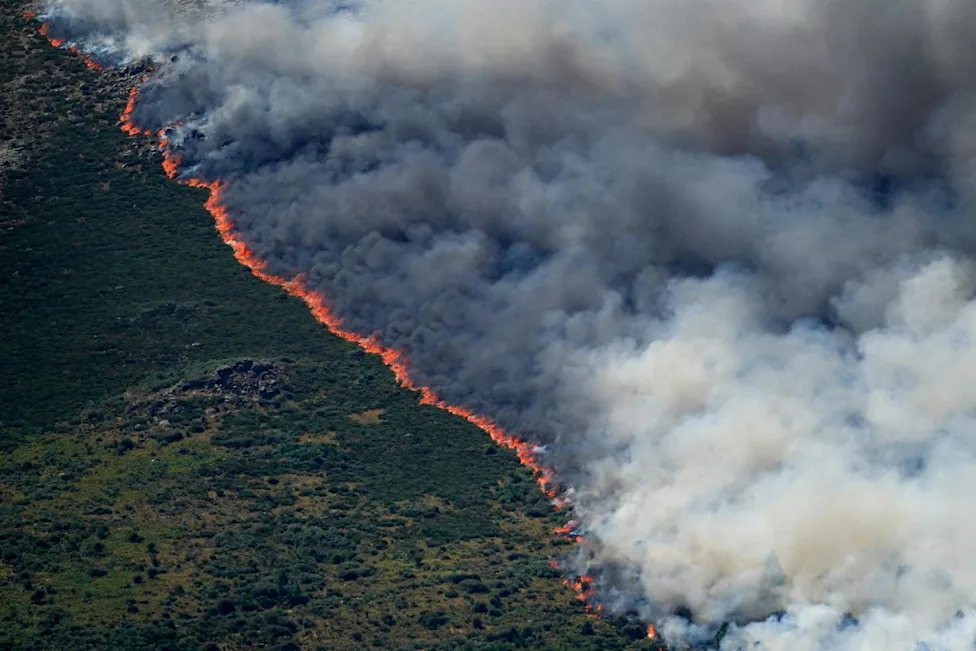
Los incendios forestales son cada vez más frecuentes por el calentamiento global.
Global warming will exceed the 1.5°C threshold above pre-industrial levels in the coming years, raising climate risks and impacts to increasingly dangerous levels; however, it remains possible to reduce temperatures and achieve the goals of the 2015 Paris Agreement, the United Nations Environment Programme (UNEP) warned in a report released on Wednesday.
The Paris Agreement aims to limit the global temperature rise to well below 2°C, and ideally to 1.5°C.
According to the report by the Nairobi-based UNEP, limiting the overshoot of the 1.5°C target as much as possible and driving temperatures back down as swiftly as possible represents the optimal path forward.
"We must make the overshoot as small and brief as possible by limiting both the rise in temperatures and the duration of time spent above 1.5°C," UN Secretary-General António Guterres stated in an official release.
"That requires redoubling our objectives: accelerating the phase-out of fossil fuels and the renewable energy transition, drastically reducing methane pollution, and protecting lands, forests, and oceans," Guterres added.
In its report, UNEP warns that mitigation measures to limit warming must be accompanied by adaptation policies to reduce the impacts of the climate crisis.
However, even under the most optimistic projection supported by the data—where warming peaks at 1.8°C before returning below 1.5°C within this century—some communities will still experience "irreversible losses" and "permanent changes" in environmental conditions.
"This is by no means an acceptable or preferred pathway: it is simply the best option remaining to us," the document notes, pointing out that global action to curb greenhouse gas emissions has so far "not been sufficiently rapid."
Once the 1.5°C threshold is breached, environmental impacts will multiply "with every fraction of a degree," the agency warns.
This scenario encompasses extreme weather events, ecosystem destruction, the submersion of Small Island Developing States (SIDS) and low-lying coastal cities, as well as severe consequences for human health, food security, water supplies, and nature.
Furthermore, the risk of "crossing irreversible tipping points" increases significantly, including the partial loss of the West Antarctic and Greenland ice sheets or the degradation of the Amazon rainforest.
To address this threat, the report outlines three simultaneous phases of action: "immediate response; adaptation and containment; and long-term resilience."
Initially, warming must be "rapidly curbed through a drastic reduction in emissions" to reach net-zero emissions, alongside "urgent adaptation measures" designed to safeguard vulnerable communities and ecosystems.
To achieve "net-negative emissions," it will also be necessary to employ "carbon dioxide removal (CDR) via conventional methods," such as afforestation and ecosystem restoration, or "novel approaches," including direct air capture and storage.
However, CDR can only assist if warming remains well below 2°C, and it requires "robust governance frameworks" because exploring novel technologies could carry "negative consequences," UNEP cautions.
"Strong political will, multilateralism, effective policies, inclusive governance, and finance are essential enabling conditions for action, and equity and justice must guide all responses," the report stresses.
Ultimately, the document concludes that "countries with the greatest historical responsibility for climate change and the highest capacity to address it must act with greater resolve and speed," while nations impacted "disproportionately" must be included and respected in decision-making processes.
Add new comment