
Two Events, Two Causes
September began charged with geopolitical implications for this beleaguered region south of the border between the "DFE" (US Federal Dis-republic) and Mexico.
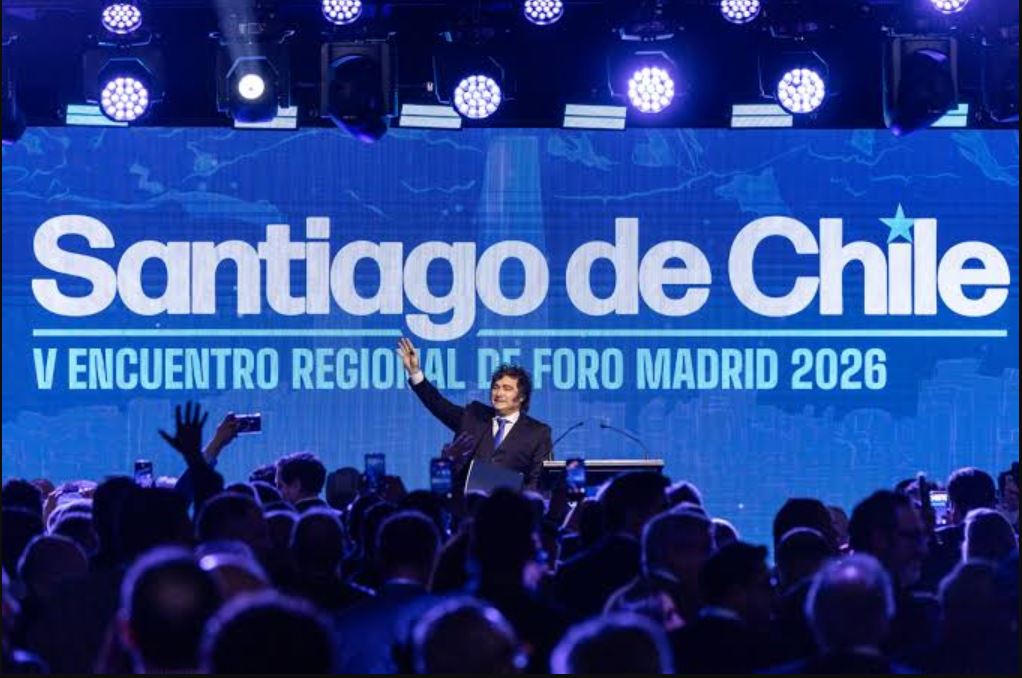
On September 3 - 4, the fifth meeting of the "Madrid Forum" took place—a gathering of far-right "thinkers" convened in the Chilean capital. VOX, the Spanish far-right political group, established this Forum through the Disenso Foundation—a sort of "think tank" that, on October 26, 2020, formalized the concept via a letter with a primary objective: to denounce and avert the "communist threat" that they claimed was looming over the so-called "Ibero-sphere"—that is, Latin America and its former colonial power.
From its inception, the Madrid Forum aimed to organize an international network to safeguard "freedom, national sovereignty, and the rule of law" against the advance of what they termed "left-wing regimes"—regimes that, according to the founders, would sweep away such "sacred rights."
Thus, the Forum announced from the very start that it would fight for these causes; yet, in practice, the far-right movements—whether the Latin American ones, the "mother" movement (Trumpism), or the Francoist faction (VOX)—now champion the exact opposite. One need not be an expert to conclude that the rhetoric of 2020 was nothing more than fanfare designed to mislead.
As is well known, the governance of these far-right movements shows contempt for freedom and the sovereignty of other nations, and—to an even greater degree—disregards the rule of law. The Trump administration epitomizes this reality, characterized by extreme cruelty; it represses its own people—after all, incarceration is a business, given the prevalence of private prisons. As for respecting sovereignty—whether domestic or foreign—it’s out of the question. And regarding the rule of law, there’s no need to detail how the White House is structured in practice to systematically violate it.
Returning to the Madrid Forum—the Spanish-speaking "branch" of Trumpism—it’s worth examining the core ideas promoted at the colloquium recently organized in Chile. Put simply, these “ideas” are characteristic of the 21st-century Nazi-Fascist creed: an emphasis on order and ideological control—in short, a total lack of freedom of thought—and mass surveillance within a quasi-police state, including the policy known as “preventive repression,” alongside the framing of the immigrant as the “primary enemy” or “main culprit.” Regarding the rule of law, all these concepts contribute to the weakening of “classic” democratic institutions—of the bourgeois “democratic” system—which has been reduced in practice to a mere façade of what it once was and will never be again.
True to their founding aims, “forum participants” gathered in Chile once again to wage a “permanent culture war.” This battle is directed not only against traditional values but, above all, toward theorizing alternatives for confronting the trajectory of contemporary capitalism, which is revealing its undeniable structural crisis.
In this war, nothing is worse than being a “communist”—an epithet repeated like a slogan to discredit any attitude, or even values that have little or nothing to do with politics. Consequently, exclusion and repression based on dissenting views are accepted as the norm, driving extreme social polarization. Thus, any adversary or dissenter who challenges the official orthodoxy is branded an enemy; the very concept of political debate vanishes, as does the personal safety of those who refuse to obey.
It’s hardly surprising, then, that for the gathering in Santiago, Chile, on the 3rd and 4th, they invited the Argentine president—the loudest ranter in these parts—as their “star” speaker.
Strictly speaking, there’s little point in dwelling on Milei’s delusions; as always, he repeated himself and even contradicted himself—a “minor slip-up,” according to his friendly press. He returned to the virtues of the “market” and, sticking to the script, warned of the dangers of a return of the “filthy leftists” (*mugrosos*—dirty, in Argentine slang). And worst of all, he vindicated the Pinochet dictatorship, celebrating the coup d’état that bloodily ended the government of the martyr-president Salvador Allende—who had been democratically elected in full accordance with the rules.
About a hundred thousand Chileans responded in the streets with a massive demonstration, declaring the Argentine *persona non grata*—a step the national government failed to take. This action served to show the latter where the limits of Chilean society’s tolerance for 21st-century fascism lie.
In terms of attendance and the stature of participants, the gathering in Chile fell far short of the expectations raised by the pre-meeting publicity. The US sent a State Department official, Sarah B. Rogers—Under Secretary of State for Public Diplomacy (a sort of “lost causes” office within the institution). To “monitor” Rogers’s behavior—and perhaps that of all the attendees—Kevin Roberts was present from the renowned Heritage Foundation, known for crafting the policy framework (Project 2025) for the Trump administration; he likely acted as the guardian of the event’s “ideological purity.”
On the “Hispanic” side, the meeting was attended by a VOX leader—its secretary-general, one Ignacio Garriga—as well as Latin American legislators linked to the ruling parties in their respective countries, such as Norma Yarrow, secretary-general of Peru’s *Renovación Popular* (Popular Renewal) party; Diana Jácome, of Ecuador’s National Democratic Action (ADN), and Enrique Gómez, of Colombia’s National Salvation Movement.
Fortunately for the people—and certainly unrelated to the forum participants' meeting—the day before, on September 2, former President Gustavo Petro delivered a truly masterful lecture before a packed auditorium at UNAM in Mexico (joined by thousands of online viewers). While philosophical in nature, the talk was essentially political and titled "Capital in the 21st Century: Political Economy of the Climate Crisis."
Petro addressed what appears to be a future issue—one some consider very distant—linked to the robotization of production processes; he also spoke about so-called "techno-fascism" and algorithmic electoral manipulation. Referencing these two phenomena—techno-fascism and algorithms—gave the talk a distinctly modern edge, though it’s worth noting that robotization is also a highly current issue.
The former Colombian president’s allegations regarding these electoral matters are well known. His most recent claims have focused on how the processes for electing leaders in several countries across the region were manipulated in bad faith—a matter that the revelations involving the criminal Cerimedo turned into near-irrefutable evidence.
However, the factor that might tie it all together—giving meaning to many events occurring almost everywhere and linking them to the rise of far-right forces and governments—was explained by Petro in his lecture: the impact of robotization. This issue has long since moved beyond the realm of science fiction films and creates a serious, proportional problem: the proliferation of "surplus" workers.
Clearly, the capitalist system of domination faces a primary challenge and fundamental contradiction: the need to continuously incorporate new technologies. Higher productivity combined with less variable capital (human labor) yields greater profit; this is how capitalism has operated since its inception—a simple concept to grasp. Based on this inescapable logic, "surplus workers" emerge.
Petro warns that while the so-called "surplus" population—essentially the well-known industrial reserve army—is nothing new, membership in this group will henceforth become permanent, because robots are here to stay. The massive social upheaval inherent in this process, with its cumulative effects, is an obvious consequence.
And what might seem like a scenario for a century from now has already been foreseen by the system's ideologues—both because we need not wait so many years for this conflict to become an everyday reality, and because it’s glaringly apparent that no solution exists within the framework of capitalism itself. If any scholar of Marxism failed to grasp one of the laws discovered by Marx—specifically the one stating that the development of productive forces drives a radical shift in the relations of production, as that moment is already knocking at the door of reality.
Thus, Petro—and not only he—concludes that at some point, the "surplus" population will have to be "gifted" money: partly to prevent a cataclysmic uprising, and partly simply to ensure they consume, keeping the wheel of production—and other laws, such as supply and demand—turning logically. And here arises the "big question": giving people money on a massive and constant scale (we are not talking about philanthropy here)—what does that resemble more: capitalism or socialism/communism?
This situation is poised to worsen, and the system’s chosen option is precisely this 21st-century fascism. It comprehends the sort of "solutions" alluded to—in summary—when discussing the "ideas" championed by the Madrid Forum; ideas that exude repression from every pore, aimed at containing the rebellion of "the surplus."
Note that, for now, they have started with immigrants—viewed as the most "logical" surplus workers—fueled by far-right fake patriotism that blithely ignores the fact that globalized neoliberalism is the current phase of capitalism, which includes the universal mobility of available labor; and if they are paid less—excellent!
The Forum members have a point—even that scoundrel Milei highlights it: the world is in the midst of a genuine culture war. It’s a battle over maintaining the status quo—dependent capitalism—regardless of the misery faced by billions of people, versus the possibility that the development of the forces of production might eventually alter that common sense—a revolutionary first step toward replacing the system with a post-capitalist model.
Thus, it becomes an inescapable obligation for the Left—the *real* Left, the revolutionary Left—to speak daily about this existential danger to capitalism, a situation that leaves no room for social-democratic half-measures, or whatever one calls the attempt to be on good terms with both God and the Devil.
From this arises another increasingly urgent axiom: the only possible response to right-wing extremism is a Left that is fully aware that no reconciliation is possible. As the saying goes, one cannot debate or converse with fascism; one simply confronts it.
Great credit is due to Gustavo Petro, who—in a moment of great clarity at the UN—proclaimed that "there is no superior race, gentlemen." Although that statement referred to a different issue—the crimes of Zionism—it applies equally well to the topic at hand: the "surplus people," a group that is gradually coming to encompass the overwhelming majority of human beings. It’s immensely valuable for a Latin American leftist leader to bring this issue to the forefront at this particular moment.
Fascism—or technofascism, or whatever one chooses to call it—represents the world of the past, a legacy of terror and social barbarism; it cannot be the future. What revolutionaries and communists—in the truest sense of the words—defend is the future: a future defined by a far more equitable distribution of wealth. This is a concept that seems clear enough, yet is rarely fully understood.
An abhorrent past versus a civilizing future—that is the question. Thank you, Petro!
Translated by Amilkal Labañino / CubaSí Translation Staff
Add new comment