
Trump Repeatedly Contradicts Himself on Iran Within Hours
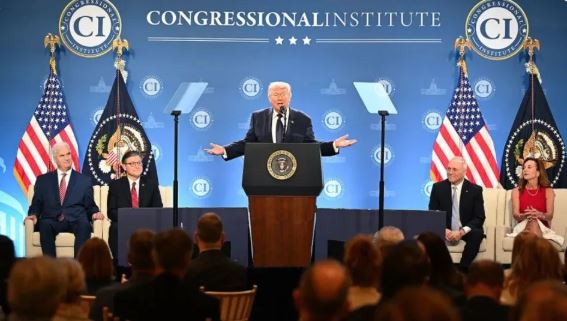
El presidente Donald Trump habla con legisladores republicanos en Doral, Florida, el 9 de marzo. - Roberto Schmidt/Getty Images
President Donald Trump's rhetoric regarding the war with Iran has been confusing and contradictory long before the first strikes began. On Monday, however, he made strikingly different statements on the same subjects within the span of just a few hours.
The War Is Over
The major news of Monday afternoon was that the war appeared to be nearing its end — at least based on Trump's comments.
In a phone interview with CBS News, Trump stated: "I think the war is pretty much over."
Yet nearly simultaneously, the Department of Defense's rapid response account posted on X: "We have barely begun to fight" — with no additional context. (And just days earlier, Defense Secretary Pete Hegseth had emphasized on CBS's 60 Minutes, in an interview recorded the previous Friday, that "this is just the beginning.")
Trump's comment in that Monday interview also differed considerably from what he would say later in the day.
"We have already won in many ways, but not enough," he stated in a speech before House Republicans in Florida. "We press forward with more determination than ever to achieve the ultimate victory that will end this persistent danger once and for all."
Minutes after that speech, Trump, at a press conference, once again characterized the victory as incomplete.
"We will not relent until we have totally and decisively defeated the enemy," he said.
"We could say it's a tremendous success right now — walking out of here, I could say that," Trump added. "Or we could go further, and we are going to go further."
The State of Iran's Defenses
Trump also offered contradictory assessments regarding the state of Iran's military firepower.
In the same CBS interview, he suggested Iran no longer had the means to fight.
Iran "has no navy, no communications, no air force," Trump stated.
He added: "They've already fired everything they had to fire."
And: "If you look, there's nothing left. There's nothing left in terms of military."
At his press conference, he also asserted: "They have no radar, no telecommunications… It's all gone."
Yet elsewhere during the same event, he described those same capabilities as severely diminished rather than entirely eliminated.
Having previously stated that Iran "had no navy," he instead claimed that "most of Iran's naval power has been sunk."
Trump also rapidly escalated the number of Iranian vessels he claimed U.S. forces had sunk — from 46 during his speech, to 50, and then to 51 at his press conference.
While he had said Iran had fired essentially everything it had, he also stated at another point that its missile capability had been "reduced to around 10 percent, maybe less," and at yet another moment said that "the majority" of its missiles had been used or destroyed.
"The drones have probably been reduced to 25 percent and will soon be reduced to nothing," he added.
Iranian Leadership
As Trump highlighted the successes of the war effort at the press conference, he initially declared that Iran's leadership had been completely eliminated.
"Everything they had is gone, including their leadership," he said.
"They have no leadership," he added.
He then acknowledged that "the top two levels of leadership are gone" and that "most people haven't even heard of the leaders they're talking about."
One name, however, is quite familiar. Iran's new Supreme Leader is Mojtaba Khamenei, the son of the recently deceased Supreme Leader, Ayatollah Ali Khamenei.
And despite having described Iran's leadership as irreparably gone just seven minutes earlier, Trump portrayed the new Khamenei as essentially a continuation of that same leadership.
"It disappointed me, because we thought this will just bring more of the same problem to the country," he said. "So I was disappointed by his decision."
The Elementary School Bombing
Trump drew significant attention on Saturday when he suggested Iran was responsible for the strike on an elementary school within its own territory — despite considerable evidence pointing to the possibility that it may have been the United States.
"In my opinion, based on what I've seen, that was done by Iran," the president told reporters aboard Air Force One.
He later became more definitive, stating that "Iran did it."
When pressed on the matter at his Monday press conference, Trump implied Iranian responsibility, but less forcefully, suggesting that Tehran may have obtained a "generic" Tomahawk missile — a weapon Iran is not known to possess.
When it was noted that Hegseth, who had been at his side on Saturday, declined to endorse Trump's claim regarding Iranian responsibility, the president acknowledged: "I just didn't know enough about it. I think it's something I was told is under investigation" — before reiterating his claims that other countries possess Tomahawk missiles.
"But certainly, whatever the outcome of the investigation report, I'm willing to live with that report," he concluded.
Add new comment