
THINKING AND THINKING: After Babel
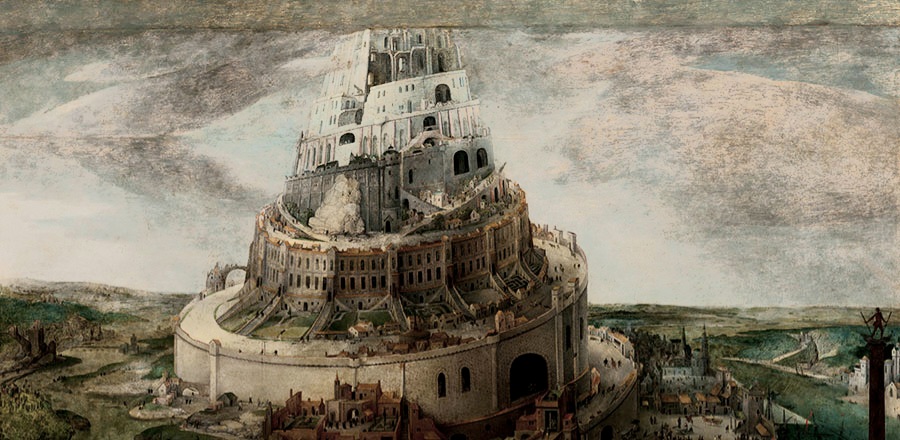
Construcción de la Torre de Babel (fragmento). Óleo sobre madera; 87 x 115.5 cm. Círculo de Jacob Grimmer. Colección del Museo Nacional de Bellas Artes, Cuba.
Artificial intelligence, machine translation, and digital platforms are beginning to make it possible for people who speak different languages to converse almost without barriers.
What for centuries was considered an exemplary warning by Catholic Church dogma, numerous contemporary writers and intellectuals paradoxically came to view as an unexpected blessing. The diversity of languages that the Creator imposed at the mythical Tower of Babel—understood in the biblical narrative as a consequence of human pride—has come to be seen by many as one of our civilization's greatest riches.
Where Genesis speaks of dispersion, a large portion of contemporary thought has preferred to discover plurality.
There is no reason for a contradiction between both readings. The story retains its moral strength intact: pride breaks community, and no human work can endure when pride attempts to take the place of humility.
However, the passage of centuries revealed another effect of that dispersion. Different languages did not merely separate men; they also gave rise to distinct ways of understanding the world, naming beauty, explaining mystery, creating art, and building thought.
Linguistics, anthropology, and history offer perfectly rational explanations for the birth of languages. Geographic isolation, migrations, contacts between peoples, and the evolution of societies are sufficient to understand the extraordinary cultural mosaic that inhabits the planet today.
Yet scientific explanations do not diminish the beauty of the symbol. Babel remains one of those stories capable of condensing, in just a few lines, a profound truth about the human condition.
Writers such as Jorge Luis Borges returned time and again to that image. His Library of Babel turns the ancient tower into an infinite universe where knowledge multiplies to the point of vertigo. Babel ceases to represent solely a breakdown in communication and becomes a metaphor for the infinite diversity of thought.
The linguist George Steiner understood that we live "after Babel": not in spite of the diversity of languages, but thanks to it. Translating, interpreting, and understanding the other constitute, in his vision, some of the most profoundly human acts.
There were even those who tried to offer a practical path toward that understanding. Esperanto was born with the beautiful aspiration of becoming a common second language for all peoples, without ever replacing national languages. L. L. Zamenhof, its creator, did not dream of standardizing humanity, but of facilitating encounter between cultures.
The project did not fail due to its linguistic virtues—which remain extraordinary today—but because languages never spread solely through their simplicity. Behind every dominant language, history, political power, economy, and cultural influence are usually found.
Our era presents a suggestive and challenging scenario. Artificial intelligence, machine translation, and digital platforms are beginning to make it possible for what neither the myth of Babel nor Esperanto fully resolved: for people of different languages to converse almost without barriers.
Technology seems to build bridges where for centuries there were linguistic borders. However, no algorithm can replace the genuine desire to understand the other. Translating words is relatively simple; translating cultures remains one of humanity's greatest challenges.
That is why the image of the mythical tower continues to be so powerful. Beyond the tools we invent, the old Renaissance endeavor of approaching other languages, reading other literatures, dialoguing with other religions, exploring other philosophies, and discovering that multiple ways of inhabiting the world exist remains beautiful.
If technology can help us along that path, let it be welcomed. After all, it is also a human creation, another expression of the endless dream of understanding one another. Perhaps that is, after all, the true lesson of Babel: not to aspire for everyone to speak the same, but to learn to listen to each other while remaining distinct.
Translated by Sergio A. Paneque Díaz / CubaSí Translation Staff
Add new comment