
"They Are Trafficking My Life," Says One of the First Cubans the U.S. Sought to Deport to Liberia
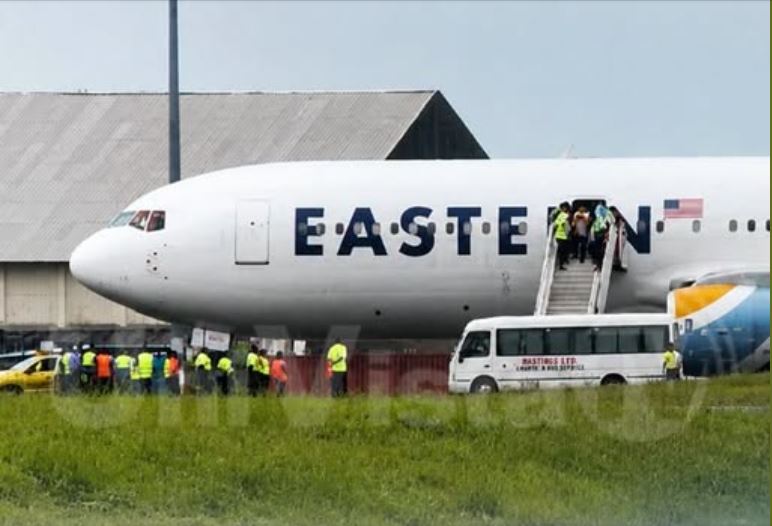
Carlos Rodríguez is one of four Cubans whom the United States left, alongside a Brazilian citizen, in Equatorial Guinea after they resisted being among the first individuals deported to Liberia. Consequently, he feels he is being "trafficked," while his wife and daughter, both U.S. citizens, seek assistance from Florida.
Rodríguez and the other Latino immigrants were traveling on the first deportation flight to Liberia, an African nation that revealed last week it had agreed to receive 1,200 foreign nationals transferred by the United States.
However, given the resistance of these five immigrants, who were subdued by officers, local authorities refused to accept them and separated them from the rest of the group, according to the Cuban man in a video call interview with EFE from his wife's home in Miami.
"They forcefully removed us from the plane and kept us on the floor with their boots on the chains we were wearing on our hands and feet. It seems the government of Liberia did not like that and ordered us to turn back," recounts Rodríguez, 35.
"Then what they explained to us on the plane was that we were turning back to the United States, and three hours later we appeared in the middle of the night in a dark part of an airport in Equatorial Guinea, with an operation of 50 guards waiting for us below the plane. They were ready to board the aircraft to pull us out," he adds.
The man, who arrived in the United States in 2013 and claims to be protected under a habeas corpus judicial order, is currently in a hotel functioning as a detention center alongside fellow countrymen Darwin Hernández, Emilio Destrade, and Leonardo Sánchez, as well as Brazilian national Pietro Graza de Lima.
They avoided being among the first expelled individuals—including Venezuelans—sent to Liberia, a country that joined Eswatini, Cameroon, Ghana, Rwanda, Uganda, South Sudan, Equatorial Guinea, the Democratic Republic of the Congo, Sierra Leone, and the Central African Republic in accepting third-country deportees from the U.S.
Even so, he is "concerned for his life" in Equatorial Guinea and asks authorities to "help us return back to the United States or to America, to another place."
"Do you want me to tell you the truth? What went through my mind was that I was being humanly trafficked, that they were trafficking my life. That is what I felt—great fear, great terror, because it is the other side of the world, where you see different people waiting with weapons. I am still afraid; even here I am fearing for my life," he says.
U.S. "Turns Its Back on Latinos"
His wife, Igrayne Ribot, considers this "a historical moment in the life of this country," calling it "horrible" and "atrocious" due to "the way they have turned their back on Latinos."
She relates that authorities detained Rodríguez in April 2025 in the southern state of Tennessee, transferring him for over a year through facilities across several states, including 'Alligator Alcatraz' in Florida, until she received a phone call from him last week.
"He was terrified for his life, and I asked him: 'Where are you?' That was my only fear, and he told me: 'My love, I am in Africa.' Well, I cannot describe what I felt; I almost fainted. I was with my oldest daughter, who is pregnant and loves him like a father, and my youngest girl. It was very hard," she mentions.
Seeking Help to Return
According to Ribot, the arrest occurred due to an "old deportation order from 2019" against Rodríguez, but she maintains he "does not have a serious record" and possessed a habeas corpus order from a judge that should have prevented his removal.
Now, through a GoFundMe campaign titled 'Support 5 Men Deported to Africa,' they are seeking community support or assistance from an immigration attorney, as she laments they are "living one day at a time without knowing what his future will be."
"I have been separated from my family, my wife, and my young daughter, both of whom are American citizens. It is an injustice, a violation of human rights on a scale rarely seen in the U.S. If anyone can help me, please do, because Africa operates very differently from the rest of the world," he concludes.
Add new comment