
Spain: No Clear Outcome
The snap elections called by Prime Minister Pedro Sánchez for this coming November 29th remain inconclusive according to the polls conducted so far. In these surveys, the incumbent—candidate for the social-democratic Spanish Socialist Workers' Party (PSOE)—does not currently have the support of his former left-wing allies, while the right and far-right—represented by the People's Party (PP) and Vox, respectively—are making their own aggressive moves.
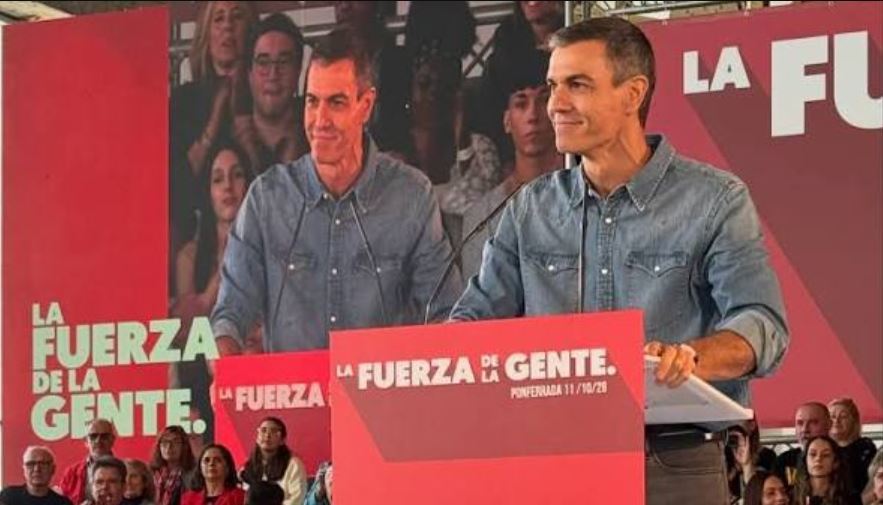
Sánchez remains confident that he will win the elections in Spain and secure the votes of the left, fully aware that what is at stake is either four more years of progress or a regression of four decades. The German news outlet Deutsche Welle reports that at a rally—held after the PSOE’s Federal Committee ratified the party’s electoral lists and unanimously proclaimed him their candidate—Sánchez donned a T-shirt bearing the slogan "With the strength of the people." He railed against the "cuts" and "sacrifices" demanded by the right and the far-right—demands imposed on workers, pensioners, and women, yet "never" on those at the top.
Sánchez declared that the "cause for housing" will be won by "the strength of the people"—the Socialist Party’s slogan for this pre-election period—and that they would do so "in honor of" Maricarmen, an octogenarian who died after being evicted, as well as all those who have mobilized "in the public squares." He further stated that the strength of the people "spills beyond the ballot boxes, bringing the demands of those mobilizing in the streets into the Official State Gazette."
He warned that the reactionary wave is not a thing of the past: "They are here—in Spain, in Europe, and in the United States—and they must be stopped." Sánchez championed his commitment to a "green revolution," feminism, and an "anti-war" stance—contrasting this with those who remain silent in the face of Israel’s "genocide" in Gaza—a message that galvanized the party members who attended the rally at the town of Fuenlabrada, in the Madrid region—a traditional Socialist stronghold.
The parties to the left of the Socialists—who currently govern Spain in a coalition with Pedro Sánchez’s party—have failed to agree on a joint national list; consequently, they will run separately in most electoral districts.
Under Spanish electoral law, this situation could result in a loss of votes and parliamentary seats, thereby increasing the likelihood of a change in government in favor of the conservative People’s Party (PP) and the right-wing populist party, Vox.
According to an extensive study published by the national newspaper *El Español*, there’s only a 0.1% chance that the right-wing bloc will fail to secure an absolute majority. The probability of the PSOE (Socialist Party) matching or surpassing the PP in terms of seats is 8.5%, while the chance of them doing so in terms of the total vote is just 5.4%.
In 19% of the scenarios analyzed, the combined total for the PP, Vox, and the UPN would reach the 210 seats required for constitutional reform. Regarding the Senate, the right-wing bloc would retain a three-fifths majority if Vox either declines to run in 19 provinces or joins the PP on joint electoral lists in those areas.
CONSIDERATIONS
The Prime Minister has emphasized that the best way to safeguard the social rights "achieved over these past eight years" is to support the PSOE. "All in on red," he declared.
Critics, however, point out that during the current legislative term, the government has not, in their view, fully committed to that "shade of red." "If the PSOE had truly gone 'all in on red,' this administration would have taken bolder action on housing," remarked Alberto Ibáñez, a deputy for the Compromís-Sumar coalition.
The Socialists are signaling that their appeal for a "useful vote"—urging voters to back a party with a realistic chance of winning—is more than just a passing talking point; they insist that they could still finish in first place. "Even the right itself believes that the PSOE is going to win—that we are going to govern," Sánchez stated.
Election analysts do not foresee the PSOE governing, though they do consider it possible that the Socialists could emerge as the party with the most votes. "There could be a 'strategic vote' [voto útil] that favors him, bringing him quite close to the PP. I wouldn't rule out the possibility that Feijóo ends up with more votes than Sánchez," explained Narciso Michavila, president of GAD3.
Experts believe it works to the Socialists' advantage that the political forces to their left have not had time to organize.
The parties to the left of the Socialists—which currently govern Spain in a coalition with Pedro Sánchez’s party—have failed to agree on a joint national list, with just over six weeks remaining until the snap general election called by Sánchez himself. According to Spanish media reports this Saturday, following the midnight deadline the previous day for registering candidacies, the main forces of the alternative left will run separately in most electoral districts.
Under Spanish electoral law, this situation could result in a loss of votes and parliamentary seats, thereby increasing the likelihood of a change in government in favor of the conservative People’s Party (PP) and the right-wing populist party, Vox.
CRITICISM OF THE U.S.
On Saturday, Sánchez criticized the United States for its military aggression against Iran and warned of the economic consequences Europe is facing. He expressed hope that Washington would not repeat the mistake made 20 years ago when it attacked Iraq.
He argued that, once again, Washington acted outside the framework of international law in its conflict with Iran, noting that "we are paying for the economic consequences with our own money."
According to the head of government, Europe has incurred an additional 100 billion euros in costs since the conflict began—an amount he claimed is more than double the entire EU budget allocated to agricultural policy.
CAUTIOUS OPTIMISM
Although, in an electoral system like Spain’s, unity is important in smaller constituencies—where the fragmentation of the vote works to the detriment of smaller parties and to the advantage of the major ones—one should not be under any illusions. The primary challenge the Left faces in once again checking the Right is the demobilization of its own electorate—voters who have grown weary following an exhausting legislative term in which little progress was made on the progressive agenda.
Rather than merely serving as a tool for electoral optimization, unity among the parties to the left of the PSOE should have acted as a catalyst to re-engage these disaffected and skeptical voters. After the absurd negotiations of the last two weeks, even a last-minute, bare-minimum agreement would likely be insufficient to achieve this.
According to progressive analysts, the outcome now hinges on three factors. First: Pedro Sánchez’s capacity to gain strength in the face of adversity. Second: the resilience of progressive parties in the Basque Country, Galicia, and Catalonia (though the situation in the latter is somewhat less certain) within their respective regions; these parties serve as a safeguard against the far Right. Third: the hope that the conservatives continue to commit blunders—as they have done by discussing cuts and privatizing pensions—and awaken in the progressive Spanish voter both a fear of what might lie ahead and a sense of responsibility to confront it. A sense of responsibility, it should be noted, that often surpasses that displayed by their own political leaders.
One can always count on the age-old foolishness of Spanish conservatives—who are feeling nervous after their 2023 defeat, despite having had every poll in their favor. They have the polls on their side now, too—by an even wider margin, if that’s possible—and yet, they are deeply anxious. They spent three years calling for elections, but, looking at them now, one might well conclude that they don’t want them at all.
The prospect of the PP and Vox seizing the Moncloa Palace—much like the potential return of the Bolsonaros to power in Brasília, or any number of other examples pushing us toward the abyss—does little to cure blindness when there are thousands of people who simply refuse to see.
Translated by Amilkal Labañino / CubaSí Translation Staff
Add new comment