
The Show Must Go On: Cuba’s Legendary Classical Ballet Company Presses Onward Despite Adversity
Every day, without fail, Dani Hernández—a principal dancer with the National Ballet of Cuba—hops onto an electric motorcycle to get to dance class, a risky mode of transport for someone whose livelihood depends on avoiding injury.
He does this sometimes after a night of blackouts, heat, and mosquitoes—conditions that force him to sleep on the terrace, just like his neighbors in the apartment building where he lives in Havana’s El Vedado neighborhood.
"We work with our bodies," Hernández, a 37-year-old Cuban, told The Associated Press. He is an international star of the National Ballet of Cuba and director of the National Ballet School, the training ground that has produced many of the discipline's most prestigious artists over the decades.
"You leave home knowing you’re about to face hours of rehearsal," the artist remarked. “Whether I have electricity or not, I have to be in the living room, but I keep wondering: ‘Will the food in the fridge go bad?’”
If being a top-tier classical dancer entails discipline and sacrifice, doing so in Cuba during these difficult times of an energy crunch is nothing short of a feat.
Ballet accessible to all
The National Ballet of Cuba recently presented the final gala of its season, closing the show with *Canto Vital*, a piece choreographed by the Russian Azari Plisetski set to the music of Gustav Mahler.
Few vehicles moved along the half-empty streets—mostly electric tricycles or motorcycles like Hernández’s, which are practically the island's only form of transport—yet the Avellaneda Hall at the National Theatre of Cuba was packed with elegantly dressed men and women with hair and makeup done for the occasion, all rising to their feet to shout “Bravo!”
The National Ballet of Cuba is one of the most prestigious in the world and is as popular on the island as baseball. A theater ticket costs less than a dollar—a price that could reach up to 300 dollars for a similar performance elsewhere in the world.
The National Ballet of Cuba is “an emblem of our identity,” Hernández reflected, “a global and international benchmark; whenever a Cuban dancer steps onto a stage, the whole world recognizes them.”
Founded in the late 1940s by *prima ballerina assoluta* Alicia Alonso and her husband Fernando Alonso, the company gained momentum following the triumph of the Revolution in 1959, and its state policy of supporting the arts in general, which also achieved mass access for the population.
The combination of Alonso’s demanding leadership and a public dance school produced dozens of stars. Among the most renowned are Josefina Menéndez, Loipa Araujo, Mirta Plá, and Viengsay Valdés. Some went on to become principal dancers in companies such as the Paris Opera, the Royal Ballet in London, and the American Ballet Theatre in New York.
Shadows on the horizon
The oil embargo imposed on the island by the United States in January has exacerbated a crisis that was already five years old and has had palpable effects across all sectors: blackouts lasting more than 30 hours, shortages of food and public transport, and industrial shutdowns. Against this backdrop, many view the future of arts—and ballet in particular—with concern.
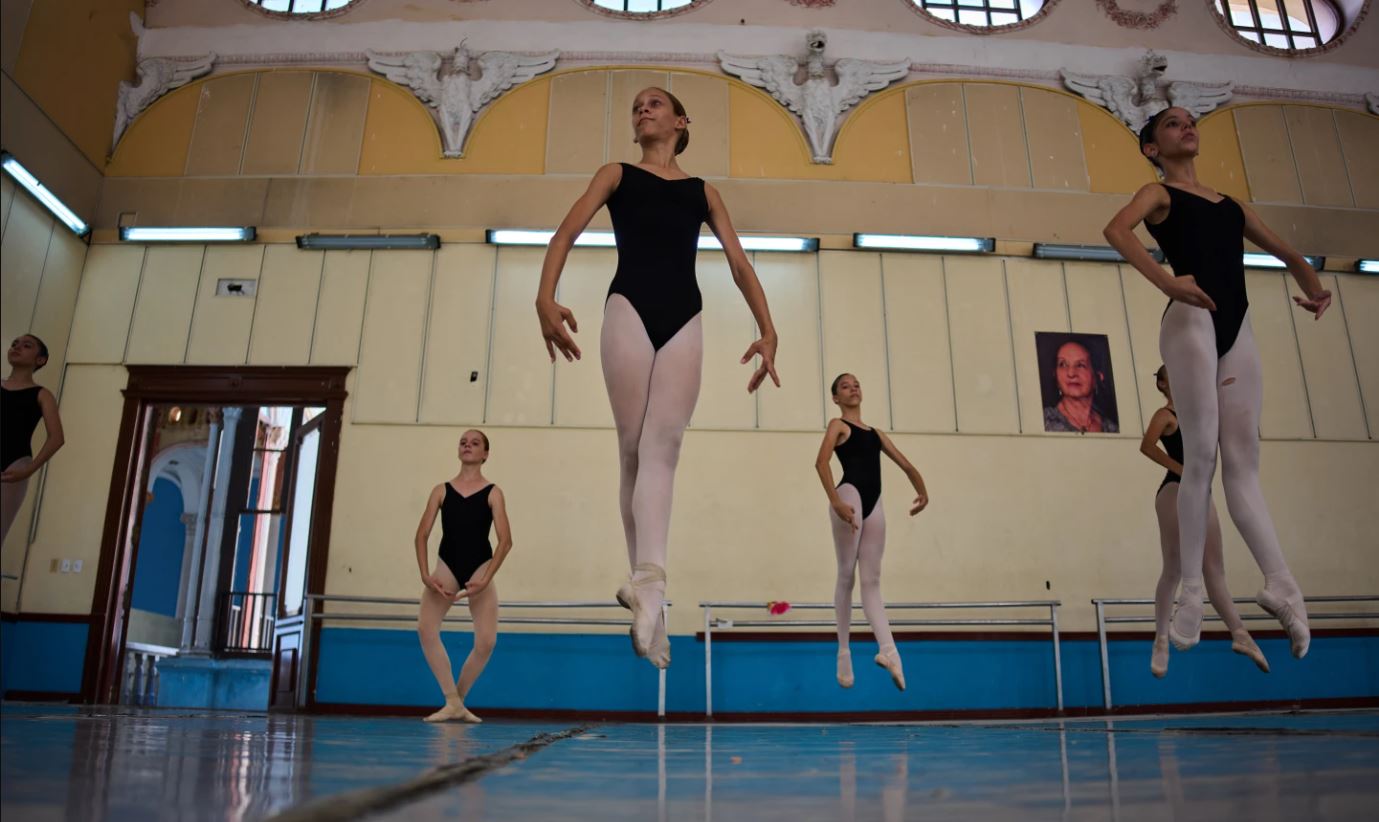
With 178 students ages 9-18, the National Ballet School directed by Hernández occupies an imposing Art Nouveau building in the heart of Old Havana; there, the young people attend regular academic classes—math, Spanish, history, science—alongside their dance training.
Families must make an ever-greater effort to support their children’s demanding careers, which require not only school supplies but also special dance attire and nutrition adequate for the physical demands involved.
“It requires an effort that borders on magic. Because behind every ballet student, there is an entire network of people,” Cynthia de la Mora Chávez, 49, mother of school student Roxana Pérez, told the AP.
De la Mora and her daughter live in the outlying municipality of La Lisa; given the current shortage of public transport, they must get up at five in the morning to arrive at the school by eight, the AP observed. “Honestly, if you ask me how I do it, I haven’t the faintest idea,” remarked De la Mora as she finished making breakfast for her 14-year-old daughter by flashlight, while the girl touched up her hair bun. The neighborhood had been without power since the day before.
“Dancers always face hardships, and ballet students always face hardships, but this historic moment we’re living through adds the complication that we have no electricity, no water, no food, and no transport. And there’s a whole list of things ‘we don’t have,’” De la Mora reflected.
De la Mora and Hernández admitted they feared that, due to current shortages, the young dancers or their families might give up on their goals, resulting in a loss of talent.
“Sometimes I say, ‘Oh Mom, I don’t want to go,’ but missing class could affect my training later on,” Pérez reflected with a shy smile, though she insisted she would press on against all odds. “I’ve always said my dream is to become a principal dancer.”
Translated by Amilkal Labañino / CubaSí Translation Staff
Add new comment