
Serrat: "Doing Away with the Elderly Is Like Burning Books"
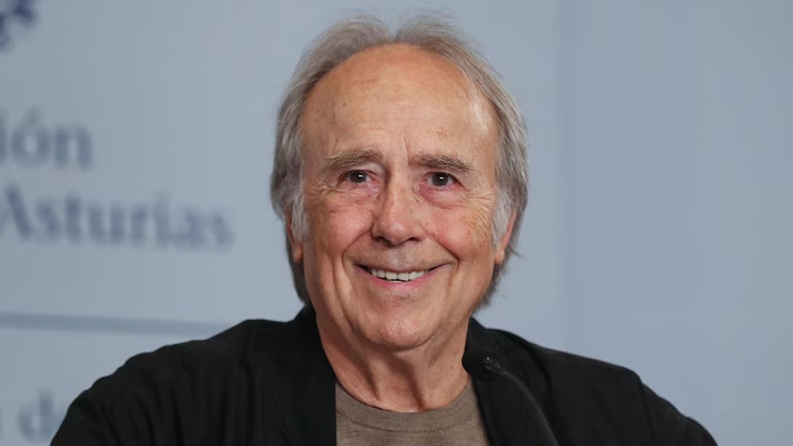
El cantautor barcelonés continúa recibiendo premios y distinciones a sus 82 años y tras retirarse de los escenarios en 2022. Foto: EFE
Joan Manuel Serrat appeared serene, thinner, and with a slightly more measured voice than in his years on stage. He no longer traverses the world in endless tours, but at 82, he still utters phrases capable of plunging any audience—no matter how large—into total silence.
"Doing away with the elderly is not only a criminal and imbecilic act; it is like burning books, it is destroying memory," he stated during the international congress "A Civil Right for Older Persons?" held at the University of Barcelona on March 12 and 13.
The declaration spread through media and social networks because it touched an uncomfortable nerve. In an era obsessed with youth and productivity, Serrat placed on the table a topic many prefer to avoid: old age.
Serrat took the floor with a mixture of serene humor and critical lucidity. He presented himself without solemnity, immediately disarming any expectation of academic discourse. He recalled that he is 82, enjoys good health and a "more than acceptable state of preservation," and with that initial irony set the tone: he did not come to speak from a distance, but from the direct experience of aging.
From there, his speech flowed toward his central idea: Old age is not an accident or an anomaly, but an inevitable stage of life that society insists on problematizing.
"This is a good time to bare my soul. I am a man grateful for life. And I accept the natural fact of aging and the inconveniences that nature and demolishing time impose on me as the days pass. With scrapes, with dents, I still retain a good part of my illusions. And I coexist with my ailments, with the help of pharmaceuticals and prosthetics. Glasses, hearing aids... In short, those things.
"I like life. I like being alive. And feeling useful. That is why I rebel against a world where the elderly are identified with a lack of capacity, talent, or preparation."
Dignity as a frontier
The singer-songwriter insisted that the problem is not aging, but how societies look at those who age.
"The elderly are uncomfortable for a society that promotes spending and seeks easy, quick profits. Meanwhile, they are marginalized because they consume less, because they have fewer needs.
"The elderly are abandoned to loneliness. Because loneliness, they say, is inherent to old age, and they must get used to it. But a society without solidarity between generations is an impoverished society."
Serrat did not speak from theory but from the embodied experience of time. His speech oscillated between acceptance of the aging body and resistance to its social devaluation.
The most cited moment of his intervention came when he introduced one of his most powerful metaphors: "Doing away with the elderly is not only a criminal and imbecilic act; it is like burning books, it is destroying memory."
In that image, he condensed his thesis that older people represent not merely an age group but a living form of collective memory. Eliminating their presence from the social space, he suggested, amounts to interrupting a community's historical continuity.
Aging without becoming invisible
Serrat insisted that aging cannot mean disappearing from the public sphere or losing symbolic rights.
"Aging is the only way we have found to live a long life, and we want to do so with dignity," he pointed out at another moment in his speech. The emphasis was not on nostalgia but on reclaiming an active place within society.
He also underscored the need for listening and respect toward older people, not as a charitable gesture but as recognition of full citizenship. He commented that older people should not be treated as a homogeneous category or as a burden, but as diverse individuals with different trajectories, desires, and capacities.
"Let them listen to and respect our preferences, let them empathize with our problems and our difficulties," he added.
Throughout his intervention, Serrat drew an indirect critique of contemporary logics that privilege productivity and youth as almost exclusive values. Without dramatism but with clarity, he suggested that this model leaves out those who no longer fit into an accelerated rhythm. His speech, in that sense, was not a sentimental defense of old age but a political and cultural vindication of its legitimacy.
Memory as collective responsibility
The final message left an emphatically underlined idea: a society that marginalizes its elders not only commits an individual injustice but also erodes its own collective memory.
Serrat was not seeking easy emotion or immediate applause with his reflection. It was, above all, a calm yet firm warning about the place a society decides to grant its elders.
His intervention leaves a question suspended in the air: what do we do with memories when they decide to grow old alongside us, instead of remaining still in the past? The answer does not seem to go hand in hand with nostalgia, but rather with the continuity of lived experience, with what we still are.
"One believes that time and absence killed them, but their train sold a round-trip ticket."
Thus Serrat sang. And perhaps aging is not about losing, but about discovering that many things never fully left, and that they are not only "small things," but living history and sometimes also a mirror, a compass.
Translated by Sergio A. Paneque Díaz / CubaSí Translation Staff
Add new comment