
Seeking Solutions Together to Move Forward
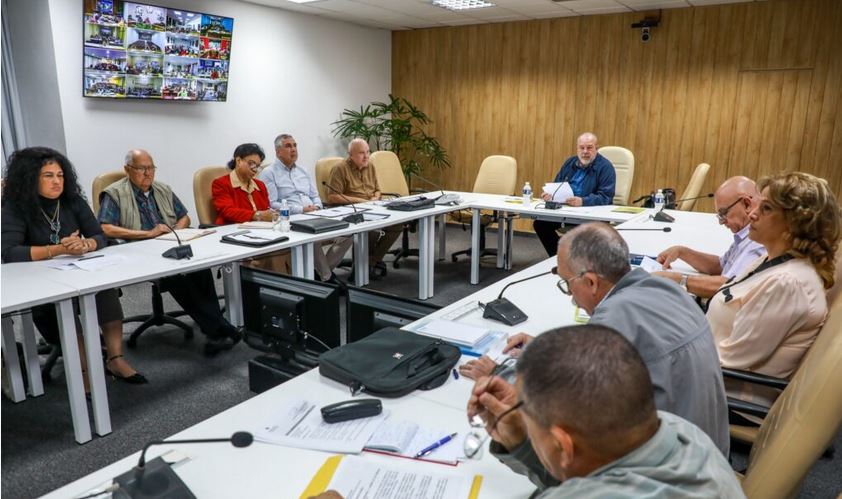
Reunión por tele conferencia con los Gobernadores, presidida por el Primer Ministro Manuel Marrero Cruz. Foto: Estudios Revolución
The energy transition toward renewable sources has become an essential pillar for confronting the country's current challenges. In this context, Cuba is advancing its program for installing photovoltaic solar systems, a topic analyzed during the monthly work meeting with Governors and the Mayor of the Special Municipality Isla de la Juventud.
The meeting was headed by Manuel Marrero Cruz, Prime Minister, with the participation via videoconference of Esteban Lazo Hernández, President of the National Assembly of People's Power and the Council of State, both members of the Political Bureau, as well as the territories.
In this session held at the Palace of the Revolution, the Minister of Energy and Mines, Vicente de la O Levy, provided an update on the progress of measures to confront the complex situation, with emphasis on photovoltaic solar systems destined for teachers, doctors, and heroes of labor.
"To date, 8,827 systems have been sold out of 10,200, and 7,719 have been installed, representing 87.4 percent. This has had a very good impact," he noted.
Marrero Cruz highlighted the importance of actions to guarantee the nation's energy sustainability in the current scenario and insisted on the essential need for fuel substitution through the search for local solutions.
"There must be much more rigorous control of the advances achieved in all sectors and in all places associated with the search for alternative solutions. We must also recognize that there are contributions from non-state management forms to guarantee the vitality of some important centers," Marrero Cruz pointed out.
This exchange also addressed the municipal food balance—its composition, management, evaluation, and control in 2026—presented by Vice Prime Minister Jorge Luis Tapia Fonseca.
"The most important activity in a municipality today is evaluating the energy situation, national defense, and food production. A municipality that does not have clarity on the results of its food balance is not aligned with government priorities."
Regarding the municipal food balance, Marrero Cruz emphasized that it represents a tool that allows direction and control on such an important issue as food production, which will enable progress toward a higher stage.
"Having defined demands, productions that must be guaranteed at the local and territorial level, the assurances, the control of what is produced—which is one of the fundamental problems—hence the need to continue perfecting contracting."
During the session, community communication management and its link with citizen portals were evaluated. Alfonso Noya Martínez, President of the Institute of Social Information and Communication, summarized as fundamental the search for mechanisms so that community communication is distinguished by popular participation, one of its main premises.
Here, the Head of Government called for granting this matter the priority it needs, updating communication strategies in line with current complexities, with a community focus. "It is important to insist that the times require timely information for our people," he specified.
"At the community level, structures must function by conversing, listening, and learning with the people," he emphasized.
The meeting also evaluated compliance with the housing plan as of January of this year. Delilah Díaz Fernández, General Director of Housing, reported that through transformation actions on maritime containers, 34 homes have already been completed with habitability certificates.
During this session, gratitude was expressed for the solidarity gesture of the Mexican Government, and information was provided on the distribution and delivery process of the aid received in recent days, which will prioritize people and families in vulnerable situations and social institutions.
Add new comment