
Putting a Ring on the Moon... and It’s Not for an Engagement
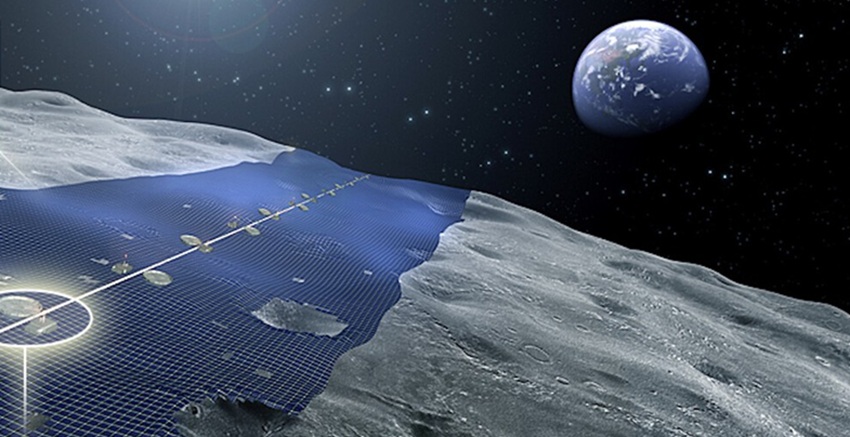
Imagen ilustrativa: tomada de xataka.com
The Moon, the satellite at the center of the recent Artemis II Mission and the inspiration for so many poems, is preparing to become the largest power plant in the solar system.
Stated that way, it sounds beautiful, but it is inaccurate. In reality, this audacious project was born in the offices of the Shimizu Corporation in Japan.
The proposal almost seems extracted from an Isaac Asimov novel: to encircle the lunar equator with a belt of solar panels 11,000 kilometers in circumference, reaching widths of 400 kilometers in certain sections.
Named the Luna Ring, the project seeks to capture solar radiation there, where it would not encounter interference from clouds or terrestrial night cycles.
The technical deployment is unprecedented in aerospace engineering. They expect it to be a structure capable of absorbing energy from the Sun uninterruptedly, because in the lunar vacuum, the flow would be constant, pure, and free of the limitations imposed by our planet's meteorology.
The logistics to finalize such a project do not contemplate the massive shipment of materials from Earth, which would be economically unfeasible.
The plan is to use the satellite’s own resources. They will process lunar regolith to manufacture cement, glass bricks, and the solar cells themselves through thermal smelting processes.
Teleoperated robots and automated systems would be responsible for manufacturing and assembly, minimizing human exposure to cosmic radiation. This strategy of utilizing resources in situ is the key to ensuring that such an endeavor does not collapse under the weight of its own budget.
The Architecture of a Ring
Once collected, the energy cannot simply be "plugged in" to a cable crossing space. This is where cutting-edge physics comes into play, as the electricity would be transformed into microwaves and high-density laser beams to be sent directly to receiving stations on Earth.
These stations would be strategically located in oceanic or desert areas to avoid any collateral risk. These gigantic antennas, or rectennas, would convert those waves back into electrical current for global distribution.
With the Luna Ring, it is not just about building an electrical grid, but about redefining the relationship between civilization and its astronomical environment.
It would be like a perpetual dynamo, eliminating from the equation the carbon emissions linked to electricity generation.
However, and there are many "buts," the path to this electrical utopia is paved with technical and ethical challenges that the international community must debate.
The ownership of lunar soil, the management of space debris, and the safety of the energy beams crossing space are issues that accompany every blueprint from the Shimizu Corporation.
Obstacles to Reaching the Light
According to projections from the Shimizu Corporation itself, the construction phase of the Luna Ring could begin, in the best-case scenario, around the year 2035. Nevertheless, that ambitious timeline depends on the prior development of a robotic and mining infrastructure on the lunar surface that is still in experimental stages.
The scientific community agrees that this is a long-term project, to be executed over several decades, given the complexity of operating in a low-gravity and high-radiation environment.
According to the technical report available on the entity’s website, the financial viability of the concept depends on space transport costs continuing to fall and on in situ material extraction successfully replacing the shipment of supplies from Earth entirely, which would turn the investment into a global-scale challenge rather than a corporate one.
The construction of the terrestrial rectennas alone—the gigantic 20-kilometer-diameter antennas responsible for receiving the microwaves—would add billions of dollars to the space bill.
Beyond the strictly financial, the strategic value of the Luna Ring lies in its capacity to redefine the global economy.
Because if the ambitious goal of generating that immense amount of terawatts of power were achieved, no matter how astronomical the initial cost might be, it would be offset and would justify such an effort to put a ring on the Moon that commits us to a future of energy abundance.
Translated by Sergio A. Paneque Díaz / CubaSí Translation Staff

Diagrama de funcionamiento del anillo de paneles fotovoltaicos en torno a la Luna. Imagen ilustrativa: tomada de xataka.com
Add new comment