
Private Sector Opening Takes Center Stage for Cuba
This view is supported by analysts both locally and in several countries closely following the recent approval of a package of economic reforms that open up to the private sector and foreign capital.
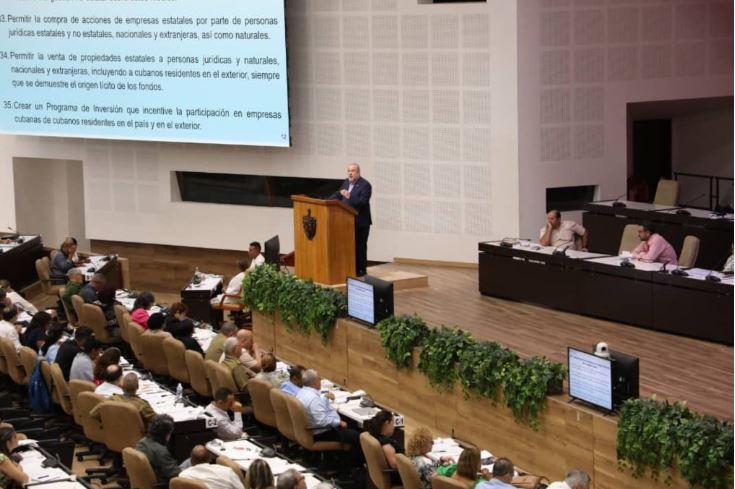
The National Assembly of People's Power (Parliament) unanimously approved 176 measures that represent the most significant change to the island's economic model.
In an extraordinary session held on June 18, the National Assembly unanimously certified a broad economic reform program that introduces unprecedented changes to the island's socialist model. This occurs amid a deep structural crisis and under maximum pressure from the U.S. administration of President Donald Trump.
The package of 176 proposals, presented by Prime Minister Manuel Marrero and backed by the Communist Party of Cuba (PCC) and revolutionary leader Army General Raúl Castro Ruz, was passed by a show of hands by over 400 deputies. The program includes transformations in key sectors such as banking, tourism, agriculture, the foreign exchange market, and the business system.
One of the central measures is the conversion of state enterprises into commercial corporations by shares or equity stakes, allowing greater management autonomy. The State will define its equity participation and maintain majority presence only in sectors considered strategic for national development.
The reforms allow legal entities and individuals, both Cuban and foreign, to acquire shares of state enterprises and assets, upon demonstration of lawful origin of funds. This opening is complemented by an Investment Program aimed at encouraging participation of Cubans residing in the country and abroad.
The new legal framework authorizes the creation of private enterprises without size limits, eliminating the 100-employee cap that had been in effect since 2021, when micro, small, and medium-sized enterprises (MSMEs) were approved. Cubans will be able to own more than one private enterprise and participate in other partnerships.
For the first time, foreign capital participation in the private sector will be permitted, whereas until now foreign investment could only be channeled to state firms. Additionally, the number of activities prohibited for non-state economic actors has been reduced, and the creation of MSMEs in agriculture is authorized.
The reforms equalize Cubans residing abroad with foreign investors, allowing them to participate in purchasing shares of state enterprises and investing in the private sector. In tourism, new business modalities such as leasing or selling properties are authorized for both Cubans residing in the country and abroad. Municipal governments will also be able to manage projects driven by Cubans living outside the island.
Cuban President Miguel Díaz-Canel justified the measures before the National Assembly, stating that Cuba is living through the most difficult hours of this century and "we have the historical responsibility to save it."
Although the president insisted that the opening to the market does not imply abandoning the socialist model, citing the experiences of China and Vietnam, the reforms represent a significant shift toward a new economic model.
The measures come amid an acute economic crisis, with an accumulated contraction of approximately 23 percent of gross domestic product since 2019, according to estimates by The Economist Intelligence Unit, and under an intensification of the U.S. blockade. The blockade almost totally prevents oil from entering the island, forcing a new economic mindset.
Add new comment