
President Díaz-Canel Visits Soberanía Platform Headquarters; 18 Digital Services Already Online
Presidente Díaz-Canel visita sede de la Plataforma Soberanía; 18 servicios digitales ya están en línea
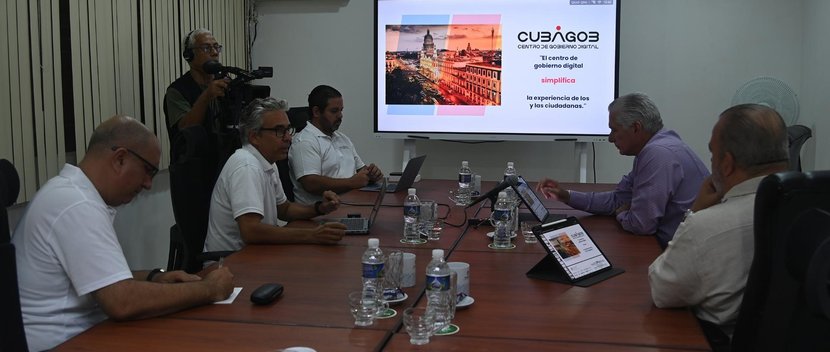
President Miguel Díaz-Canel Bermúdez visited the Digital Government Center on Saturday, an entity attached to the Council of Ministers, where the push for digital transformation seeks citizen well-being, as well as the improvement of efficiency and transparency in government management, administration, and public services through digital technologies, data utilization, information, and citizen participation.
The Soberanía platform constitutes the main citizen-facing tool in digital government management and emerged following the publication of Decree 125 in ordinary edition number 63 of the Official Gazette on July 25 of last year.
The director of the Digital Government Center, engineer Wilfredo González Vidal, presented to the Cuban President the results of the initial working period—considered an exploratory phase—which is now transitioning into expanding and refining the management of digital procedures and their connection with citizens and the country's various institutions.
After more than twelve months of operation, González Vidal noted that eighteen online services are available, "which means that citizens can access them from the comfort of their phones or from the internet at home to request these services."
Among the services rendered, he highlighted over 24,000 passport applications for individuals over 18 years of age and nearly 40,000 civil registry requests. These figures, according to González Vidal, remain insufficient, requiring greater public awareness of the possibilities offered by Soberanía, as well as increased trust in the platform.
The director of the Digital Government Center pointed out to the Head of State that, although more than 43,000 digital identities have been verified nationwide to date for the use of the Soberanía platform, significant potential exists to continue growing the number of people accessing the portal.
In his comments, Díaz-Canel affirmed that as people realize procedures are resolved faster and yield results through the use of this platform, greater trust will be gained.
CHALLENGES AHEAD
Among future challenges, the Digital Government Center is working to help legitimize the use of digital documents in the country, based on Resolution 284 of the Ministry of Justice, which establishes that a digital document matching the data of the National Central Registry holds equal value to a printed one.
"This first requires awareness on the part of public officials so that this citizen right is respected," Wilfredo González noted. "It also involves preparation and a culture to understand that Soberanía today generates an alternative to the in-person method for accessing new services."
The platform currently maintains active, among others, twelve requests linked to the civil registry, five services associated with citizen identity and electoral location changes, and, more recently, passport processing for individuals over 18 years of age was made available, alongside social assistance services tied to the Ministry of Labor and Social Security's mandate to care for vulnerable individuals.
"But the biggest challenge is cultural," he considered. "We are talking about organizing public administration differently, generating more efficiency, placing the citizen at the center of the process, and providing solutions related to public services."
He also maintained that "public administrations must act more nimbly, simplify processes, and achieve greater use of technology to avoid citizen movement and unnecessary economic expenses."
THE GOAL IS TO CONTINUE EXPANDING SERVICES
During the extensive presentation, progress on two projects was shown to the President: one will facilitate public participation and analysis regarding the content of the 176 recently approved economic and social transformations, which could lead to enriching their content and fostering citizen participation in decision-making; the other seeks to provide individuals with access to job openings in both the state and non-state sectors according to their skills.
In this regard, the Head of State highlighted the contributions this digital communication channel can offer in both cases, from a functional standpoint to facilitate public access to the content of the transformations, their evaluation, and proposals for new ideas, as well as providing greater visibility to the country's job market.
For the Director of Operations of the Digital Government Center, Rafael Santana Ferrera, the Soberanía Platform operates under the concept of government interaction with its citizens, which allows for the constant addition of new services.
"This project we have created for the analysis of the 176 transformations is just the beginning of this platform," he pointed out.
"Our mission is to foster exchange between the government and citizens whenever decided, in order to favor decision-making," he assured.
"Our concept is to progressively create new services while defending the principle of the government-citizen bond."
Add new comment